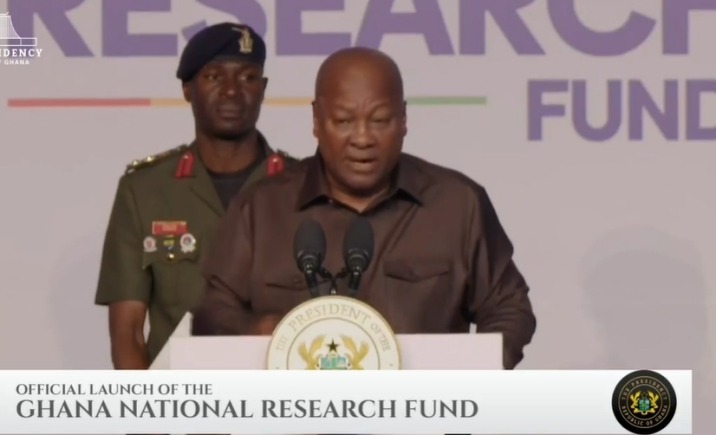
President John Dramani Mahama has launched the Ghana National Research Fund (GNRF) with seed money of GH¢100 million and called on scientists and researchers to develop practical solutions to Ghana’s challenges.
He said research must contribute to job creation, industrial growth and improved livelihoods, stressing that public investment in science and innovation should produce direct benefits for citizens, businesses and farmers.
Speaking at the launch of the fund on Tuesday [June 16, 2026], President Mahama urged research institutions to tackle challenges such as cocoa swollen shoot disease, fall armyworm infestations, boll weevil attacks on cotton farms, and post-harvest losses that continue to affect food production and economic activity.
“We need research that solves problems, creates jobs, builds industries, and improves lives,” he said.

President Mahama said the GH¢100 million, which he described as immediate catalytic support, would finance competitive national research grants, doctoral and postdoctoral programmes, a digital grants management system and priority research initiatives linked to the government’s development agenda.
He also drew attention to Ghana’s research funding levels, noting that while the African Union recommends that member states invest at least one per cent of Gross Domestic Product (GDP) in research, Ghana’s legal provisions amount to about half that level.
Using Ghana’s current GDP of about GH¢1.14 trillion, he said, even the lower threshold would require annual research spending of about GH¢6 billion.
President Mahama said the government alone could not meet that funding gap and directed the ministries of finance, education, and environment to begin the gradual release of statutory funding to support research activities.
He also instructed the ministries of finance and education to submit Ghana’s expression of interest to participate in the World Bank’s ACE Innovate programme and pledged full presidential support for the initiative.
The president linked the fund to his administration’s economic agenda, including the 24-hour economy initiative, agricultural modernisation and industrialisation.
He urged researchers to move innovations beyond laboratories and into commercial production, citing a non-toxic organic pesticide developed at the University of Cape Coast which, according to him, has yet to reach farmers despite Ghana spending hundreds of millions of dollars annually on pesticide imports.
President Mahama also paid tribute to Ghana’s first president, Dr Kwame Nkrumah, and former president John Evans Atta Mills, saying both leaders championed home-grown research and innovation.
The Minister of Education, Mr Haruna Iddrisu, described the launch as an important step towards establishing a sustainable system for financing research in the country.
Mr Iddrisu said no nation had achieved lasting economic transformation without deliberate investment in science, technology and knowledge creation.
He also disclosed that the government had resolved the long-running dispute over book and research allowances for university lecturers, adding that the launch of the fund would not be accompanied by labour unrest in the tertiary education sector.
The Acting Administrator of the GNRF, Prof. Abigail Opoku Mensah, said the fund already had a secretariat, offices at East Legon and a research and innovation strategy covering the period from 2026 to 2030.
Prof. Opoku Mensah said a pilot research call had also been launched in partnership with Canada’s International Development Research Centre to support technologies aimed at advancing the Sustainable Development Goals.
The Chairman of the GNRF Board, Prof. Eric Yirenkyi Danquah, outlined a six-point strategy for the period 2026 to 2030, covering research talent development, competitive funding, industry partnerships, policy support, sustainable financing and institutional capacity building.
Prof. Danquah said the board had identified five national research missions covering food systems, health innovation, digital and industrial transformation, climate resilience and governance data.
The United Kingdom’s High Commissioner to Ghana, Mr Christian Rogg, speaking on behalf of the United Kingdom’s Foreign, Commonwealth and Development Office, said the UK invests about 2.5 per cent of its national income in research.
Mr Rogg said there were more than 360 partnerships between Ghanaian and British research institutions.
The UNESCO representative to Ghana, Mr Edmond Moukala, described the launch as a “declaration of mind’s independence” and praised the appointment of Prof. Opoku Mensah as the first woman to head the fund.
The launch marked the operationalisation of the Ghana National Research Fund, established under the Ghana National Research Fund Act, 2020 (Act 1056). Although the law was passed six years ago, the fund only began moving towards full operation after its governing board was inaugurated a year ago.
The ceremony brought together ministers of state, diplomats, vice-chancellors, scientists and development partners, including representatives of the United Kingdom and UNESCO.