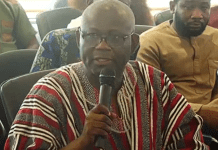
The Director-General of the National Communications Authority (NCA), Rev. Ing. Edmund Yirenkyi Fianko, has described Ghana’s Digital Terrestrial Television (DTT) platform as a monopoly, stressing that its tariffs must be subject to regulatory approval in line with the Electronic Communications Act.
Speaking during the submission of the final report of the Digital Terrestrial Television (DTT) Committee, Rev. Ing. Fianko said the committee’s work had provided a long-awaited pathway toward establishing a sustainable financial and regulatory framework for the national broadcasting platform after a decade of uncertainty.
According to him, the NCA has carried a significant financial responsibility over the past 10 years by mobilising funds on behalf of the government to support the operation of the DTT platform.
He disclosed that whenever government allocations were exhausted, the authority had to rely on its own internally generated resources to keep the national digital television infrastructure operational.

“We have been, for the last 10 years, responsible for raising the funds on behalf of government. Even when the government-allocated funds are depleted, we are obliged to go into the NCA’s own resources,” he said.
Rev. Ing. Fianko expressed satisfaction that the work of the DTT Committee had finally produced a clear roadmap for addressing the long-standing financial and operational challenges affecting the platform.
“We are very happy that we are here now with a way forward through the committee’s work,” he added.
The NCA Director-General emphasised that because the DTT platform operates as a monopoly infrastructure, the pricing of its services cannot be left to market forces alone.
He explained that under the Electronic Communications Act, tariffs for monopoly services are required to undergo regulatory scrutiny to ensure they are fair, transparent and in the public interest.
“Just to put on record that the DTT platform, as we have it today, is a monopoly, and by the requirements of the Electronic Communications Act, its tariffs have to be regulated,” he stated.
Rev. Ing. Fianko revealed that the NCA supported the committee by undertaking financial modelling to guide the development of a sustainable tariff framework.
He assured stakeholders that any tariffs proposed under the new governance framework would be subjected to the authority’s regulatory approval before implementation.
“We would be subjecting the eventual tariffs to regulatory approval as and when it comes up,” he said.
Describing the submission of the committee’s report as a major milestone, the NCA boss acknowledged that although the reforms had taken a decade to materialise, they represented a significant breakthrough for Ghana’s digital broadcasting sector.
“This is a big, big step 10 years late, but better late than never,” he remarked.
The DTT Committee’s final report is expected to guide government decisions on reforms to the governance, financing and sustainability of Ghana’s Digital Terrestrial Television platform, with the Ministry of Communication, Digital Technology and Innovations expected to review the recommendations before announcing implementation measures.