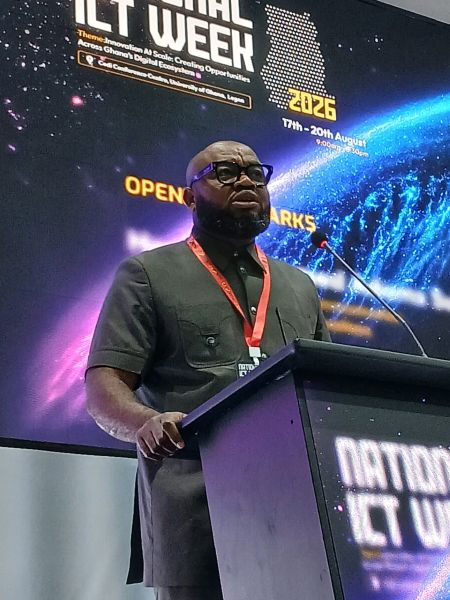
The government has called for stronger links between research institutions, universities, technology innovators, industry and investors to transform Ghanaian ideas into commercially viable businesses and jobs.
Deputy Minister for Communication, Digital Technology and Innovation, Hon. Mohammed Adams Sukparu, said Ghana possessed the human and institutional capacity to develop technologies capable of generating significant economic and social value.
He, however, said the country needed to strengthen the pathway connecting research to innovation, innovation to enterprise and enterprise to job creation.
He made the call at the opening of the 2026 National ICT Week celebration.

“Ghana is home to universities, research institutions, technology companies and entrepreneurs with the capacity to develop solutions that can create significant economic and social value,” he said.
According to the deputy minister, the challenge was to create an ecosystem in which promising ideas could move beyond research laboratories and become products and services capable of competing in the market.
“Our collective responsibility is to strengthen the pathway that enables research to translate into innovation, innovation to develop into enterprise and enterprise to contribute to job creation, productivity and economic growth,” he said.
Hon. Sukparu said the Ministry would continue engaging industry, academia, innovators and technology communities to create an environment that supports responsible experimentation, commercialisation and adoption of innovative solutions.
He said the National ICT Week provided an important platform for bringing together the institutions and individuals whose ideas, investments and decisions would shape the future of Ghana’s digital economy.
The Deputy Minister said the government’s digital transformation agenda was also focused on developing the infrastructure and human capacity needed to support innovation.
He cited the One Million Coders Programme, which seeks to equip one million Ghanaians with practical digital and coding skills relevant to employment, entrepreneurship and participation in the digital economy.
More than 12,000 course completions had already been recorded during the early weeks of Phase Two, he disclosed.
He said the programme represented a significant investment in Ghana’s human capital and was intended to produce a generation capable of creating, managing and applying digital technologies for national development.
Beyond skills development, Hon. Sukparu said the government was working to expand next-generation connectivity, with a target of achieving 70 per cent population coverage of 5G by the end of 2028.
He said the government was also reviewing spectrum policies and the regulatory framework to facilitate greater investment and competition in next-generation connectivity.
The Deputy Minister said these measures would create the foundation for businesses and innovators to develop and deploy new digital services.
He also highlighted Ghana’s National Artificial Intelligence Strategy, launched in April 2026, which seeks to provide a framework for responsible and inclusive AI adoption.
The strategy, he said, would focus on data governance, infrastructure, talent development, ethical use and practical applications of artificial intelligence.
Hon. Sukparu maintained that Ghana could not afford to operate in isolation as technology continued to reshape global economies.
He urged private-sector companies, universities, investors and innovators to deepen their collaboration with government to identify practical opportunities within Ghana’s digital ecosystem.
He said the ultimate objective must be to create a digital economy that is efficient, scalable, interoperable and innovative, while contributing meaningfully to national development.
“Our task now is to consolidate these gains and translate them into sustainable systems, stronger institutions, greater opportunities and measurable outcomes for Ghanaians,” he said.
Hon. Sukparu therefore encouraged participants at the National ICT Week to use the celebration to exchange ideas, build partnerships and identify practical solutions that could accelerate Ghana’s digital transformation.
He said with the right policies, infrastructure, institutions, skills and governance frameworks, technology could become a powerful instrument for economic development, job creation, innovation and improved public-sector service delivery.