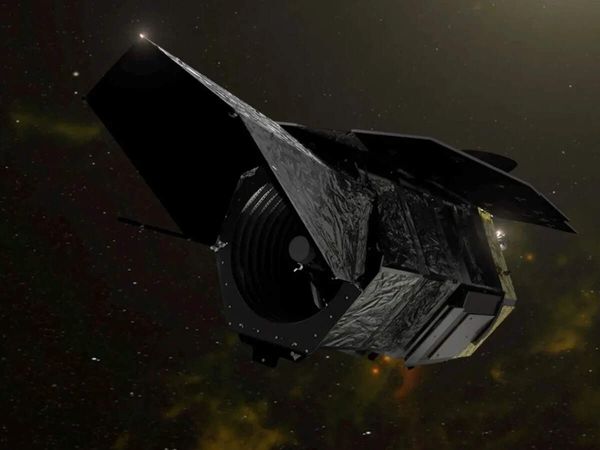
SpaceX has launched NASA’s $4.3 billion Nancy Grace Roman Space Telescope, beginning a major mission to investigate dark energy, dark matter and planets beyond the solar system.
The telescope lifted off aboard a SpaceX Falcon Heavy rocket at 7:26 a.m. local time on Sunday from Cape Canaveral, Florida.
Roman is expected to travel to an orbit roughly one million miles from Earth, where it will study how dark matter and dark energy influence distant stars and galaxies. Observations could begin as early as December, with the mission expected to operate for five to 10 years.
“There might be something fundamentally missing from physics as we understand physics, and so Roman has the potential to shed light on that,” Kristen McQuinn, head of the Nancy Grace Roman Space Telescope mission office at the Space Telescope Science Institute, said before the launch.

Scientists hope Roman’s observations will provide new insights into the expansion of the universe and improve understanding of the forces shaping its evolution.
The telescope will also search for exoplanets, including worlds that may share characteristics with Earth.
Roman has a mirror similar in size to that of the Hubble Space Telescope but is equipped with a wide-field camera capable of observing an area about 100 times larger. NASA expects the telescope to map the sky roughly 1,000 times faster than Hubble.
The spacecraft will primarily collect infrared light and carries a coronagraph designed to block light from stars. The instrument could enable scientists to directly image faint planets orbiting nearby stars.
Following the launch, Roman will spend several months travelling to its destination and deploying its instruments. Mission teams will then conduct about three months of testing before science operations begin near the end of the year.
The telescope’s first images are expected in 2027.
The mission has faced years of development challenges and rising costs since it was conceived in the early 2010s.
The first Trump administration sought to cancel the project in 2018, while an early 2025 budget proposal provided no funding for the telescope. Congress blocked the earlier cancellation attempt, and funding was ultimately included in the final budget request.
With its launch now complete, Roman will begin the journey towards its destination and preparations for a mission designed to deepen scientists’ understanding of the universe and search for planets beyond the solar system.