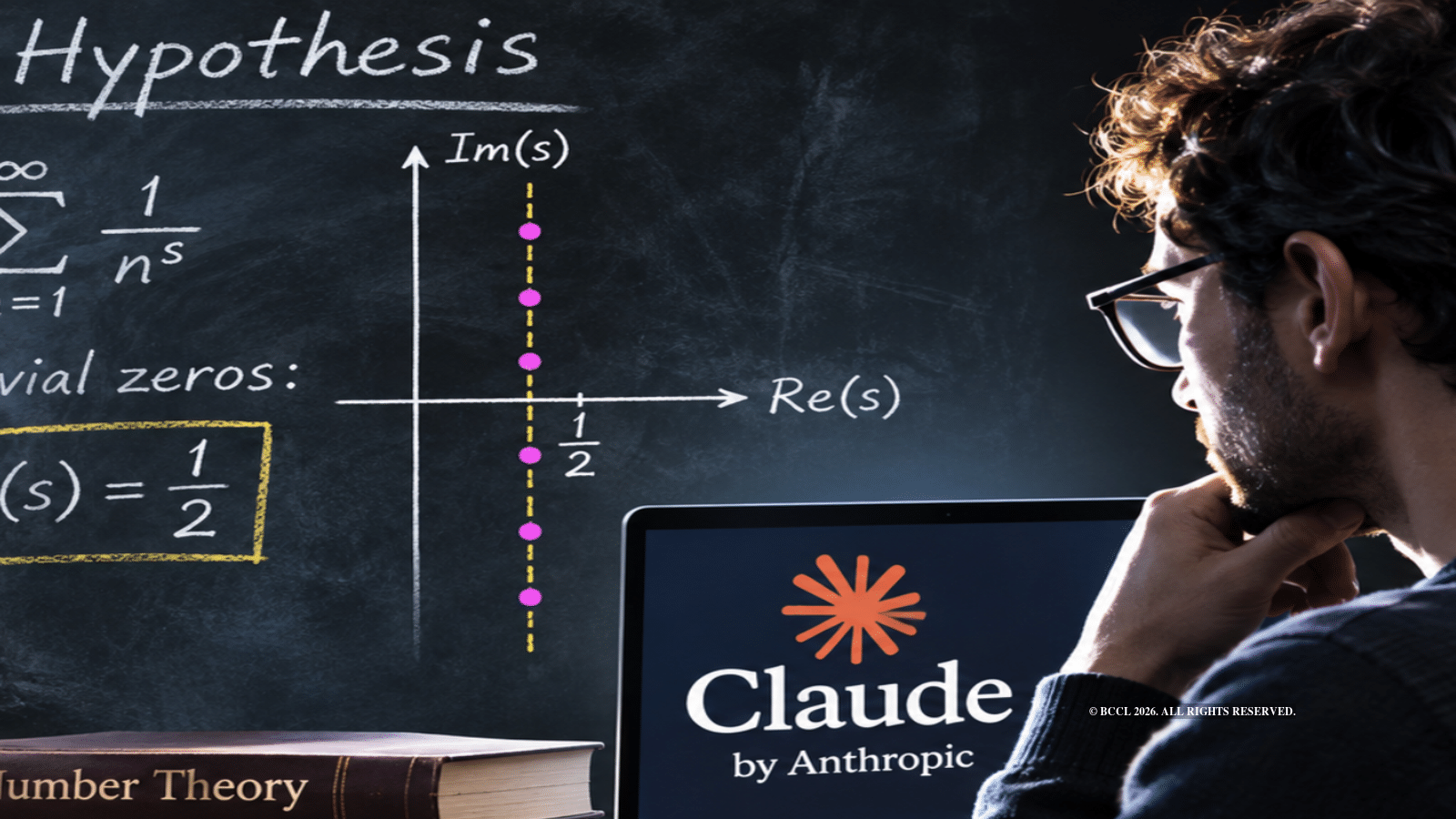
An Anthropic researcher has claimed to have used the company’s Claude artificial intelligence (AI) system to develop a proposed proof of the Riemann hypothesis, one of mathematics’ most challenging unsolved problems, which has remained unresolved for more than 150 years.
Mathematician Levent Alpöge published a research note on Friday outlining the proposed proof, accompanied by computer code written in the Lean programming language.
Alpöge said Claude played a significant role in developing the proof and eventually made contributions that went beyond his own work during the final stages of the research.
The proposed solution has received initial verification from several mathematicians. Andrew Sutherland, a senior research scientist at the Massachusetts Institute of Technology (MIT), said he had successfully verified the submitted work using his computer.

Sutherland also reported that at least three other professional mathematicians had independently verified the proof using different computing systems.
However, the findings have yet to undergo broader mathematical scrutiny, with further examination expected to establish their validity, significance and potential applications.
Noah Giansiracusa, a mathematics professor at Bentley University, described the proposed solution as promising but said its validity required further assessment.
The Riemann hypothesis concerns the distribution of prime numbers and is widely regarded as one of the most difficult outstanding questions in mathematics.
Alpöge’s announcement comes amid growing attention to the capabilities of advanced AI systems following Anthropic’s record-breaking initial public offering (IPO).
If confirmed, the proposed proof would mark a significant milestone in the application of artificial intelligence to complex mathematical research.
The development also follows an announcement by OpenAI in September that its models had generated a proposed solution to the Navier-Stokes problem, another longstanding mathematical challenge.
Both the Riemann hypothesis and the Navier-Stokes problem are among the Millennium Prize Problems, a collection of exceptionally difficult mathematical questions.
The latest development underscores intensifying competition among leading AI developers to demonstrate that their systems can contribute to advanced scientific and mathematical research beyond conventional commercial applications.
Anthropic declined to comment on Alpöge’s announcement, while the researcher did not respond to requests for further clarification.