Margin ID Group, Africa’s most certified and leading identity and security printing giant, has certification to print money, but the only thing standing in its way now is whether government will ever adopt a policy that allows a local company to print the Ghana cedi.
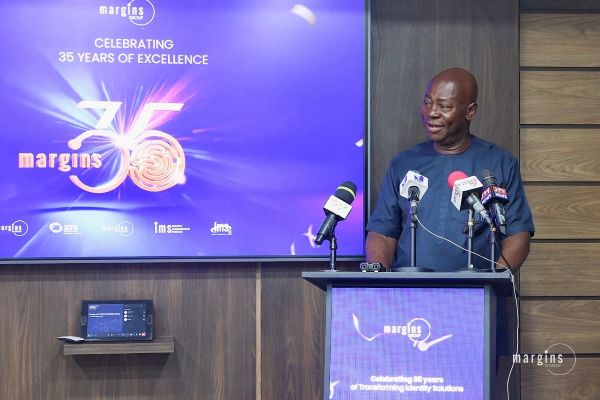
Group Founder and CEO, Moses K. Baiden Jr disclosed this at a forum with senior journalists, where he told the beautiful story of how a US$100 investment 35 years ago has become a multi-million dollar world-class African giant in identity solutions, security printing, border control solutions, access control systems and indeed a citadel of proof that Africans can build world-class, high-security and technology intensive companies at home, if only its governments can trust in, rather than doubt, the abilities of its people.
Over the last 35 years, Margins Group has by dint of hard work and commitment to excellence and compliance with global standards and best practices, secured at least 15 very high global standardization certifications, comprising of six by the group itself and nine by its security cards printing company called Intelligent Cards Production Systems (ICPS).
At least seven of those global standardisation certifications are from International Standardization Organization (ISO), and the others are from PCI, ICMA, Visa, Mastercard, Crest Pathway, DPC and from Ghana’s Cybersecurity Authority (CSA).

In an industry where the smallest hitches come at a very high cost, these certifications have become a passport of trust that puts Margins above its African peers and in strong contention against their European, American and Asian counterparts.
INTERGRAF Certification

One of the nine certifications for ICPS is the INTERGRAF certification, which qualifies the company to print money, provided government can assure them that if they invest in that direction, the opportunities are guaranteed.
Indeed, ICPS has Visa and Mastercard certifications and they already print cards for Visa and Mastercard customers locally. So a greater part of the processes and rails for banknotes print already exist at ICPS.
For context, INTERGRAF certification is a rigorous, internationally recognized system for security printing companies and their suppliers, focusing on managing risks against counterfeiting for high-value items like banknotes, IDs, and passports, based on ISO 14298 standards and Intergraf’s specific requirements (ICR). It ensures suppliers of secure inks, papers, foils, and software meet stringent quality and security management systems, building trust in the secure supply chain.
What the Intergraf certification body does is to send a team of auditors to the manufacturing plant of the applicant, and do an audit of the processes before issuing the company with certification.
According to Moses Baiden, in practice, Intergraf is a set of very stringent rules that account for every single thing that goes on in the applicant’s factory, including people and items which go in and come out of the factory. It also means everything done by one department must be checked at every stage before it moves to the next department.
Of particular importance in this whole process is the issue of balance in weight. The weight of whatever and whoever goes into the factory must be the same weight that comes out. So even if there are waste materials, they must be accounted for to ensure balance. That kind of standardization is critical for a facility that prints banknotes.
“The Intergraf requirements are very stringent but we have achieved that and now it has become a culture and a normal routine at ICPS,” he said.
Margins Group’s ICPS secured the Intergraf certification way back in 2019, but the company is yet to be given the opportunity to print even one banknote in Ghana.
Meanwhile, in 2024 alone, the Bank of Ghana reportedly spent a significant GHS987 million (US$85.63 million) to printing fresh banknotes abroad. That figure was 47% more that what was spent in 2023, which stood that about GHS689 million (almost US$60 million).
These costs, which include the cost of transporting the banknotes from abroad into Ghana, can be cut down significantly if the banknotes are printed locally.
Policy Predictability

Moses Baiden noted that for ICPS to actually print money in Ghana, the company would need to invest in additional equipment to make that happen. But that would mean there is a clear government policy predictability to serve as an incentive for that kind of investment by Margins.
“We were able to build the biggest ID solutions company in Africa because we paid consultants to do market analysis and we could predict that our investment was not going to go waste. Money goes where it is wanted [and] investment goes where it will grow – so if the local policy environment is friendly and conducive we will invest and you wouldn’t even need to ask us why we are not printing money,” he said.
Prioritizing local businesses
The Margins CEO said if the company invests into a manufacturing plant for money printing and someone else outside of Ghana is doing same “I have to be sure that government will prioritize me over that person.”
He believes Ghana has enough policies that prioritizes local businesses on paper, but successive governments have not paid attention to implementing those policies to the benefit of local investors.
“All we need to do is to agree that we are going to establish a rule-driven environment and reward hard work and promote meritocracy. The policies for supporting local industries are there, we just need to take the hard decision that are market driven and everything else will fall in place,” he said.
Moses Baiden for instance, noted that in other African countries, a lot of things don’t work well in the digital space like they do in Ghana. He said the fact that the technologies driving Ghana’s dynamic digitalization journey was, for the most part, built by local companies, should be an indication to policy makers that when they prioritize local businesses, the dividends inure to the benefit of the country.
E-Wallet
Touching on the recent announcement by the National Identification Authority (NIA), that it is working with banks to make Ghana Card a payment card, Moses Baiden noted that there is an e-wallet feature on the Ghana Card, which can be activated, but that again will need clear policy decision and a set of laws to support its operationalization.
He explained that one of the cardinal conditions for creating the Ghana Card was to make the NIA a revenue-generating rather than cost-generating entity, and the creating of the e-wallet feature and one of the key ways that goals is to be achieved.
According to him, as a technology company, Margins knows exactly how that feature can be rolled out effectively, but it important for the policy makers to also understand what needs to be done in order to achieve that goal, adding that once that is achieved the e-wallet rollout will not be a problems because it has been designed to ensure that both payments and ID details are verified simultaneously during a transaction.