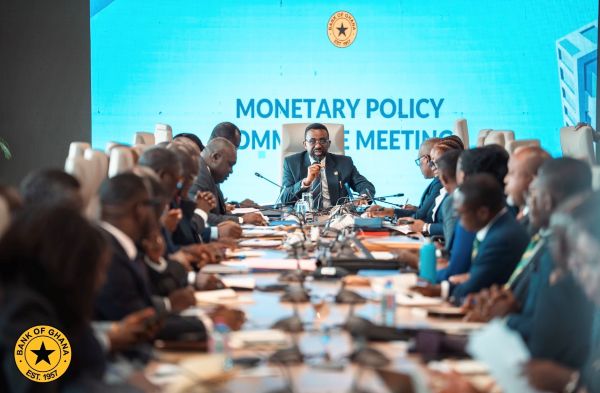
Governor of the Bank of Ghana, Dr. Johnson Pandit Asiama has noted that the ongoing war in the Middle East threatens to derail the gains made in Ghana’s economy, particularly in area of inflation.
At the 129th Monetary Policy Committee (MPC) Meeting, the governor noted that since the last MPC meeting in January 2026, Ghana’s economic picture has sharpened considerably, with some of the key indicators doing much better that expected.
He noted, for instance, headline inflation declined to 3.3 percent in February, marking the fourteenth consecutive monthly decline, saying that “We are now below the medium-term target band.”
External buffers, he said, have strengthened further, with gross international reserves now standing at about US$14.5 billion, equivalent to 5.8 months of import cover, up from approximately US$13.8 billion at the time of our January meeting.

“The real economy is also showing stronger momentum. The Composite Index of Economic Activity grew by 8.4 percent year-on-year at the start of 2026, supported by stronger bank credit, industrial output, trade activity, and household consumption. Consumer and business confidence rose in February 2026, supported by easing inflation,” Dr. Asiama noted. “Taken together, these indicators point to an economy stabilising more rapidly than many had expected.”
The governor however noted that, whereas the numbers would have been considered aspirational, the escalation of conflict in the Middle East has disrupted key energy and shipping corridors, increased volatility in global oil markets, and introduced new uncertainty into the trajectory of global inflation.
He said, for Ghana, the spill over channels are clear – sustained oil price increases raise the risk of imported inflation, which could necessitate policy tightening with implications for financial conditions.
Dr. Asiama observed that, whereas geopolitical uncertainty tends to support gold prices, which benefits Ghana’s trade balance – the net balance of risks from the external shock for Ghana is inflationary.
He said, against the backdrop of the external shock and its impact on the Ghanaian economy, the decision of the 129th MPC must reflect both the progress achieved and the risks the economy faces.
“…Today, there is a live external threat to the disinflation trajectory. Whatever decision the Committee takes, our communication must reflect both the progress achieved and the risks that remain,” he said. “The question before this Committee is not whether conditions have improved. They have, significantly and across the board. However, how do we respond to that improvement when the conditions that enabled it are under pressure?”
The governor also noted that since the last MPC meeting, the Government has announced Ghana Accelerated National Reserve Accumulation Programme (GANRAP), which seeks to raise international reserves to 15 months of import cover by 2028, from the current level of around 5.8 months.
“Strengthening external buffers is an important element of macroeconomic resilience. At the same time, initiatives of this scale raise questions regarding liquidity conditions, the Bank’s balance sheet, and the interaction between reserve accumulation and monetary policy operations,” he said.,
Dr. Asiama also observed that the banking sector remains sound, profitable, and well-capitalised, with asset quality improving meaningfully over the past year, which is critical for financial stability, and also for the effectiveness of monetary policy, the extent to which changes in the policy rate translate into the credit conditions experienced by households and businesses.
“Understanding the factors constraining credit expansion, whether on the supply or demand side, will therefore be important in assessing the real economy impact of any policy decisions taken today,” he told he members of the MPC.
Dr. Asiama said, where the MPC’s decision in January was about restraint, today’s decision requires a more complex judgment, adding “We must make our decision at the intersection of genuine domestic success and genuine external uncertainty.”