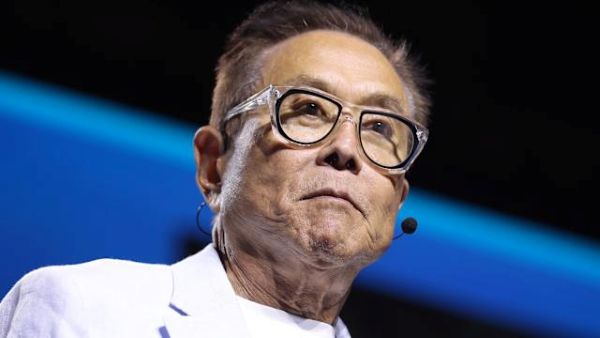
Author and financial educator Robert Kiyosaki has used a reported peace agreement between the United States and Iran to illustrate what he describes as a recurring lesson about wealth creation, market timing and investor behaviour.
In a post published on his Facebook page, Kiyosaki reflected on what he characterised as 104 days of conflict and economic disruption, culminating in a purported agreement that would end hostilities and reopen the strategically important Strait of Hormuz.
According to Kiyosaki’s account, US President Donald Trump announced on Truth Social that a deal with Iran had been completed, authorising the reopening of the Strait of Hormuz and the removal of a US naval blockade.
He further claimed that Iranian officials quickly confirmed the arrangement and that a formal signing ceremony is scheduled to take place in Switzerland on 19 June.

Kiyosaki said the reported breakthrough triggered an immediate response across global financial markets.
He noted that Brent crude oil prices fell by more than four per cent, moving towards US$83 per barrel after having surged to a wartime peak of US$120. Prior to the conflict, he said, oil had traded at approximately US$70 per barrel.
The investor also pointed to gains in global equities, claiming that Asian stock markets advanced by more than three per cent, while futures linked to the S&P 500 rose by around 1.1 per cent. Bitcoin, he added, climbed to its highest level in nearly two weeks, while the US dollar weakened against major currencies.
For Kiyosaki, however, the significance of the development extends beyond the market reaction itself.
He argued that investors who expected the geopolitical risks associated with a closure of the Strait of Hormuz were able to position themselves in energy-related assets, defence stocks and gold before prices surged.
By contrast, he said, ordinary households largely experienced only the economic consequences of the conflict, including higher fuel costs, increased grocery bills and elevated inflation.
Describing the situation as a clear example of the “Cantillon Effect”, Kiyosaki suggested that those who act before major developments become widely recognised are often best placed to benefit financially.
”The ordinary person who held cash, watched the news and waited for certainty experienced only the pain,” he wrote, adding that investors who understood the implications of supply disruptions in global energy markets were able to profit from the volatility.
Kiyosaki also recalled a lesson he said he learned from his mentor, often referred to in his books as “Rich Dad”, during the oil embargo of the 1970s.
”By the time a crisis is on television, the positioning is already done,” Kiyosaki quoted him as saying. “The wealthy are not watching the news. They are already in it.”
Looking ahead, Kiyosaki highlighted the potential economic opportunities that could emerge if relations between Iran and Western nations continue to improve. He referenced discussions surrounding the G7 summit in France and suggestions that several European countries may consider easing sanctions should progress be made on Iran’s nuclear programme.
He further pointed to Iran’s population of approximately 90 million people and its vast natural gas reserves as factors that could attract significant international investment in the event of a broader diplomatic settlement.
Concluding his remarks, Kiyosaki argued that major geopolitical events tend to follow a familiar pattern: conflict creates disruption, while peace creates new investment opportunities.
”The war created the disruption. The peace creates the opportunity,” he wrote. “The same pattern. Every single time.”