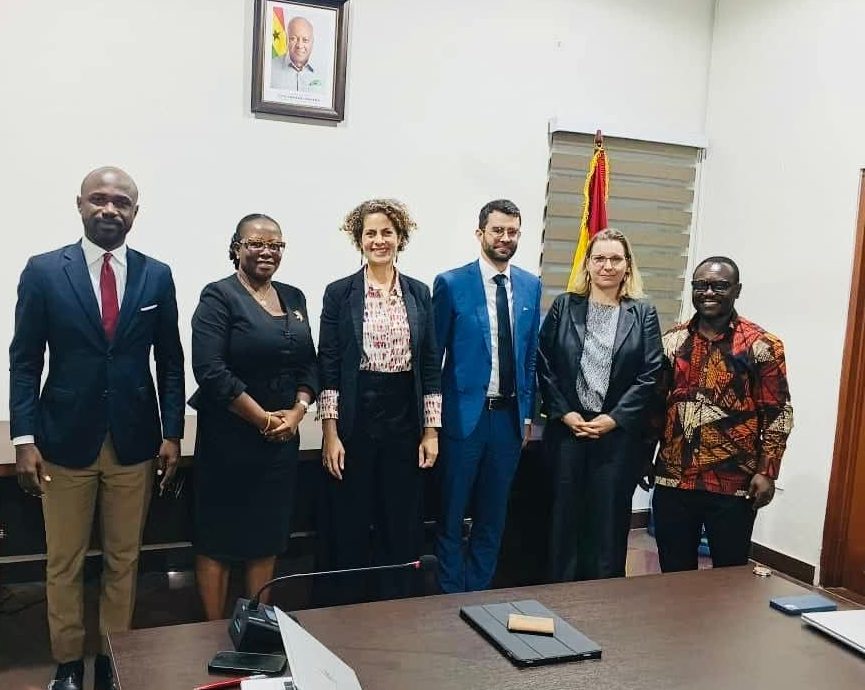
The National Development Planning Commission (NDPC) has hosted a delegation from the Agence Française de Développement (AFD) as part of the French Development Agency’s exploratory mission aimed at strengthening cooperation on public financial governance, climate governance and sustainable development in Ghana.
The meeting provided an opportunity for both institutions to discuss Ghana’s development priorities, ongoing institutional reforms and potential areas for future collaboration.
During the engagement, the Director-General of the NDPC, Dr Audrey Smock Amoah, underscored the Commission’s commitment to evidence-based planning through the use of development indicators and results frameworks to monitor national progress.
She revealed that the Commission is in the final stages of developing the results framework for Ghana’s current medium-term national development policy framework, which will enable institutions to assess performance against agreed targets throughout the implementation period.

“Development indicators are identified and agreed upon before the results framework is finalised. The results framework then serves as a comprehensive tool that consolidates all the indicators intended for tracking throughout the implementation period of a development policy or plan,” Dr Amoah explained.
According to her, while all institutions report on core indicators to provide a national overview of development outcomes, planning authorities are also encouraged to develop context-specific indicators that reflect local priorities and circumstances.
Dr Amoah noted that the Commission works closely with institutions at both national and sub-national levels to ensure consistency in data collection, monitoring and reporting. She added that NDPC continues to strengthen capacities for policy formulation, implementation and evaluation through training programmes and stakeholder engagement.
Addressing Ghana’s long-term development agenda, she stressed the need to look beyond political cycles in tackling persistent national challenges. She observed that although Ghana has made several attempts to establish long-term development frameworks, including Vision 2020, the 40-Year Development Plan, Ghana Beyond Aid, Ghana at 100 and Vision 2057, implementation has often proved difficult.
She said the consolidated long-term development plan currently being developed is expected to provide a stable national development trajectory capable of guiding successive governments, while allowing medium-term priorities to be reviewed and implemented every four years.
Dr Amoah further highlighted the extensive consultations undertaken across all 16 regions of the country, involving Metropolitan, Municipal and District Chief Executives, planning officers, sector agencies and traditional authorities to ensure that the plan reflects the aspirations of Ghanaians.
She also emphasised the Commission’s commitment to participatory planning and accountability, explaining that national reports undergo rigorous validation by government institutions, academia, civil society organisations and the private sector before publication.
In addition, she disclosed that NDPC is promoting a “Good Society Campaign” in partnership with the National Commission for Civic Education (NCCE) and the Information Services Department (ISD) to strengthen civic responsibility and national values.
On climate governance, the Director of Research at NDPC, Mr Richard Tweneboah Koduah, said the country’s planning framework provides clear guidance for integrating climate change considerations into the work of Ministries, Departments and Agencies (MDAs), as well as decentralised government structures.
He noted that climate priorities are increasingly reflected in national budget allocations through the Ministry of Finance and that annual progress reports consistently demonstrate the effects of climate change on infrastructure, social services and broader development outcomes.
“Climate change is recognised as a critical factor that must be addressed to avoid long-term developmental setbacks,” Mr Koduah said.
He added that NDPC is collaborating with institutions such as the Council for Scientific and Industrial Research (CSIR) to strengthen climate-risk modelling and adaptation planning, while supporting national reporting systems.
According to him, recent flooding incidents and changing rainfall patterns have heightened the need for stronger resilience measures, disaster preparedness and climate-responsive infrastructure planning.
Speaking on behalf of the visiting delegation, the Country Director of AFD, Ms Clémentine Dardy, welcomed the strong alignment between Ghana’s development priorities and the thematic areas supported by her organisation.
She identified energy transition, climate governance, digital governance, natural resource management, infrastructure development, creative industries and citizen engagement as key areas of mutual interest.
Ms Dardy reaffirmed AFD’s commitment to supporting Ghana through a range of financing instruments, including technical assistance, feasibility studies, grants and non-sovereign financing arrangements.
While acknowledging global constraints affecting grant funding, she expressed confidence that ongoing discussions with the NDPC would help identify appropriate financing mechanisms and partnership opportunities to advance Ghana’s development agenda.