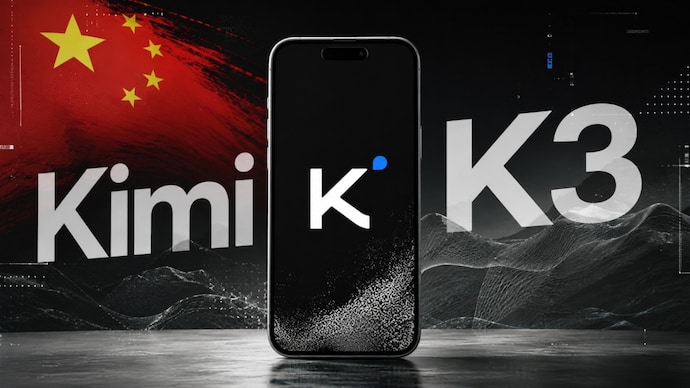
Chinese artificial intelligence startup Moonshot AI has unveiled Kimi K3, a 2.8-trillion-parameter large language model that analysts say marks a significant milestone in China’s pursuit of frontier AI capabilities, prompting a reassessment of the competitive landscape between Chinese and US developers.
The launch has drawn widespread attention across financial markets after Kimi K3 matched, and in some areas outperformed, leading American AI models on independent benchmarks, challenging the long-held view that US firms maintained a comfortable lead in advanced AI development.
According to the independent Artificial Analysis Intelligence Index, Kimi K3 achieved a score of 57, placing it close to leading US models including Claude Fable 5 and GPT-5.6 Sol.
Morgan Stanley analyst Gary Yu described the release as evidence of China’s sustained progress rather than a sudden breakthrough.

”K3 has received positive feedback globally, signalling an all-round catch-up of Chinese large language models with US leaders in model size, performance and pricing,” Yu said. He added that the model reflects cumulative advances across China’s AI sector and predicted that more competitive Chinese models would emerge with greater scale and stronger global appeal.
Bernstein analyst Robin Zhu also characterised the launch as a major achievement, saying it reinforced expectations that China’s leading AI laboratories would continue narrowing the technological gap with their US counterparts.
He noted that K3 followed earlier advances by DeepSeek V3 and GLM-5.2, demonstrating China’s ability to remain competitive at the cutting edge of AI development. Zhu also highlighted the model’s reasoning capabilities and the quality of its generated content, particularly its emphasis on producing visually refined outputs.
Moonshot AI has also departed from the pricing strategy traditionally adopted by many Chinese software firms, introducing Kimi K3 as a premium product rather than competing primarily on low costs.
BofA Securities analyst Alex Liu said K3 is a mixture-of-experts model with 2.8 trillion parameters, activating 16 of 896 experts, while offering a one-million-token context window and native multimodal capabilities. He added that the company had priced the model at US$3 per million input tokens and US$15 per million output tokens, making it the most expensive Chinese AI model released to date.
Liu said the pricing remains below comparable frontier US models but represents a substantial increase from Moonshot AI’s earlier offerings, signalling confidence in the model’s commercial value.
Macquarie analyst Ellie Jiang said the higher pricing reflected growing demand for AI systems capable of handling complex reasoning tasks and suggested that businesses were increasingly willing to pay more if the productivity gains justified the investment.
She added that the launch reinforced confidence in China’s AI innovation while supporting expectations that leading frontier models would retain pricing power despite rising infrastructure costs.
The launch also had an immediate impact on financial markets, contributing to declines in technology and semiconductor shares as investors weighed the implications of stronger competition in the AI sector.
Analysts at B. Riley said the emergence of another frontier-class open-weight model would intensify price competition among AI developers while benefiting companies that integrate AI into enterprise applications. They cautioned, however, that corporate adoption of Chinese models outside China could continue to face regulatory and data governance scrutiny.
Bernstein’s Zhu warned that increased competition could place further pressure on the profit margins of leading closed-source AI developers, noting that recent pricing moves by OpenAI and Anthropic already reflected intensifying rivalry.
He added that Kimi K3 could also prompt greater regulatory attention in the United States as policymakers evaluate China’s rapid advances in artificial intelligence.
The launch of Kimi K3 is widely viewed by analysts as another indication that the global AI race is becoming increasingly competitive, with China establishing itself as a serious challenger in the development of frontier AI models. As advanced AI systems become more widely available, analysts expect competition to shift towards the platforms and businesses that successfully deploy the technology rather than the models alone.