The High Court in Accra has dismissed an application by 75 graduating students of the African University of Communications and Business (AUCB) seeking to stop the university’s 23rd congregation scheduled for 31 October 2026, despite finding that their case raises a serious question to be tried.
Her Ladyship Justice Halimah El-Alawa Abdul-Baasit, presiding over the General Jurisdiction 2 Court, ruled that although the applicants had demonstrated an arguable case and faced some risk of prejudice, the grounds presented were insufficient to justify the broad interim injunction sought.
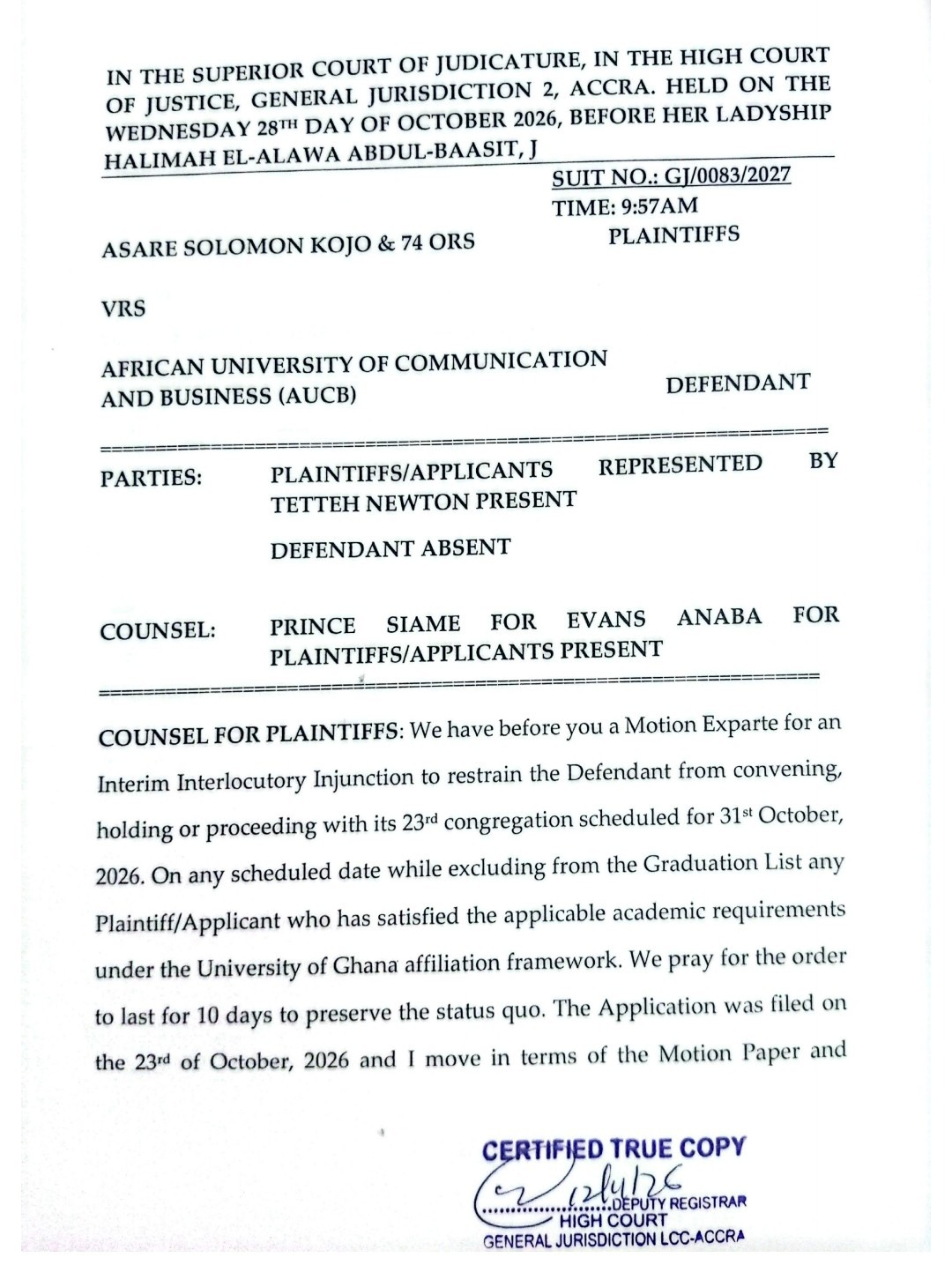
The ruling followed an ex parte application for an interim interlocutory injunction filed on 23 October 2026 by Asare Solomon Kojo and 74 others against AUCB.
The applicants asked the court to restrain the university from holding its 23rd congregation or proceeding with any graduation schedule that excluded applicants who had satisfied the applicable academic requirements under the University of Ghana affiliation framework.

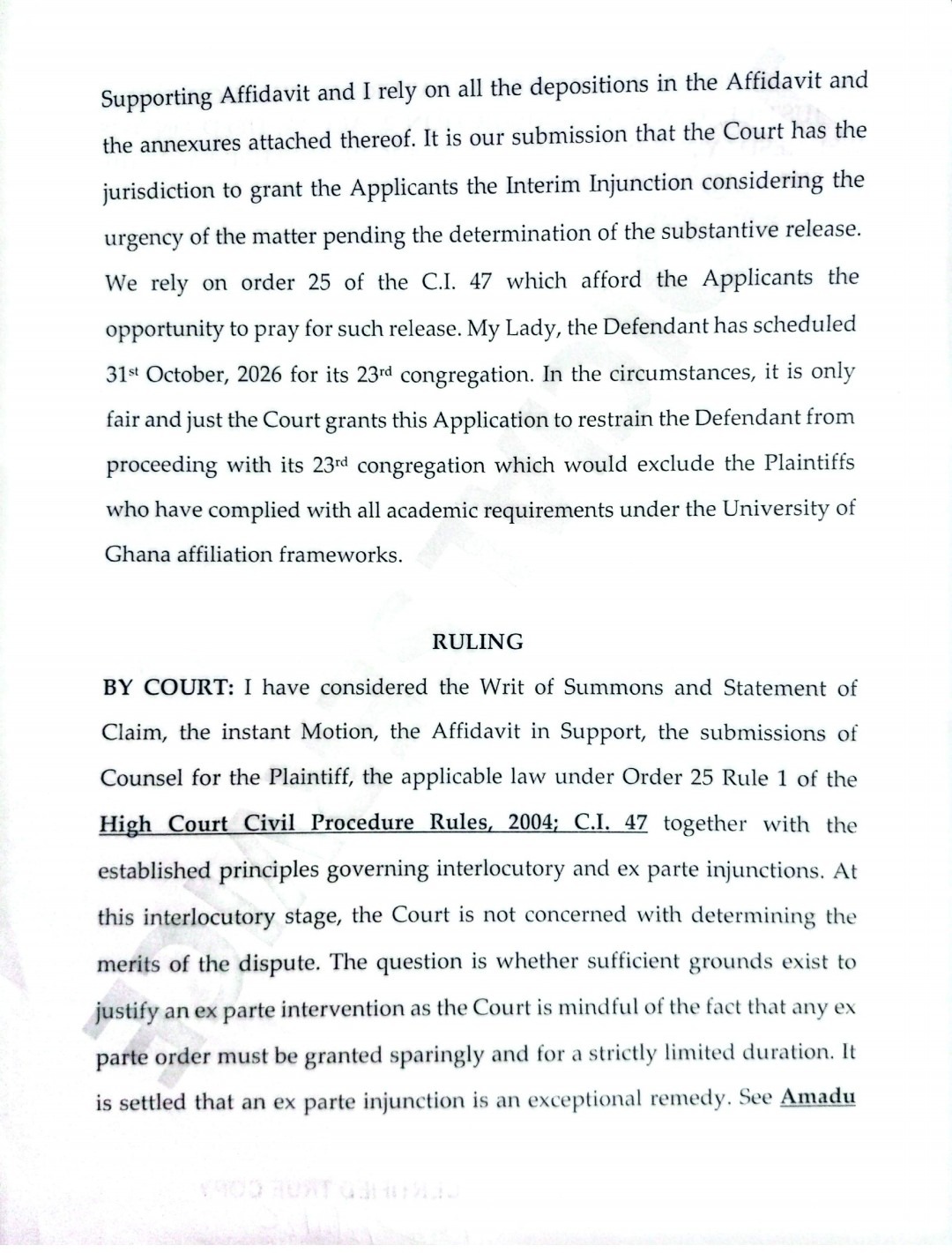
Moving the application, counsel for the applicants, Prince Siame, representing Evans Anaba, argued that the court had the jurisdiction under Order 25 Rule 1 of the High Court Civil Procedure Rules, 2004 (C.I. 47), to grant the injunction to preserve the status quo.
He asked the court to make the order effective for 10 days, pending the determination of the substantive action.
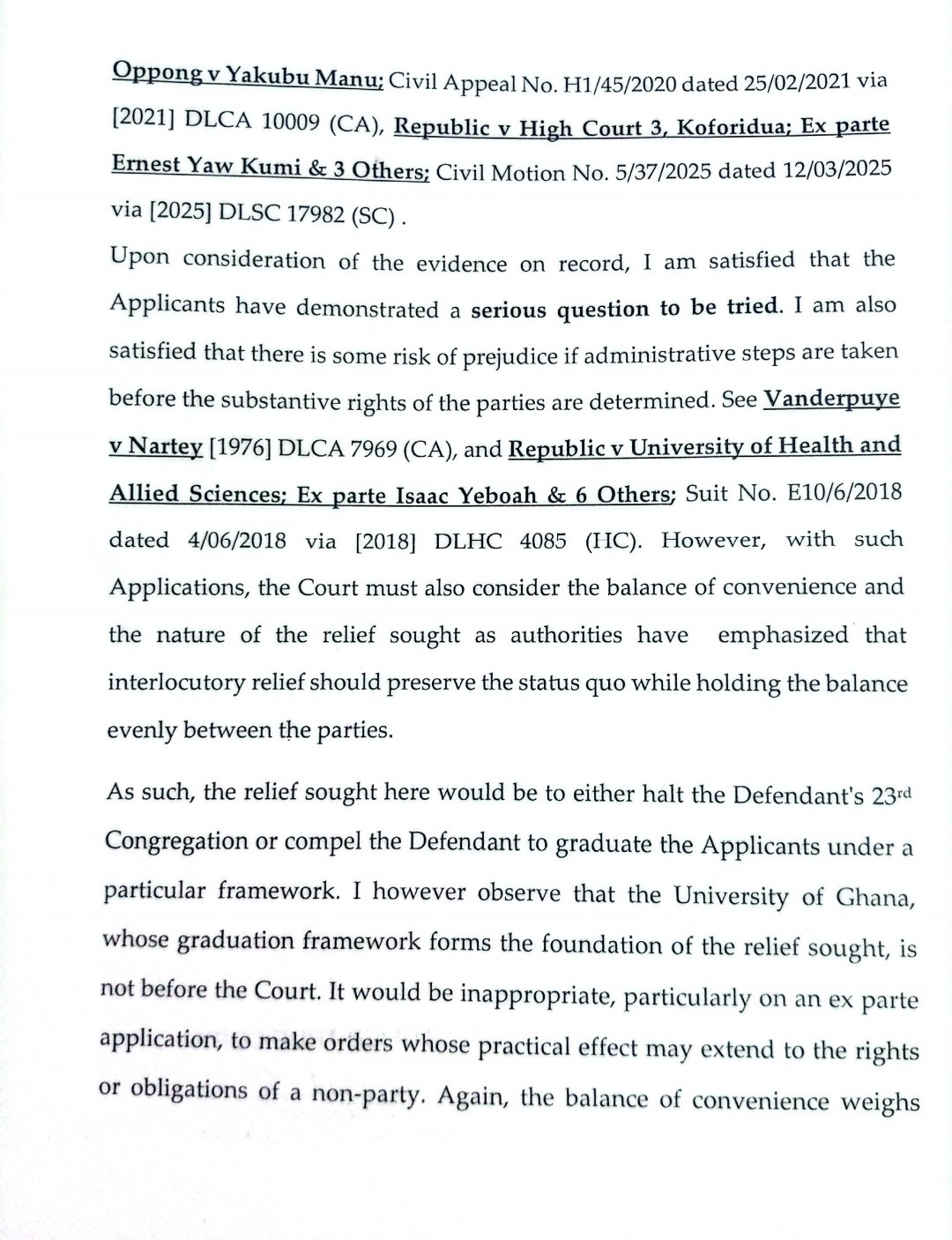
However, in her ruling, Justice Abdul-Baasit said the University of Ghana, whose graduation framework formed the basis of the applicants’ claims, was not a party to the proceedings.
She held that it would be inappropriate, particularly in an ex parte application, for the court to make orders whose practical effect could extend to the rights or obligations of an institution that was not before it.
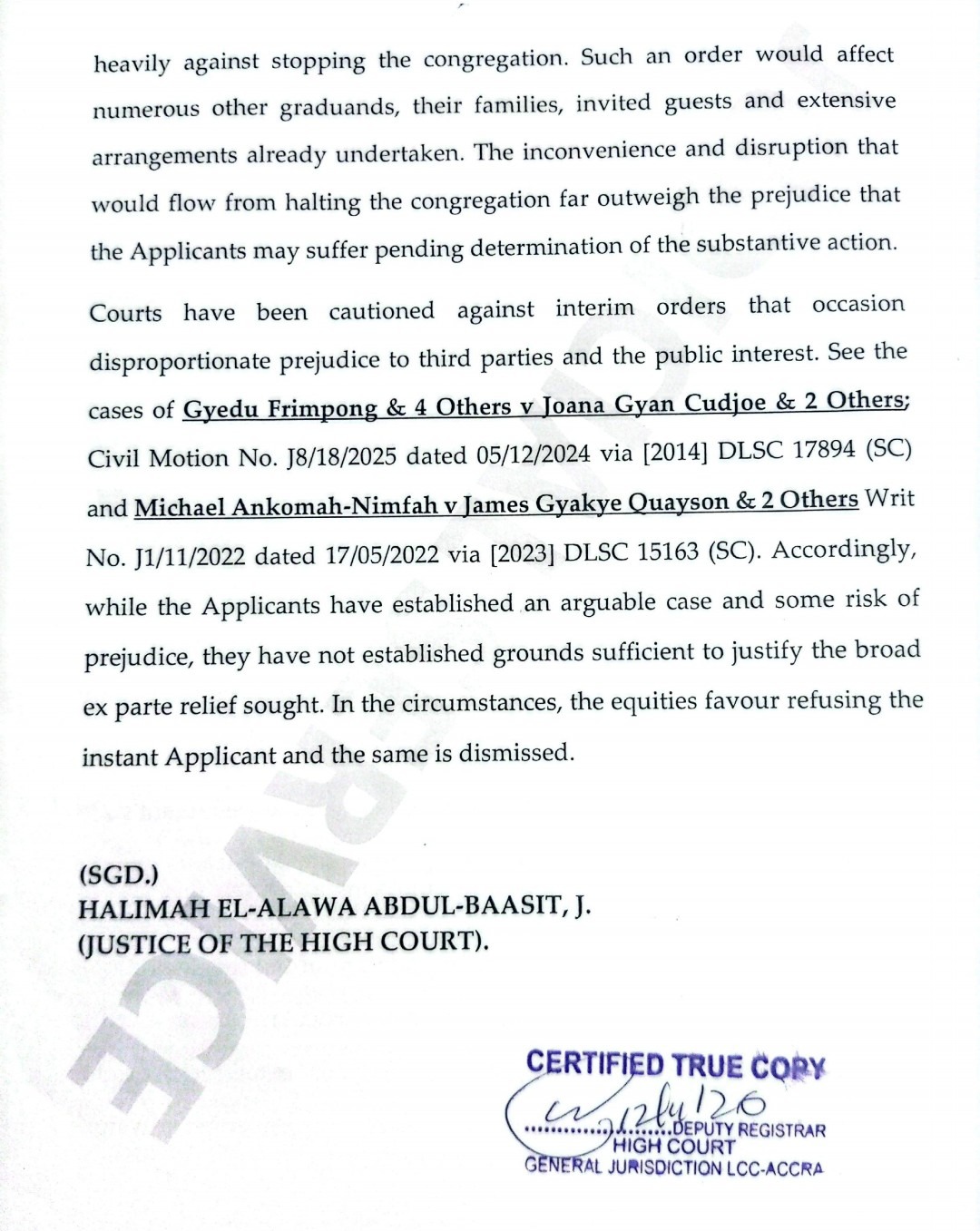
The judge also rejected the argument for halting the congregation, citing the potential disruption to other graduands, their families, invited guests and the extensive arrangements already made for the ceremony.
According to the court, the inconvenience and disruption that would result from stopping the congregation outweighed the prejudice the applicants might suffer while awaiting the determination of the substantive action.
Justice Abdul-Baasit emphasised that interim injunctions must preserve the status quo while maintaining a fair balance between the parties and avoiding disproportionate prejudice to third parties and the public interest.
In reaching her decision, she relied on established principles governing interlocutory and ex parte injunctions, including decisions in Amadu Oppong v Yakubu Manu and Republic v High Court 3, Koforidua; Ex parte Ernest Yaw Kumi & 3 Others.
The court stressed that an ex-parte injunction was an exceptional remedy that must be granted sparingly and for a strictly limited period.
Although it acknowledged that the applicants had established a serious question to be tried, the court concluded that the balance of convenience weighed against granting the relief.
The application was consequently Refused and Dismissed.
The ruling was delivered on Wednesday 28 October 2026, at 9:57 am. The defendant, AUCB, was absent, while the applicants and their counsel were present.
NB: Three of the 75 students have resits, while the records of the 72 graduating students are currently being processed.
Below are screenshots from the Court hearing and ruling