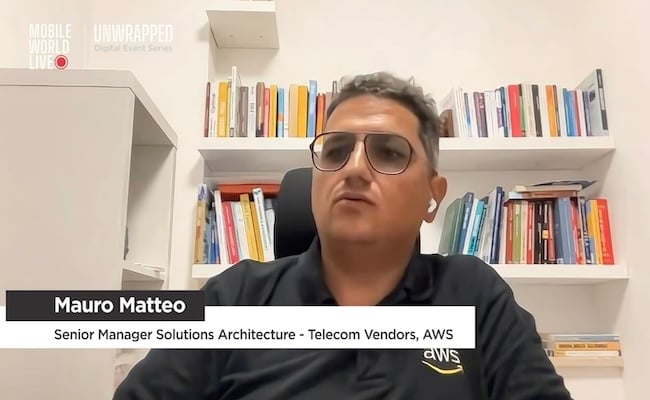
Private network deployments are gaining traction across the logistics and manufacturing sectors, but existing equipment and skills shortages remain significant barriers to wider adoption, according to AWS Senior Manager for Solutions Architecture, Telecom Vendors, Mauro Matteo.
Speaking during a Live Unwrapped Digital Industries keynote, Matteo said the growth of private networks was “real”, citing Amazon’s logistics operations, where about one million robots are connected across multiple fulfilment centres.
He said reliable connectivity was also becoming increasingly important in complex environments such as ports and airports, where operators, carriers, truckers and passengers operate within the same ecosystem.
“When something goes down, the first concern when network isn’t reliable, so to speak, the primarily concern is about safety of operations,” Matteo said.

However, Matteo cautioned against viewing private 5G as a standalone solution for industrial connectivity, arguing that different applications require different technologies.
“It’s not a single technology solution that will win it all,” he said, noting that some applications remain better suited to wired connections, while others can use Wi-Fi or private 5G.
“5G is a tool and not a destination,” Matteo added, stressing that connectivity should ultimately become largely invisible to users when it is functioning properly.
Brownfield equipment remains a challenge
Matteo identified existing physical equipment as one of the major obstacles to wider private network deployment.
He said radios and standards were already “mature”, but technology barriers were often linked to the physical equipment already in use.
Ports and airports, for instance, frequently depend on existing cranes, vehicles and control systems that cannot easily be retrofitted to support new connectivity.
“When the physical equipment doesn’t allow for a network to be on the device, there is so much less that can be done,” he explained.
Beyond equipment, Matteo highlighted skills as another challenge, urging organisations to increase investment in people capable of building and operating increasingly complex technology environments.
While he acknowledged that cost remained a consideration, Matteo said it was “not a blocker”, arguing that organisations should instead focus on improving the return on investment from their connectivity deployments.