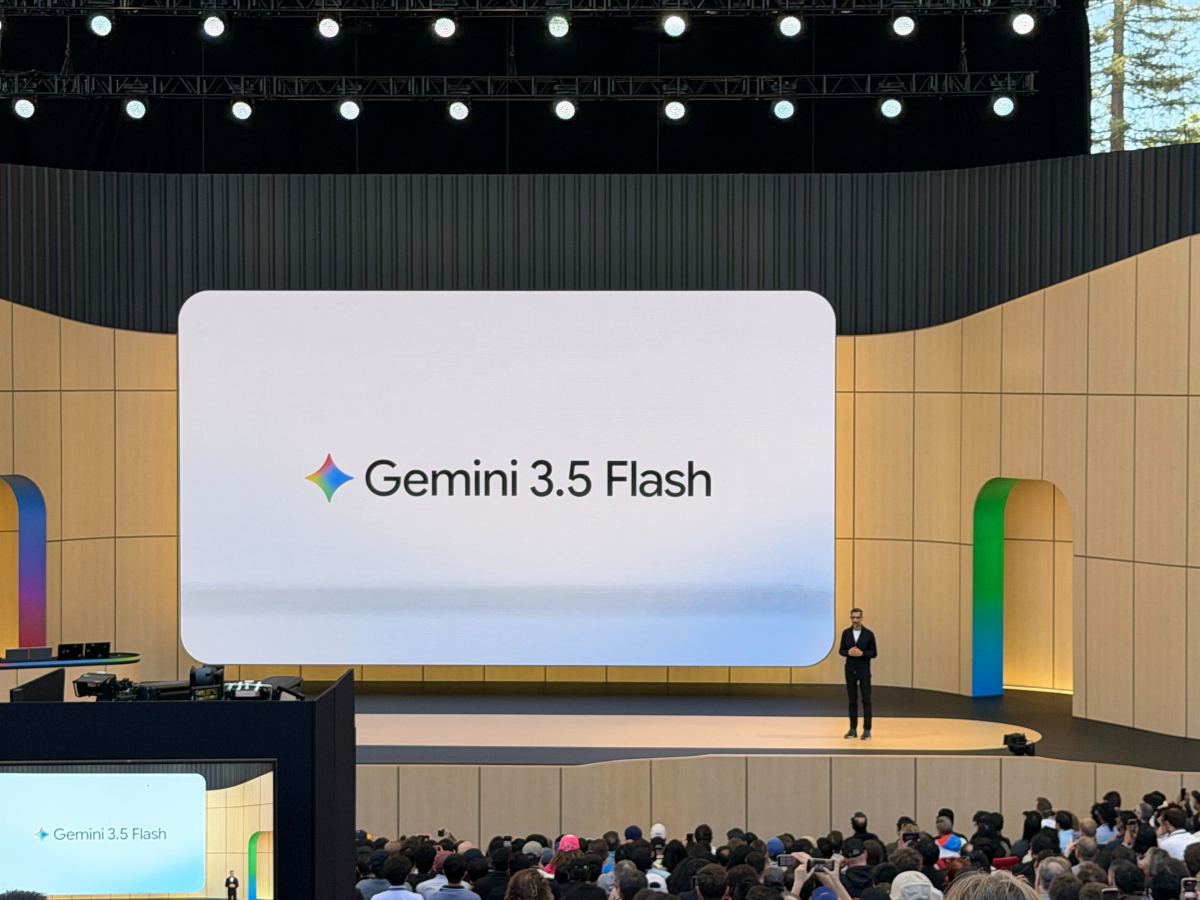
Google has unveiled Gemini 3.5 Flash, which the company claims is its most capable model yet for coding and autonomous AI agents.
According to Google, Gemini 3.5 Flash can also independently carry out coding workflows, oversee research projects, and build an entire operating system from the ground up.
The announcement marks Google’s transition from promoting AI as a conversational tool to one that is agentic. It involves more than merely responding to enquiries; it involves organising, constructing and refining actual work with little assistance from humans.
Prior to the public rollout, DeepMind’s chief technologist, Koray Kavukcuoglu, told reporters that “3.5 Flash offers an incredible combination of quality and low latency.” On almost every measure, including coding, agentic activities and multimodal reasoning, it performs better than our most recent frontier model, 3.1 Pro.

It is 4 times quicker than other frontier models, which is perfect for coding and agentic jobs, he continued, but Google has “taken it to another level” by creating an optimised version of Flash that is 12 times faster without sacrificing quality.
According to Kavukcuoglu, this speed is essential to Flash’s design for agentic labour, which involves several AI agents working simultaneously on lengthy tasks. In Antigravity, the company’s agentic development platform and IDE, Google developer Varun Mohan showed onstage at I/O how agents split out to work on different components before coming together to build a whole operating system.
According to Kavukcuoglu, Flash 3.5 was created in collaboration with Antigravity to provide agents with a “native environment where they can live, work and execute.”
Google unveiled Antigravity 2.0, a stand-alone desktop programme built on agent-first development, during I/O.
Beyond demonstrations, the benefits are becoming apparent. According to Google, 3.5 Flash’s agentic features are already having an impact on partners, such as data science teams discovering insights in intricate data settings or banks and fintechs automating multi-week operations.
The model can operate independently for several hours, but Tulsee Doshi, senior director and head of product at Google, stated that when it reaches a decision point or permission issue that calls for human judgement, it occasionally pauses and requests user involvement.
The two are intended to function together when Google publishes its upcoming 3.5 Pro model.
”3.5 Pro becomes your orchestrator, your planner and it actually can leverage Flash to be the various sub-agents,” according to Doshi. I believe it really boils down to whether you have activities that truly require solid brute force tool use capabilities or if you truly want that reasoning capacity and a larger model that can really push on the reasoning side.
Currently, 3.5 Flash is the standard model in both AI Mode in Search worldwide and the Gemini app. Google also revealed at I/O that agentic features will be added to Search, enabling users to directly construct, modify and control AI agents. Gemini Spark, Google’s new personal AI agent that will operate around-the-clock to assist users in managing their digital lives, will also be powered by the new model.
There is scrutiny surrounding the provision of that degree of AI capabilities for typical users. After weeks of speaking with Gemini last year, a guy almost perpetrated a mass casualty event and committed suicide. As a result, Google is currently being sued.
When powerful autonomous agents are made more widely available, the potential for harm only increases. Gemini 3.5, according to Google, has improved cyber and CBRN (chemical, biological, radiological and nuclear) protections and is better suited to respond to delicate enquiries rather than flatly reject them.
Gemini 3.5 Flash is currently widely accessible through the Gemini app and AI mode in Search, Antigravity, the Gemini API and Gemini Enterprise.