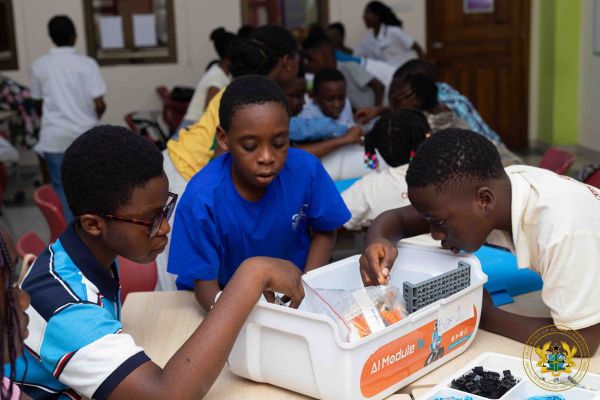
The government has reaffirmed its commitment to equipping young Ghanaians with the skills required to participate meaningfully in an increasingly technology-driven economy through early exposure to emerging technologies.
The commitment was expressed by the Minister for Communication, Digital Technology and Innovations, Hon. Samuel Nartey George (MP), in a statement delivered on his behalf by the Director for Innovations at the opening of the five-day AI and Robotics Summer Bootcamp.
The bootcamp brings together 100 students from 19 schools, with the aim of providing them with practical exposure to artificial intelligence (AI), robotics, coding and other emerging technologies.
The beneficiaries are drawn from Nima Cluster of Schools, Teshie Anglican Basic School, 37 Military Basic School, Accra Newtown Experimental School, Osu Ringway Estate Basic School, Salem School, Osu, Mizpah International School, KinderKids International School, Royal Standard Learning Centre, My Redeemer School, Globen School, Labone S.D.A. Church School, University of Ghana Basic School, Sunflower School, AgyeBaff Educational Center, Ahtoo Montessori School, Crystal Gate International School, Platinum School and Ghana International School.

The students are organised according to their age and grade levels to support age-appropriate learning. The grouping guide places learners aged 6–8 in the Foundation cohort (Grades 1–3), 9–11 in the Junior cohort (Grades 4–6), 12–14 in the Intermediate cohort (Grades 7–9), and 15–18 in the Senior cohort (Grades 10–12).
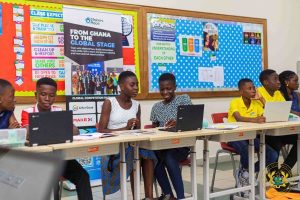
The minister explained that the approach allows the training to be tailored to the learners’ developmental and educational levels, ranging from structured support and visual or block-based tasks for younger participants to guided robotics and coding challenges, independent design and programming, and more advanced problem-solving and project work for older students.
Hon. George said the bootcamp is being delivered through a hands-on learning approach, exposing participants to AI, robotics, coding and other emerging technologies. Through guided activities, experimentation and project development, students are encouraged to apply what they learn, test their ideas and explore technology-based solutions to real-life challenges.
According to the minister, the rapid advancement of AI, robotics and automation is reshaping the world of work, businesses and economies, making it necessary to give young people opportunities to acquire relevant skills and apply them in practical settings.
He said the initiative complements the government’s digital skills development agenda and contributes to the objectives of Ghana’s National Artificial Intelligence Strategy, particularly efforts to build the competencies required for meaningful participation in the digital economy.
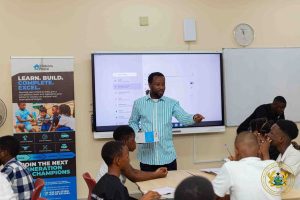
Hon. George encouraged the participants to approach the programme with curiosity, discipline and an open mind, urging them not to be discouraged by mistakes but to regard them as opportunities to learn and improve.
He also appealed to parents, teachers, facilitators and partners to sustain their support for the young innovators beyond the bootcamp, stressing that continued guidance would be essential to transforming the skills acquired into meaningful opportunities.
The minister expressed the hope that the initiative would help nurture a new generation of Ghanaian innovators and problem-solvers capable of harnessing technology to create solutions and opportunities for Ghana and the wider African continent.