Commissioner-General of the Ghana Revenue Authority (GRA), Anthony Sarpong, has targeted an ambitious programme of tax reforms and digital transformation initiatives aimed at boosting domestic revenue mobilisation and reducing the country’s dependence on external financing.
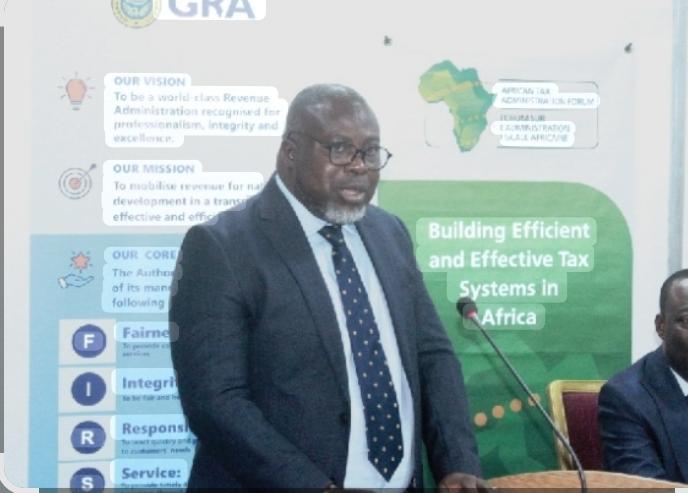
Speaking at the 10th Ghana CEO Summit in Accra, Mr Sarpong said Ghana’s long-term economic transformation and industrialisation agenda would only succeed if the country developed a stronger and more sustainable domestic revenue base.
According to him, critical national priorities such as infrastructure, energy, healthcare, education and efficient public services require reliable domestic financing rather than continued dependence on donor support and external borrowing.
Mr Sarpong explained that the current tax reform agenda is anchored on four key pillars — fairness, capability, productive economic growth and national sovereignty.

He stressed that the government’s approach is not centred on imposing additional tax burdens on compliant businesses, but rather on broadening the tax base and ensuring greater fairness within the system.
“We want this era of tax reform to ensure that businesses which comply with the law are no longer disadvantaged by those that evade taxes,” he stated.
He noted that low tax compliance has historically created an uneven business environment in Ghana, where compliant companies often compete against firms operating outside the tax system.
Mr Sarpong commended President John Dramani Mahama for maintaining a policy direction that prioritises improved tax administration over the introduction of new taxes.
According to him, government has already abolished the one per cent COVID-19 levy and removed several taxes that negatively affected business profitability.
The Commissioner-General disclosed that several tax laws are currently under review to align them with modern economic realities.
He explained that amendments to the Value Added Tax Act in 2025 increased the VAT registration threshold from GH¢200,000 to GH¢750,000, effectively exempting smaller businesses from VAT compliance obligations.
Under the revised arrangement, businesses with annual turnover below GH¢750,000 will no longer be required to register for VAT.
Mr Sarpong further announced that reviews of the Income Tax Act, Customs Act and Excise Act are scheduled for 2026, while reforms involving international tax treaties are expected in 2027.
A major focus of the GRA’s strategy is the integration of Ghana’s vast informal sector into the tax system.
Mr Sarpong said the modified taxation scheme introduced in November 2025 was specifically designed to simplify taxation for informal businesses through a fair and proportionate structure.
Under the scheme, businesses with annual turnover of up to GH¢500,000 are required to pay a flat three per cent income tax on turnover.
He disclosed that the GRA intends to bring more than two million informal sector operators into the tax net over the next three years, a move expected to generate more than GH¢10 billion in additional revenue.
“The path to a stronger fiscal foundation lies in expanding the tax base rather than tightening the burden on those already paying taxes,” he said.
Beyond policy reforms, the Commissioner-General highlighted technology and artificial intelligence as central pillars of the GRA’s modernisation agenda.
He noted that manual tax administration systems have long created inefficiencies, delays and opportunities for revenue leakages.
According to him, the GRA has now introduced an Artificial Intelligence-powered customs valuation and decision-support system aimed at improving efficiency and strengthening customs revenue collection at the ports.
Mr Sarpong revealed that the AI-powered system generated more than GH¢1 billion in customs revenue in April 2026 alone, with May revenue expected to exceed the same figure.
He also announced the successful implementation of the Integrated Tax Application and Preparation System (iTaPS), a project that had stalled for years before being revived and completed within nine months under the current administration.
The iTaPS platform integrates data from key institutions including the Registrar-General’s Department, the Lands Commission and the National Identification Authority to improve compliance monitoring and reduce tax evasion.
According to Mr Sarpong, taxpayers accounting for 95 per cent of Ghana’s tax revenue are expected to be migrated onto the new platform by mid-June 2026.
“As businesses register, they will automatically become visible within the GRA system. Technology will help us identify who is complying and who is not,” he stated.
The Commissioner-General further disclosed that electronic fiscal devices for VAT collection are expected to be introduced by the third quarter of 2026.
He explained that the technology will allow government to monitor sales transactions in real time, reduce leakages and improve transparency in VAT collection.
Mr Sarpong added that the GRA is also preparing systems to monitor online businesses and digital transactions to improve VAT collection from e-commerce activities, an area government estimates could generate approximately GH¢2.5 billion in additional revenue.
He further warned that cryptocurrency and digital asset transactions will increasingly come under regulatory monitoring as part of efforts to widen the country’s tax net.
On the broader issue of economic sovereignty, Mr Sarpong stressed that Ghana must reduce its reliance on external financing and strengthen its capacity to fund development internally.
He argued that increasingly difficult global financing conditions make domestic revenue mobilisation more important than ever for national resilience and economic independence.
According to him, the GRA aims to double Ghana’s tax revenue by 2028 compared with 2024 levels by expanding the tax base, improving compliance and leveraging technology-driven administration.
He called on businesses and citizens to support the country’s revenue mobilisation efforts, describing tax compliance as a shared national responsibility essential to Ghana’s long-term prosperity and economic transformation.