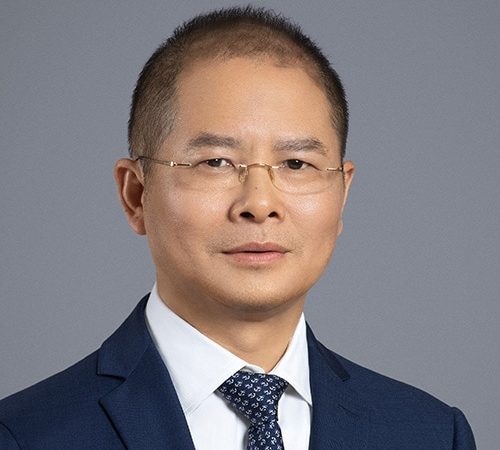
Huawei rotating chairman Eric Xu has said Chinese artificial intelligence (AI) developers may need to advance their models further before they encounter the safety risks increasingly associated with frontier AI systems in the United States.
Xu told reporters at the Huawei Connect conference in Shanghai that Chinese AI providers may not yet possess the computing power or model capabilities required to experience some of the risks being reported by leading US developers, Reuters reported.
“Maybe the type of risk from AI that they can feel, they can perceive, is something that people in China or AI model providers in China cannot,” Xu said.
He added that Chinese AI providers may need to “speed up their pace” until they reach a level where they can also experience the risks associated with AI development.

Xu simultaneously called for “a balance between driving AI development and managing AI risk”, highlighting the challenge of advancing AI capabilities while addressing emerging safety concerns.
His comments come as global debate over frontier AI safety intensifies, following calls by Anthropic chief executive Dario Amodei and OpenAI chief executive Sam Altman for AI development to be paced.
China has pushed back against such proposals. Foreign Ministry spokesperson Guo Jiakun called for an open approach to AI, while Chinese state media criticised US proposals as a “Cold War playbook” targeting China’s AI development and “geopolitical dominance”.
AI agents to dominate global traffic
Huawei has forecast a major shift in global AI workloads towards autonomous agents, saying they could account for more than 90% of global AI traffic by 2035.
In a report released on 16 September, the company also projected that token consumption would increase 100,000-fold from current levels as AI workloads expand.
According to the Financial Times, Xu said six or seven Chinese AI laboratories could target models with between 10 trillion and 40 trillion parameters within two years.
Huawei accelerates AI infrastructure push
Xu acknowledged that Huawei remains “not as advanced” as leading US rivals in semiconductors but said US export restrictions had encouraged Chinese customers to adopt domestic technology.
He said Huawei was “pushing for full self-sufficiency for chips and the entire supply chain around semiconductors”.
The company is also expanding its AI computing systems as it seeks to strengthen its AI infrastructure capabilities.
Huawei unveiled a new computing architecture designed to allow up to one million processors to operate as a single computer.
The company also brought forward the planned launch of its Ascend 960DT training chip to the first quarter of 2027, while the Ascend 960PR inference silicon is now scheduled for the third quarter.
Huawei said both chips would deliver twice the computing performance of its current flagship.