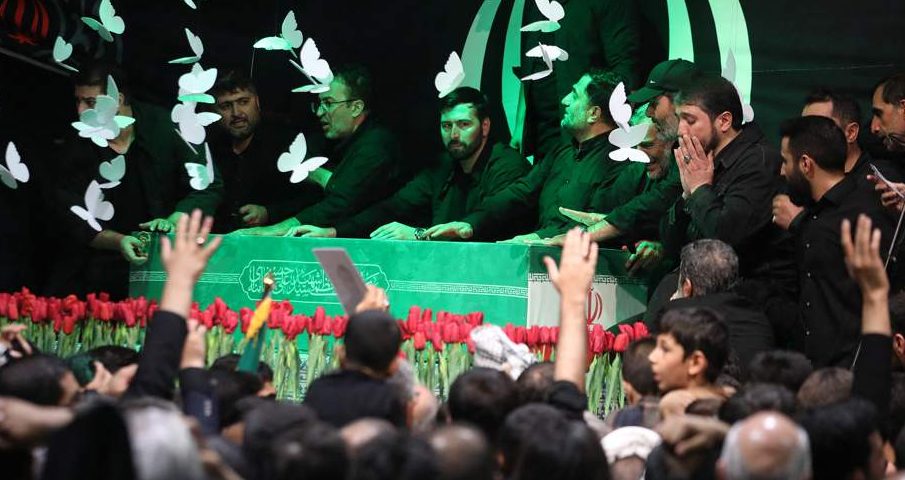
Millions of mourners gathered in Tehran on Saturday for the state funeral of Iran’s slain Supreme Leader, as authorities imposed extraordinary security measures and regional tensions continued to cast a shadow over the country.
Iranian state media confirmed that Ayatollah Mojtaba Khamenei, who succeeded his father as supreme leader in March, would not lead prayers during any of the week-long funeral ceremonies because of security concerns, amid fears he could be targeted in an assassination attempt.
Mojtaba Khamenei has not appeared in public since assuming the country’s highest office after his father was killed in U.S.-Israeli strikes on 28 February. The new supreme leader was reportedly wounded in the same attacks.
Instead, three senior ayatollahs will lead prayers at ceremonies in Tehran, Qom and Mashhad.

According to Iranian officials, the decision was driven by heightened security concerns. Two members of the Islamic Revolutionary Guards Corps familiar with the planning told The New York Times that Mojtaba Khamenei’s security team had ruled out any public appearance over fears Israel could track his movements or attempt an assassination.
Tens of thousands of mourners began arriving before dawn at Tehran’s Grand Mosalla mosque, where the late supreme leader’s glass-encased coffin, draped in the Iranian flag, lay in state alongside the coffins of family members killed in the same attack.
Iranian authorities expect as many as 20 million people to participate in funeral events running until 9 July. Following ceremonies in Tehran, the body will be taken through the holy city of Qom before travelling to the Iraqi shrine cities of Karbala and Najaf ahead of its final burial in Mashhad.
Foreign dignitaries from Russia, Pakistan, Iraq, Türkiye, Saudi Arabia, Qatar and Egypt attended opening ceremonies on Friday, underlining the regional significance of the funeral.
The government has declared a three-day public holiday, closed large parts of Tehran and tightened airspace security to accommodate the events, which were postponed from March because of the war and concerns over crowd safety.
The funeral comes as diplomatic efforts to ease tensions between Tehran and Washington continue to struggle.
Qatar and Pakistan have been mediating indirect negotiations aimed at reaching a broader agreement over Iran’s nuclear programme and regional security. Despite several rounds of talks, the discussions have so far failed to prevent renewed fighting or fully restore confidence in navigation through the Strait of Hormuz.
The latest indirect technical talks took place in Doha on Wednesday. U.S. President Donald Trump described the discussions as “very good”, although disagreements remain over key issues.
Iranian officials said both sides had agreed to the partial release of billions of dollars in frozen Iranian assets, a claim that U.S. officials subsequently denied.
The negotiations follow a memorandum of understanding signed two weeks ago, giving both sides 60 days to negotiate a comprehensive agreement covering Iran’s nuclear programme.
Another round of talks is expected to take place in Pakistan on 11 July, according to Saudi-owned Al Arabiya. Trump has announced a one-week pause in negotiations out of respect for the funeral ceremonies, while Iranian officials said the composition of their delegation would be confirmed once the mourning period concludes.
Meanwhile, concern over the security of the Strait of Hormuz remains elevated.
Britain and France issued a joint statement describing the strategic waterway as “a vital artery for the global economy” and announced that Oman had agreed to cooperate with both countries to safeguard commercial navigation through its territorial waters.
London and Paris also said they were prepared to deploy a broader multinational military mission to support freedom of navigation if required.
Iran responded sharply. Senior official Ali Bagheri Gharibabadi warned on social media platform X that the Strait of Hormuz was “not a theatre for the military display of extra-regional powers”, adding that Tehran regarded itself as “the responsible power and guarantor” of the waterway’s security and would hold what it called the “crisis-makers” accountable for any consequences arising from their actions.
France has already deployed mine-clearing assets to the region as commercial shipping gradually resumes following last month’s ceasefire.
Elsewhere in the region, Israel said it had struck around 10 Hezbollah infrastructure sites in southern Lebanon, indicating that hostilities continue despite the recent ceasefire agreement.
In Yemen, the Iran-backed Houthi movement warned it would target Saudi airports and critical infrastructure if Riyadh violated Yemeni airspace or launched military operations.
Energy markets continue to monitor developments closely. Although shipping activity through the Strait of Hormuz has improved since last month’s ceasefire, analysts caution that risks to one of the world’s most important energy corridors remain significant, with the waterway carrying around one-fifth of global oil shipments.