A group of scientists from Kwame Nkrumah University of Science and Technology (KNUST) have developed a novel process for turning taro (Kooko or Brobe) peels into high-performance batteries.
By converting food waste into a renewable energy source, this economical and eco-friendly invention, which was published in the journal Energy Storage, has the potential to completely transform the energy storage sector.
The lead researcher and member of the KNUST Centre for Engineering Materials study (KCEMR), Dr Daniel Nframah Ampong, described the straenergytegy the study team used.
“We used an environmentally friendly approach to synthesise activated carbon from taro peels. These waste materials contain some properties or functional groups that we believed at the time would enhance the performance of energy storage devices,” he stated.

The goal of the project was to turn taro peels into activated carbon, which was subsequently evaluated for usage in energy storage applications.
The market currently depends on activated carbons that are manufactured synthetically utilising dangerous and poisonous processes, claims Dr Ampong. However, the KNUST team was inspired by the traditional methods of manufacturing charcoal in Ghanaian villages.
“We decided to come down to our level and use the process of producing charcoal in our villages. We mimicked that process using crucibles, and at the end, we were able to synthesise the activated carbon, which had similar properties to the commercially available activated carbons,” Dr Ampong revealed.
The material made from biomass showed remarkable energy storage qualities, providing a sustainable substitute for traditional battery parts.
The innovation aligns with Ghana’s renewable energy agenda, as the country aims to enhance its renewable energy mix.
“The purpose of the research is to get some storage systems to store renewable energies when they are in excess so that when we need them, we would be able to utilise them effectively,” Dr Ampong explained.
“We want to produce something that is eco-friendly with a cheap synthesis process, and the starting materials are locally available.”
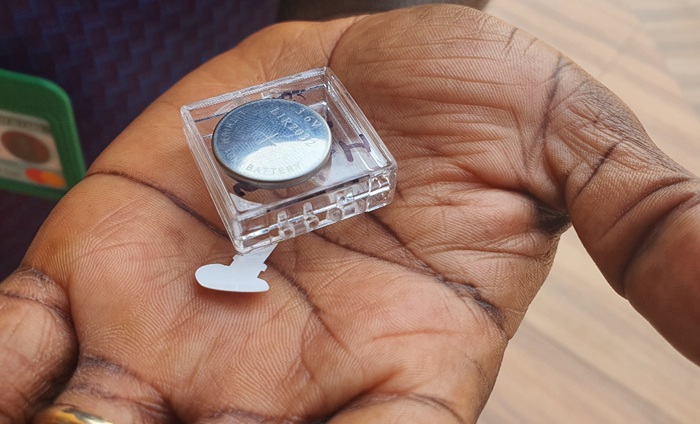
Professor Kwadwo Mensah-Darkwa, Dr Ampong’s supervisor and Research Lead of the Energy Materials Research Group, highlighted ongoing efforts to use biowaste for energy storage solutions.
“There has been a lot of development trying to use these biowaste materials mostly to drive our energy storage agenda. The plan is we want to get an eco-friendly way of creating materials for energy storage devices. This is what we are looking forward to at our lab,” he said.
Additionally, Prof Mensah-Darkwa pointed out that their research capacities have been improved by recent investments in lab equipment made possible by the KNUST Engineering Education Program (KEEP).
“We have equipment now where we can test these assembled cells. So now the output of our research is going to be quite effective, and we would be able to look at all other opportunities we have,” he stated.
He did concede, though, that additional material characterisation methods are necessary to verify the qualities required for certain applications, which the department does not now have.
Regarding the future, Prof. Mensah-Darkwa was upbeat about their work’s prospects.
If we expand on our experience, we can now consider how to scale it up and have an impact.” We are aware that there is opportunity in this field. Although we are still a ways off from producing our own batteries, we are getting close to realising how we can accomplish these tasks locally,” he said.
The development focuses on using biowaste materials for energy storage, aiming to create eco-friendly materials for energy storage devices in the lab.