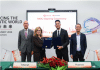
Brahim Jelassi, Sales Manager Africa at LAWO, a global technology partner delivering pioneering IP-based infrastructure solutions for audio, video, control and monitoring has urged broadcasters to embrace the shift from traditional SDI infrastructure to IP-based workflows, saying software-defined infrastructure is emerging as a key component of scalable and distributed production.
Speaking during a presentation at the Broadcasters Convention 2026 in Accra, Mr Jelassi said broadcasters across the globe were increasingly replacing SDI systems with IP technologies such as SMPTE 2110, SRT and NDI.
He said the transition did not have to happen at once, as broadcasters could begin by replacing selected components in a studio or building before gradually expanding their IP infrastructure.
“We believe that software-defined infrastructure, whether from FPGA or purely software running in the cloud or on-prem, is the future,” he said.

According to Mr Jelassi, the move towards IP would allow broadcasters to distribute production resources and signals between different locations, creating more flexible production environments.
He also pointed to the emerging DMF initiative by the European Broadcast Union, which involves different vendors contributing to a common IP infrastructure and sharing resources.
He said although the initiative was still at an early stage, it had potential technical and commercial benefits for broadcasters.
SDI limitations
Mr Jelassi said broadcasters were moving away from legacy SDI workflows partly because of the limitations associated with centralised infrastructure.
He explained that a traditional SDI workflow was typically centred on a matrix connected to hardware from different vendors, meaning broadcasters needed additional hardware purchases when they wanted to scale production.
He cited major events such as elections as an example, saying broadcasters could require additional hardware to handle increased production demands.
He also identified separate control systems for audio and video as another challenge, describing the integration of the two environments as technically difficult.
Mr Jelassi further noted that manufacturers were announcing the end of production of some equipment, leaving broadcasters with a three-to-five-year period of SDI support as they consider their next steps.
He said IP technology provided a way of moving from a centralised SDI model to a distributed network fabric, where signals are packetised and distributed across the network.
He added that technologies such as SRT over RTC could also be used to replace satellite links and accelerate content delivery and production.
Interoperability and skills
Despite the benefits of the transition, Mr Jelassi said broadcasters faced challenges in implementing IP-based infrastructure.
He identified interoperability, staff training and cybersecurity as the major issues requiring attention.
“The challenge is the interoperability. You have different vendors, different standards,” he said.
He added that broadcasters would need new skills to manage IP-based environments, while IT and broadcast teams would have to work more closely together.
On cybersecurity, Mr Jelassi said LAWO had taken the issue seriously and had worked on addressing it as part of its approach to IP infrastructure.
He said network and bandwidth requirements were not necessarily the biggest challenges, particularly for broadcasters that began the transition with local deployments.
LAWO’s HOME platform
Mr Jelassi said LAWO had developed its HOME platform to address some of the challenges associated with IP-based broadcasting.
He explained that HOME is an IT platform capable of running on a standard server or being hosted in the cloud, while most installations were hosted on regular IT servers.
The platform allows users to discover IP signals and equipment within a facility, including equipment from other manufacturers through SNMP.
Mr Jelassi said HOME had also been designed with a user-friendly interface to enable operators without extensive technical knowledge to operate the system after installation.
For cybersecurity, he said connected equipment could be placed into quarantine mode, allowing operators and engineers to administer it safely.
He gave the example of a recording device accessing the infrastructure and bringing content into a system before the content was later exported to social media or an OTT platform.
Open standards
On interoperability, Mr Jelassi said LAWO’s approach was designed to allow integration with equipment from different vendors.
He said HOME supports standards and technologies including SRT, SMPTE 2110, Dante, NDI and MOS with RTC.
He added that LAWO intended to support new standards as they emerged.
Mr Jelassi also stressed the flexibility of the platform, saying HOME could be hosted on a conventional IT server and could even run on a small computer.