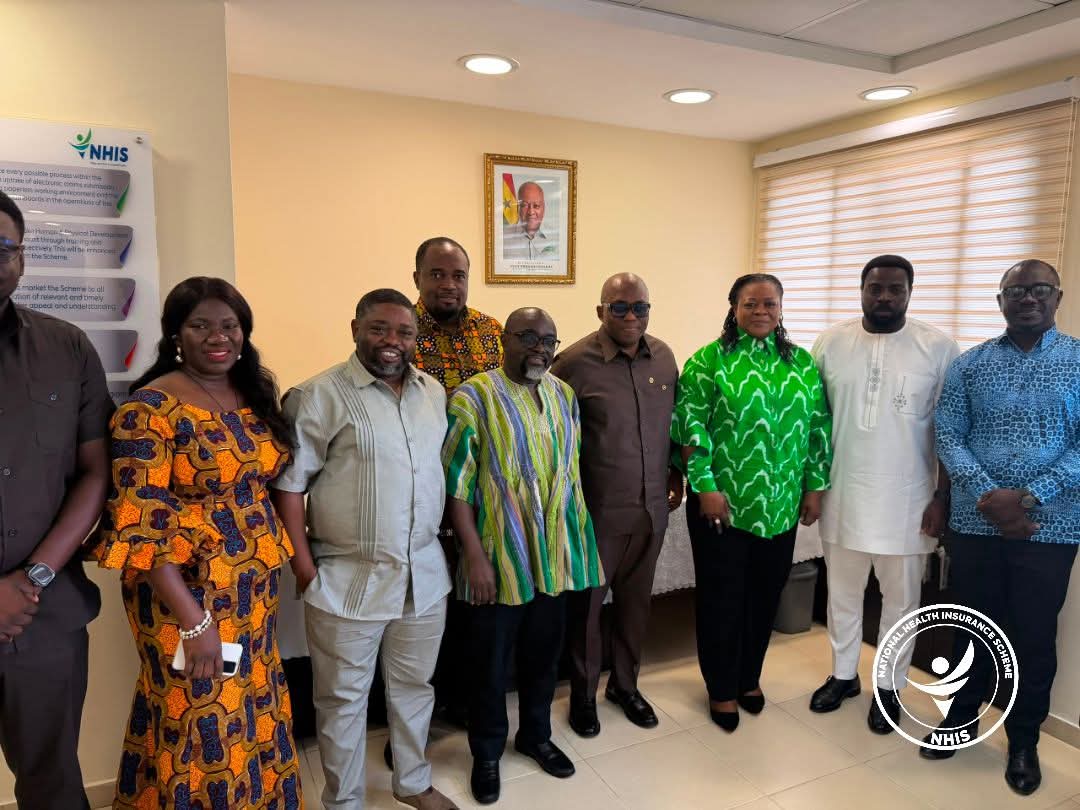
The newly elected leadership of the Medical Superintendents’ Group of Ghana has raised concerns over challenges affecting claims management under the National Health Insurance Scheme (NHIS), following the transition to the Ghana Health Information Management System (GHIMS) and delays in the implementation of revised NHIS tariffs.
The concerns were raised during a working visit by the Group to the National Health Insurance Authority (NHIA) Head Office, where the new executives were formally introduced to the Authority’s Executive Management.
President of the Medical Superintendents’ Group, Dr Eric Sarpong-Ntiamoah, commended the NHIA for the timely reimbursement of claims to healthcare providers, noting that the payments had enabled health facilities to continue delivering quality healthcare services across the country.
Despite the progress in claims reimbursement, Dr Sarpong-Ntiamoah highlighted operational difficulties arising from the migration from the Lightwave Health Information Management System (LHIMS) to GHIMS.

According to him, disruptions associated with the transition prevented a number of healthcare facilities from submitting claims for services rendered during certain periods, creating financial and operational challenges for providers.
He appealed to the Authority to consider possible interventions to support affected facilities and also sought an update on the long-awaited review of NHIS tariffs, citing rising healthcare delivery costs.
Responding to the concerns, the Chief Executive of the NHIA, Dr Victor Asare Bampoe, acknowledged the difficulties encountered during the system migration and assured the Group that the Authority had been engaging stakeholders to identify an appropriate solution.
Dr Bampoe explained that the NHIA had explored the option of compensating affected facilities based on their average historical claims and had obtained approval from its Governing Board to pursue the proposal. However, consultations with the Ministry of Health and the Ministry of Finance revealed that existing Public Financial Management (PFM) regulations do not permit payments without verifiable evidence of services rendered.
“We explored every available option because we understand the challenges providers are facing. However, we must ensure that any intervention complies with the Public Financial Management regulations. We will continue to engage the appropriate authorities to find a workable solution,” he said.
The Deputy Chief Executive for Finance and Investment, Madam Anatu Anne Seidu Bogobiri, also stressed that while the Authority appreciates the concerns of healthcare providers, claims payments must be supported by verifiable records in accordance with existing financial regulations.
On the issue of tariff adjustments, the Deputy Chief Executive for Operations, Dr Kwesi Senanu Djokoto, assured the medical superintendents that progress was being made towards a review of NHIS tariffs.
He disclosed that stakeholder consultations had been completed and that a draft proposal had been developed and was currently undergoing the required approval processes.
Dr Djokoto noted that the NHIA recognises the impact of rising operational costs on healthcare providers and remains committed to securing the necessary approvals to ensure tariffs better reflect current economic conditions.
He further assured stakeholders that efforts were underway to address operational challenges affecting the GHIMS platform and improve its stability to facilitate seamless claims submission and processing.
The NHIA management reiterated its commitment to strengthening collaboration with healthcare providers and working closely with stakeholders to resolve challenges affecting healthcare delivery under the NHIS.
The meeting concluded with both parties reaffirming their commitment to sustained dialogue and partnership aimed at improving healthcare financing and expanding access to quality healthcare services for all Ghanaians.