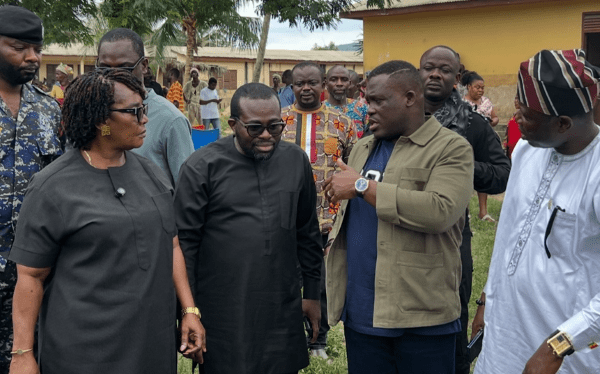
The Minister of Communication, Digital Technology and Innovations, Sam Nartey George, has directed the National Communications Authority (NCA) to reverse the policy where customers pay higher for data services when they connect to rural telephony sites.
Sam George said the directive is to ensure that both urban and rural dwellers, as well as visitors to rural communities paid the same fees for internet access across the country.
He disclosed this when he led officials of the Ministry, the NCA and the Ghana Investment Fund for Electronic Communications (GIFEC) to inspect selected cell sites in the Eastern Region to assess network connectivity challenges.
The team visited communities including Dwupong-Akwapem, Nkumkrom, Nsatse and Obosono following complaints from residents about poor mobile networks and internet services.

According to Sam George, under the existing arrangement, customers who move into some rural telephony coverage areas are unable to use their existing data bundles and are instead required to pay separately for data services, which makes data cost in rural areas much higher.
He described the situation as unfair to rural dwellers and said he had therefore instructed the NCA to work with telecommunications operators to reverse the policy.
“I have given a policy directive to the NCA to reverse that,” Sam George said, adding that the regulator was already engaging telecommunications companies to undertake the necessary technical integrations.
The minister said the government’s objective was to ensure that people in rural communities enjoyed the same benefits of mobile connectivity as customers in urban areas.
Mr George also called for a major upgrade of Ghana’s Rural Telephony Project, insisting that rural communities must no longer be left with outdated network technologies.
He said although the world was moving towards 5G, the government’s immediate objective should be to ensure that rural communities have access to at least 4G connectivity.
He explained that many existing mast and donor sites were already configured to support 4G, with the major requirement being the upgrading of radio equipment at local rural telephony sites.
“We must make a decision to invest in telecom as well, and the country must decide to convert all telephony sites to a minimum of 4G, prepared for 5G,” he said.
Mr George said reliable internet connectivity had become as important to national development as roads and other social infrastructure.
He said the government could not invest heavily in roads, education and other social interventions while leaving communities without reliable digital connectivity.
The inspection formed part of the Ministry’s broader assessment of the Rural Telephony Project and its effectiveness in addressing connectivity gaps.
Mr George acknowledged the contributions of previous ministers, including the late Edwin Omane Boamah, Haruna Iddrisu and Ursula Owusu-Ekuful, to the development of the Rural Telephony Project.
However, he said the current administration had a different outlook for the project and was assessing existing sites and network challenges to determine the appropriate interventions.
He said the findings from the exercise would be presented to Cabinet and would inform decisions on future investment in rural telecommunications.
The minister also disclosed that Ghana was expected to witness a significant increase in the number of new telecommunications sites being constructed this year.
He said between 2015 and 2025, there were years when the country recorded as few as 40 new masts, while the average number of new sites constructed annually over the decade was about 210.
He said the situation was changing, with MTN expected to construct 800 new sites in 2026, while Telecel was expected to construct about 350.
Mr George said nearly 180 of the targeted new sites had already been completed.
He expressed optimism that about 400 of MTN’s 800 sites would be completed by the end of 2026, with the remaining sites expected to be operational by the first or second quarter of 2027.
He was accompanied by officials from the NCA, GIFEC and the telecommunications industry, including the Chief Technical Officer of MTN.
Mr George said the expansion and upgrading of telecommunications infrastructure, together with the removal of additional cost barriers at rural telephony sites, would improve digital inclusion and ensure that rural communities benefit fully from Ghana’s digital transformation.