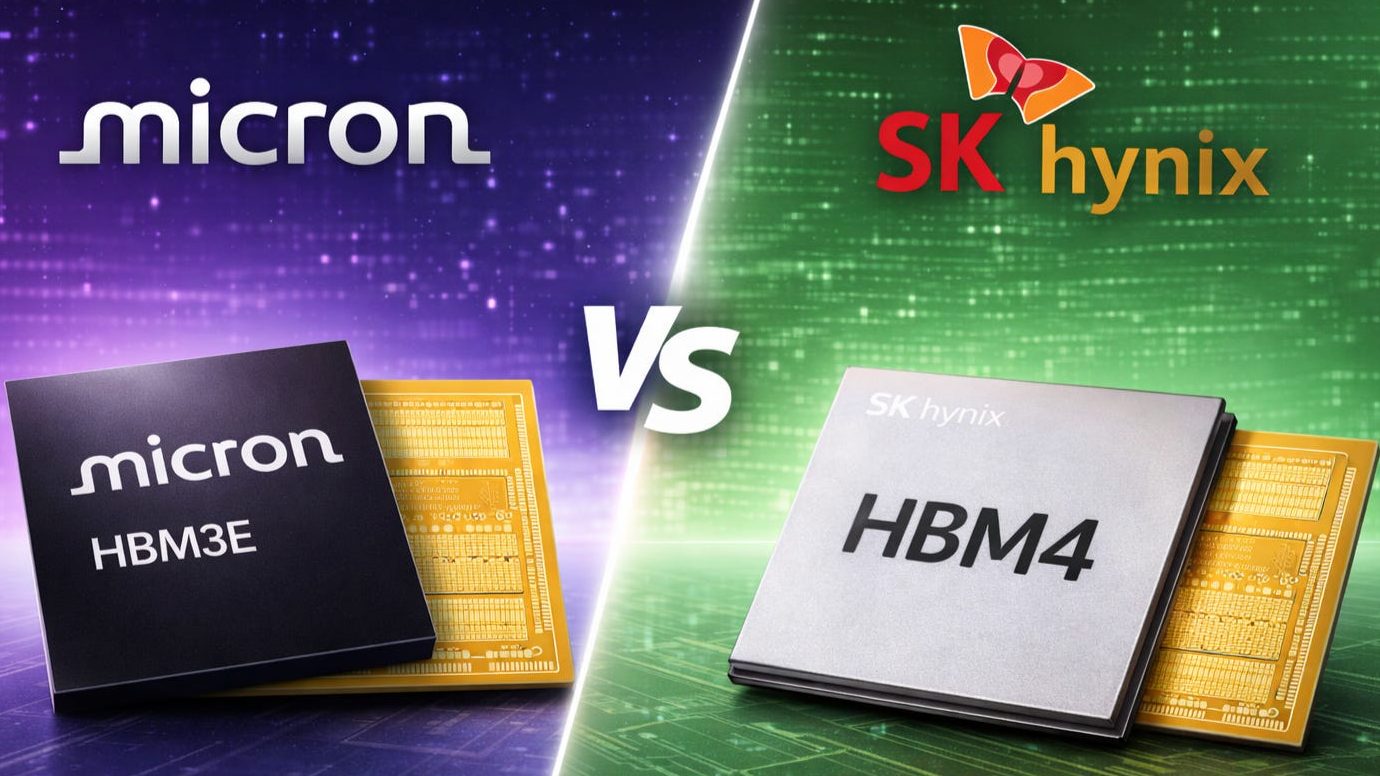
The race to dominate the artificial intelligence (AI) memory market has intensified after SK Hynix’s record-breaking Nasdaq debut, with investors weighing whether the South Korean chipmaker or its US rival, Micron Technology, is better positioned to benefit from the industry’s unprecedented growth.
SK Hynix raised $26.5 billion in its Nasdaq listing on 10 July 2026, marking the largest U.S. stock market debut by a foreign company and the second-largest initial public offering (IPO) in history. The milestone has renewed focus on the competitive landscape for high-bandwidth memory (HBM), a critical component powering AI accelerators.
The debate comes as demand for AI memory continues to outpace supply. UBS forecasts total global memory industry revenue will reach $992 billion in 2026 before climbing to $1.76 trillion in 2027, while the dynamic random-access memory (DRAM) market is expected to remain structurally undersupplied until at least 2028.
Speaking in an interview on 10 July, SK Hynix Chief Executive Officer Kwak Noh-jung said the industry faced severe supply constraints that could persist well into the next decade.

”We forecast that next year will be the worst year in the industry’s history from the supply perspective,” Kwak said, adding that customer demand is expected to exceed production capacity beyond 2030.
SK Hynix currently leads the HBM market with an estimated 56–58% market share in the first quarter of 2026, supported by its long-standing partnership with Nvidia, the world’s leading AI chipmaker.
However, its dominance has narrowed from around 69% a year earlier as Samsung Electronics and Micron expanded their HBM production and advanced next-generation HBM4 technology.
Micron has also posted exceptional financial performance. The company reported fiscal third-quarter 2026 revenue of $41.46 billion, a 346% year-on-year increase, while earnings per share reached $25.11 and gross margin climbed to 84.9%, reflecting robust demand for AI memory products.
Despite SK Hynix’s market leadership, investors continue to assign a higher valuation to Micron. SK Hynix trades at approximately 5.8 times forward earnings, compared with around seven times for Micron.
Analysts attribute the premium to Micron’s U.S. base, which aligns with Washington’s efforts to strengthen domestic semiconductor manufacturing amid growing geopolitical tensions and export controls.
Micron has pledged to invest more than $250 billion in US operations by 2035, targeting domestic production of 40% of its DRAM output.
The company has also announced plans to invest up to $3 billion to strengthen the US semiconductor supply chain, while its New York fabrication facility, backed by more than $6.1 billion in CHIPS Act funding, is expected to become the largest chip manufacturing site in US history.
By contrast, SK Hynix plans to deploy proceeds from its Nasdaq listing to expand production capacity in South Korea, including a new semiconductor fabrication plant, advanced chip packaging facilities and 11.9 trillion won worth of investment in extreme ultraviolet (EUV) lithography equipment.
The company’s close collaboration with Nvidia remains one of its strongest competitive advantages, particularly as it entered the HBM4 qualification process ahead of many rivals.
Both companies, however, acknowledge that manufacturing capacity remains the industry’s biggest challenge.
While SK Hynix expects demand to exceed supply well beyond 2030, Micron’s management has similarly indicated that it has little visibility on when production will catch up with customer requirements.
Investors are now looking ahead to the next set of earnings.
Micron expects to report fiscal fourth-quarter 2026 results in late September and has guided for revenue of about $50 billion and earnings per share of roughly $31. The company also disclosed that 16 long-term customer agreements guarantee a minimum of approximately $100 billion in revenue at agreed floor prices, supported by $22 billion in customer deposits.
Meanwhile, SK Hynix will report its first earnings since its Nasdaq listing on 29 July, with analysts forecasting record operating profit of 63.45 trillion won. Investors will closely monitor its margins and whether its new U.S. listing helps narrow the valuation gap with Micron.
Although both companies stand to benefit from the AI-driven memory boom, SK Hynix offers investors a combination of market leadership, strong ties with Nvidia and a lower valuation. Micron, meanwhile, benefits from its expanding US manufacturing footprint, stronger geopolitical positioning and accelerating earnings momentum.
With demand expected to exceed supply for years to come, the key question for investors is no longer whether the AI memory market will grow, but which company is best placed to capture its long-term rewards.