Starlink leads terrestrial ISPs on throughput in Africa but lags on latency, according to Speedtest Intelligence® data.
Satellite broadband access is spreading across Sub-Saharan Africa (SSA) as Starlink expands into 27 countries and mobile operators show growing interest in partnering with non-terrestrial network providers. While satellite coverage is often cited as a solution for the rural connectivity gap, the technology is primarily used as an alternative to high-speed terrestrial broadband service. Using Starlink as the key reference point, Speedtest Intelligence® data confirms the widening speed gap with terrestrial networks, though local ISPs retain a clear advantage in latency and price. The market is also being shaped by new partnerships and the rise of Direct-to-Device (D2D) technology that enables smartphones to connect to satellites directly.
Key Takeaways:
- Starlink’s throughput has improved substantially over the last two years, but results vary sharply across regions and countries. Speedtest Intelligence® data shows that 16 out of the 23 countries analyzed exceeded 50 Mbps median download speeds in Q1 2026, with only Eswatini, Botswana, and Senegal surpassing 100 Mbps. The Central region experienced the most important improvement, nearing 100 Mbps in Q3 2025, while the East region declined.
- Starlink’s investments in ground infrastructure helped to slash satellite latency, though progress is uneven by country. The deployment of dedicated Points of Presence (PoPs) in Johannesburg and Nairobi has cut latencies by over 80%, enabling Kenya, for example, to achieve the lowest continental latency at 39 ms. Conversely, countries without localized gateways, like DR Congo (127 ms) and Liberia (222 ms), face severe performance penalties.
- Starlink is an important alternative to traditional fixed broadband providers in SSA. It outperforms local ISPs’ median download speeds in almost every market (except Madagascar). However, terrestrial networks remain competitive, often superior, in upload speeds and, crucially, multi-server latency, thanks to the inherent advantages of fiber routing.
- Satellite is a partner for mobile operators, not a rival in Africa. High upfront hardware costs, high-end device requirements, and a lack of indoor coverage prevent satellite internet from posing a competitive threat to traditional mobile providers. Instead, it creates partnership opportunities for mobile backhaul and Direct-to-Device (D2D) connectivity. These agreements enable African operators to close the rural connectivity gap and efficiently monetize new services.
Starlink’s rapid expansion is revolutionizing broadband access across SSA, with an estimated half a million users already connected
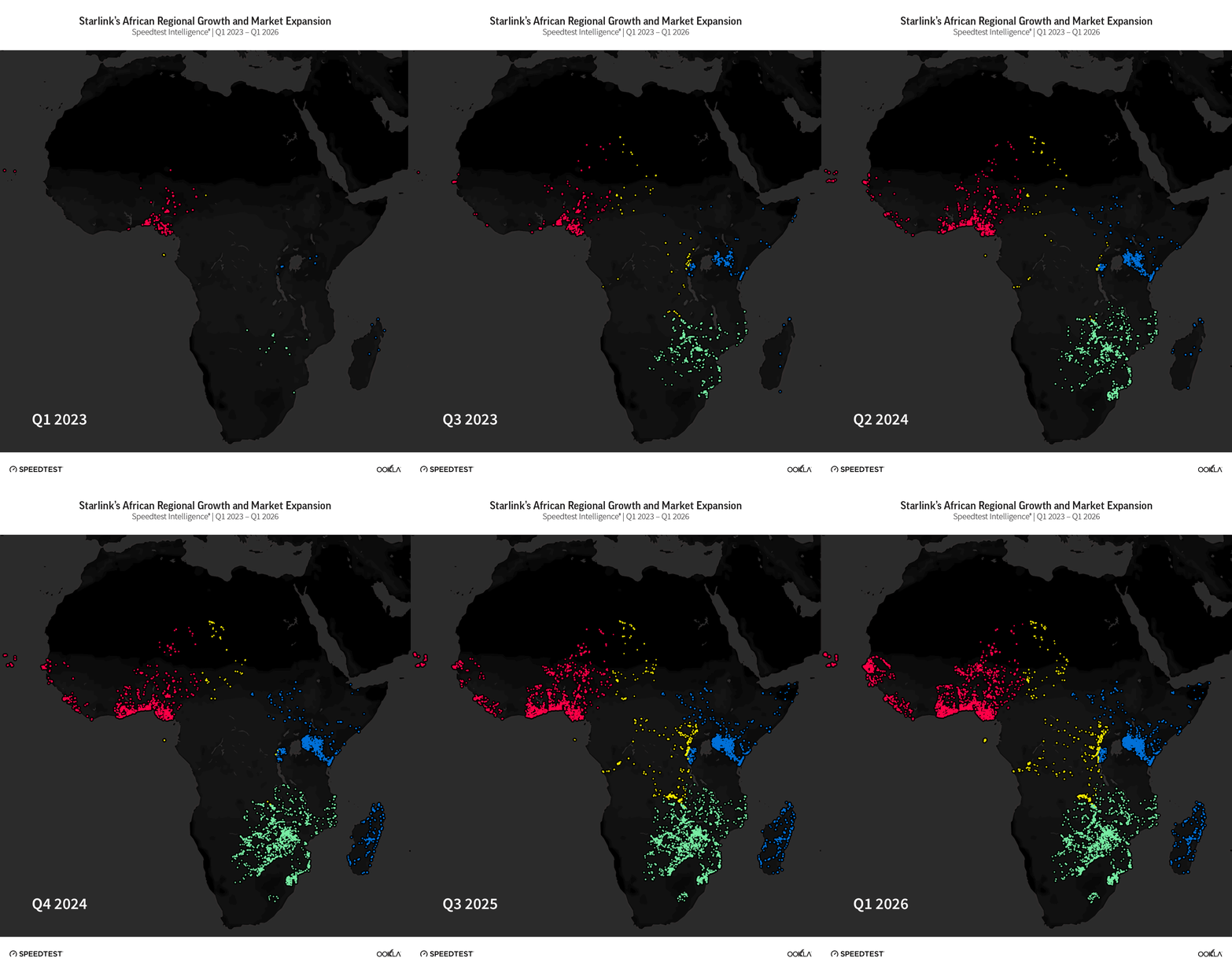
Low Earth Orbit (LEO) satellite technology, pioneered by SpaceX’s Starlink, removes the need to rely on physical terrestrial infrastructure for high-speed connectivity. Starlink expanded rapidly across Africa, starting with Nigeria in February 2023 and Rwanda in March 2023, and is projected to cover 28 countries by June 2026, including Senegal, the Central African Republic, and Uganda. Ookla’s Speedtest data confirms Starlink’s growing geographical and user base expansion. The animation below shows the number of Starlink users who ran Speedtest over a period of 2 years (Q1 2024 and Q1 2026) across the four sub-regions of SSA: West, Central, East, and South.

While Africa represents a smaller segment of Starlink’s global user base, its growth has been significant, reaching an estimated half a million users by the end of 2025, out of around 10 million globally, with the Americas and Asia leading. Very few telecom regulators publish actual subscriber numbers, such as NCC in Nigeria (66,523 in Q2 2025; Starlink is the second ISP in the market), CA in Kenya (19,470 in September 2025), and RURA in Rwanda (4,489 in Q2 2025). Zimbabwe, which saw Starlink’s launch in September 2024, has experienced the greatest relative growth: the satellite subscriber base reported by the local regulator, POTRAZ, has increased over 17-fold in just 16 months, driven mostly by Starlink.
Satellite Subscribers, Zimbabwe
Demand for Starlink was driven by the unreliability of terrestrial internet infrastructure, as well as a combination of limited throughput, data allowances, and low rural coverage of traditional broadband services. Starlink’s affordability varies widely across Africa compared to traditional broadband. For example, in Ghana and Zimbabwe, Starlink’s monthly plans are cheaper than those provided by ISPs. On the other hand, fiber packages are cheaper than subscribing to Starlink in Nigeria, Kenya, and Rwanda. In addition, the service remains inaccessible to most African households and businesses due to upfront kit costs ranging from US$200 to US$700.

In some countries, Starlink kit costs are subsidized, primarily for schools and public institutions. For example, in Zimbabwe, the government funded the acquisition of thousands of Starlink kits for schools. In the Central African Republic, Starlink donated hundreds of kits for rural schools and health centers. In Kenya, Starlink offered kits’ rental plans starting at US$15 per month, but we understand that this option has been discontinued.
Starlink performance has significantly improved in upload speeds and latency, while there has been some variability in download speed
We evaluate Starlink’s network performance across four SSA sub-regions: Central, East, Southern, and West, as shown below, spanning Q1 2024 through Q1 2026. We excluded Lesotho and São Tomé and Príncipe (both launched in late 2025), the Central African Republic (launched in early 2026), and Uganda (launched in May 2026) due to the small sample size.
Starlink’s ongoing technological improvements, including more precise targeting and more powerful inter-satellite laser links, are designed to boost throughput and responsiveness by bypassing terrestrial bottlenecks. Starlink also deployed regional ground stations, Points of Presence (PoPs), to reduce the number of hops between internet services. Ground stations (and gateways) are terrestrial links between satellites and the wider internet, and help with routing, traffic management, and satellite commands. PoPs serve as internet relays for ground station data, linking up with the public internet through peering at major internet exchange points (IXPs).
The distribution of these assets primarily impacts latency but can also influence download and upload speed indirectly. Placing these assets closer to the user reduces the path length, which is crucial for lowering latency and optimizing traffic routes. While Starlink has not detailed its African terrestrial infrastructure, we understand it has ground stations in at least Nigeria and Mozambique, with plans for Rwanda. It also has three PoPs in Africa (Lagos in Nigeria, Nairobi in Kenya, and Johannesburg in South Africa), which had a visible impact on performance.
Download trends vary considerably by sub-region based on Ookla’s Speedtest data:
- Central region experienced the biggest improvement, peaking at 96.24 Mbps in Q3 2025, before settling at 75.3 Mbps at the end of Q1 2026.
- Southern region has maintained high median speeds since 2025, peaking at 87.5 Mbps in Q3 2025 before a slight correction to 59.58 Mbps, close to its Q2 2024 level.
- East region saw a steady decrease, dropping from 50.67 Mbps in Q1 2024 to 37.39 Mbps by Q1 2026.
- West region was more moderate with stable growth over the last two years to 54.6 Mbps.
Upload speed trends were generally more positive across all regions. The Central and East regions doubled their median values to 14.67 and 17.2 Mbps, respectively, while the Southern region nearly tripled to 18.17 Mbps. The Western region had a strong baseline in Q1 2024 and grew modestly to 15.3 Mbps in Q1 2026.
Historically poor latencies in the Southern and East regions in Q1 2024 were reduced by over 80% by Q1 2026, making them SSA leaders. This was the direct result of the establishment of the two PoPs in South Africa and Kenya. Although the Central region has also had its latency cut by nearly 60% over two years (to 121.35 ms), it remains the highest sub-region. The West region, which already benefited from sub-100 ms latency in early 2024 thanks to the Lagos PoP, maintained a strong position ending Q1 2026 at 66.24 ms.
Starlink’s Performance Trends per Sub-region, Sub-Saharan Africa
A few countries stood out in each region in terms of performance improvements:
- Central: DR Congo saw a near six-fold increase in download speed between Q1 2025 and Q1 2026 to 80.78 Mbps. However, its latency remained relatively stable at around 127 ms.
- East: Most countries experienced download speed degradation, while their upload speed and latency improved. Somalia was an outlier with the highest increase in download and upload speeds in one year, as well as the greatest reduction in multi-server latency, which more than halved from 160 ms to 63 ms. Kenya recorded the lowest latency on the continent, reaching 39 ms in Q1 2026.
- Southern: Eswatini and Botswana led the continent in terms of speed. Eswatini saw download speed jump from 85.8 Mbps to 121.4 Mbps, while Botswana remained relatively stable and high (over 106 Mbps). Both countries also had excellent upload speeds (>24 Mbps) and very low latency (~40-42 ms). Conversely, Zambia and Zimbabwe saw noticeable performance degradation over the year. Their download speed dropped by 22% and 29%, respectively, while having the smallest increase in upload speed year-on-year and trailing their peers in the sub-region. Latency in both markets improved significantly, stabilizing in the upper 60 ms range.
- West: It exhibits the widest disparity in country-level performance. Senegal stood out as the most improved country, with download speed more than doubling to 106.29 Mbps and upload speed increasing by 66% to 18.32 Mbps. Latency decreased more modestly at a rate of 23%. On the other hand, Liberia and Niger saw their download speed drop significantly, while the former had the highest latency in SSA at 222 ms. Nigeria, supported by local PoPs and gateways, remained consistent, with download speeds around 48-49 Mbps, upload speeds around 15 Mbps, and stable low latency near 50 ms.
Standout Starlink Performance, Selected Sub-Saharan Africa
16 out of 23 analyzed countries in Africa had a download speed that exceeded 50 Mbps; only three surpassed 100 Mbps
Starlink’s speed and reliability gains over terrestrial alternatives often justify the premium price, despite the service’s unaffordability for most African households and businesses. Demand has been so strong that Starlink halted sign-ups in some of the biggest cities across Africa, like Abuja and Lagos (Nigeria), Nairobi (Kenya), Lusaka (Zambia), and Harare (Zimbabwe), due to capacity limitations. However, the launch of more and newer satellites (V2 Mini) is helping to alleviate these constraints. V3 satellites, to be launched in late 2026, are expected to provide a 10x increase in downlink capacity per satellite compared to previous generations.
Analyzing Speedtest Intelligence data reveals three distinct tiers based on median download speeds:
- High performers (80+ Mbps). The fastest markets, including Eswatini, Senegal, Somalia, and DR Congo.
- Mid-tier performers (50-80 Mbps): The largest group, comprising 10 countries, including Mozambique, Rwanda, Liberia, and Zambia. This tier is dominated by West Africa and is characterized by stable, average performance.
- Lower performers (Under 50 Mbps). These countries, including Nigeria, Kenya, Zimbabwe, and Madagascar, show signs of bandwidth bottlenecks. This aligns with the heavily populated or highly subscribed countries that forced Starlink to pause sign-ups.
Furthermore, upload and download speeds show a correlation, creating three clusters:
- Leaders: Eswatini and Botswana have the highest combined download and upload performance.
- Mid-tier: A dense group of countries clustered around 50–80 Mbps download and 14–19 Mbps upload.
- Laggards: Markets like Madagascar, Zimbabwe, Kenya, and Niger are constrained in both metrics.
Correlation of Median Upload and Download Speeds for Starlink Services, Select African Countries
Starlink continues to lead over terrestrial ISPs across Africa in terms of download speed, but still generally lags in latency
Last year’s analysis already established that Starlink delivered substantially higher median download speeds than the median for other ISPs across the 14 surveyed markets. This trend continues in the new analysis. Starlink leads in 22 of 23 analyzed markets, offering a multi-fold performance leap in markets with underdeveloped fixed broadband infrastructure. For example, Starlink is nearly nine times faster than local ISPs in Eswatini, and five to six times faster in Guinea-Bissau and Botswana. Madagascar is the only country where local ISPs outperform Starlink, a clear sign of the country’s strong private-sector fiber investment and government focus on rural network expansion. Starlink has a comfortable lead in the countries identified before as having among the highest upload speeds, such as Eswatini, Botswana, Somalia, and Mozambique.
The fixed market is more competitive in upload speeds. Starlink maintains an advantage over local ISPs in 13 out of 23 markets, delivering 21–28 Mbps in Eswatini, Botswana, Somalia, and Mozambique, for example, compared to local ISPs with an upload speed in the 10-18 Mbps range. Terrestrial providers outpace Starlink in the remaining ten, where the use of fiber-to-the-home (FTTH) networks is more prominent. In Zimbabwe, Madagascar, and Ghana, local ISPs’ median upload speeds are three or more times faster than Starlink’s. In the other seven countries, terrestrial speed multipliers range from 1.25 in Cape Verde to nearly two in Sierra Leone.
Latency is the defining factor favoring terrestrial networks. While Starlink trailed local ISPs last year in all markets, Q1 2026 data shows it now leads in six. However, a closer look reveals that the advantage is minimal and reflects the degraded terrestrial infrastructure. For example, Starlink’s 107 ms and 82 ms latencies in Chad and Niger, respectively, beat the local ISPs’ 242 ms and 211 ms. For most markets, terrestrial providers retain the edge, sometimes significantly, like in Sierra Leone and DR Congo: local ISPs deliver latencies below 19 ms, compared to Starlink’s 127–175+ ms, due to a lack of localized satellite ground gateways.
How regulatory openness and partnerships are shaping Africa’s satellite future
Starlink made its first African launches in 2023 and rapidly expanded, but not without regulatory friction. The number of served countries doubled in 2024 then nine more countries were added in 2025. Delays in acquiring operating licenses in some countries led to residents importing equipment from neighboring markets.
South Africa is a case in point where Starlink has attempted to introduce its low-Earth orbit (LEO)satellite services to the market for several years. Starlink has not met the 30% local ownership requirement for service providers, though it has recently stepped up efforts to build public support. In May 2026, the Minister for Communications and Digital Technologies proposed to amend the country’s Electronic Communications Act (ECA) to create alternative licensing routes for international companies, focusing on investment in local skills development rather than equity transfer. Starlink has already pledged at least US$29 million to provide free high-speed internet to 5,000 South African schools and will invest US$120 million to build local infrastructure. Despite this, a 2027 launch remains the likely timeline.
Other regulators show greater flexibility. Uganda, for example, officially granted a license after a turbulent period that included a complete network shutdown on January 1, 2026. Uganda marks Starlink’s 27th African market, establishing a specific regulatory precedent focused on revenue assurance and strict data accountability.
The regained interest in satellite communication compelled established players to sharpen their competitive strategies. For example, Eutelsat announced an aggressive expansion pledge aimed at bringing satellite broadband to an additional two million underserved individuals across SSA by 2030, exploiting multi-orbit fleet capacities to lower wholesale bandwidth pricing for regional ISPs.
Unlocking opportunities through satellite-mobile operator collaboration
The market is also being shaped by new partnerships and the rise of Direct-to-Device (D2D) technology that enables smartphones to connect to satellites directly :
- Airtel Africa partnered with SpaceX to distribute Starlink broadband and offer its D2D service (starting with text and limited data) in uncovered areas across its 14 markets in Africa in 2026.
- Vodafone agreed to use Amazon’s LEO constellation to backhaul on 4G/5G sites in remote areas across Africa, with a Vodacom-led African rollout beginning in 2026. Amazon Leo will be powered by a constellation of more than 3,000 satellites, with an expected commercial launch in a few countries in late 2026 or early 2027.
- Orange signed a multi‑year deal for Eutelsat OneWeb capacity to serve enterprises, governments, and mobile backhaul. Eutelsat OneWeb has a constellation of more than 600 satellites.
- MTN South Africa and Lynk Global, a D2D connectivity provider, conducted a technical trial of a D2D call and SMS in March 02025. MTN’s goal is to complement terrestrial towers with LEO-powered “cell‑tower‑in‑space” to expand network coverage to underserved, rural, and remote areas. Lynk Global has five LEO satellites in operation.
Despite their rapid expansion, satellite communications do not threaten mobile operators because of high hardware costs, D2D device requirements, and poor indoor coverage. As the examples mentioned above show, it opens up opportunities for mobile operators by offering cost-effective backhaul via multi-orbit satellites and expanding service reach into undercovered areas through D2D. Rather than replacing traditional mobile networks, these partnerships allow African operators to cost-effectively bridge the rural connectivity gap, diversify their enterprise offerings, and secure new revenue streams.
Please contact us to learn more about how to use Speedtest Intelligence® to benchmark the performance of satellite communications.