
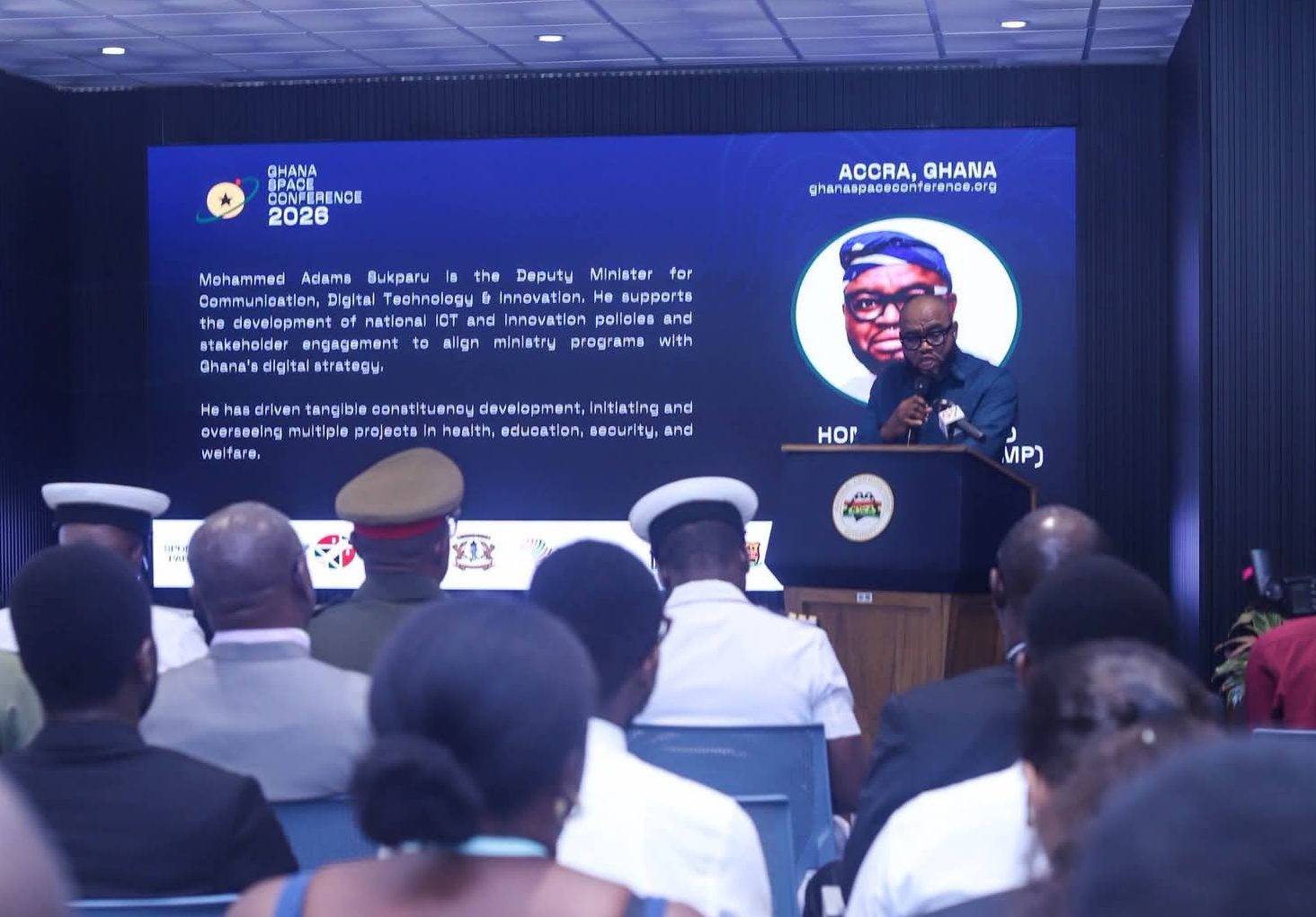
Deputy Minister for Communication, Digital Technology and Innovations, Mohammed Adams Sukparu, has urged Ghana to translate its space technology ambitions into practical solutions to address national development challenges, including agricultural productivity, digital connectivity, environmental protection, national security and climate resilience.
Speaking at the opening of the second Ghana Space Conference 2026 in Accra, Mr Sukparu said the country’s progress in space technology should be measured by its impact on people’s lives rather than policy discussions and ambitions.
Representing President John Dramani Mahama, he called on stakeholders to turn research, policy commitments and international partnerships into measurable outcomes that address the country’s development needs.
The three-day conference, held at the National Communications Authority (NCA) Tower in Airport City, is under the theme, ‘From Vision to Action: Connecting Space Solutions to Ghana’s Greatest Challenges’.

Mr Sukparu highlighted the potential of satellite technology in weather forecasting, agricultural planning, flood monitoring, maritime surveillance and environmental protection. He also identified satellite communications as an important complement to terrestrial telecommunications infrastructure in extending reliable connectivity to underserved communities.
He said satellite technology should help bridge the digital divide by ensuring that children in rural communities have access to the same digital learning opportunities as their counterparts in Accra, while farmers in remote areas benefit from technology-driven services.
He further emphasised the NCA’s role in effective spectrum management to support the sustainable integration of satellite and terrestrial networks.
On building local capacity, the Deputy Minister called for sustained investment in research and development, stronger collaboration between universities and industry, support for local technology companies and skills development.
He said Ghana must develop its own space technology capabilities rather than depend on solutions developed elsewhere.
Mr Sukparu also encouraged young people, particularly women, to explore opportunities in engineering, artificial intelligence, cybersecurity, telecommunications, data analytics, law and entrepreneurship.
He stressed that participation in the space economy extends beyond astronauts to include professionals across several disciplines.
On international cooperation, he called for partnerships that promote technology transfer, research opportunities, investment and local capacity development.
He also urged participants to ensure that the conference produced practical commitments, stronger industry-research partnerships and commercially viable innovations.
He said the proposed Accra Youth Declaration must serve as a framework for measurable action rather than remain a statement of good intentions.
”The success of this conference will not be determined by the number of speeches delivered or presentations made here,” he said before officially declaring the conference open on behalf of the President.
Earlier, the Director of the Ghana Space Science and Technology Institute (GSSTI), Dr Joseph B. Tandoh, stressed the importance of translating space research into practical applications for national development.
He highlighted the institute’s work in radio astronomy, satellite communications, Earth observation and space engineering as a scientific foundation for Ghana’s participation in the global space ecosystem.
The conference comes as Ghana advances plans to transition the GSSTI into a national space agency following Cabinet approval announced in October 2026.
The security implications of space technology also featured prominently, with the Chief of the Naval Staff, Rear Admiral Godwin Livinus Bessing, highlighting its importance to maritime security and national surveillance.
A dedicated session involving representatives of the Ghana Navy, Ghana Air Force and Ghana Armed Forces examined how satellite-based information could strengthen maritime domain awareness and support security operations.
Professor Abdulai Baba Salifu, Chairman of the Board of the Ghana Atomic Energy Commission and former Director-General of the Council for Scientific and Industrial Research, also called for the application of science and technology to national challenges, including illegal mining.
He identified satellite imagery and remote sensing as useful tools in addressing the problem and emphasised the need for coordinated enforcement.
The conference, organised by Spacehubs Africa, the GSSTI and the NCA under the auspices of the Ministry of Environment, Science and Technology, brings together policymakers, scientists, researchers, industry leaders, security officials, academics and young innovators.
Proceedings continue until November 18, with November 17 dedicated to science and entrepreneurship, focusing on research, innovation, commercialisation and satellite technologies.
The final day will focus on youth participation, startups and the development of the Accra Youth Declaration 2026. A technical visits programme is scheduled for November 19.
The event builds on the maiden Ghana Space Conference held in October 2025 at the University of Ghana.
Mr Sukparu reaffirmed the Ministry’s commitment to working with government institutions, academia, industry and international partners to advance Ghana’s space ambitions and ensure that the emerging sector delivers tangible benefits for the country.