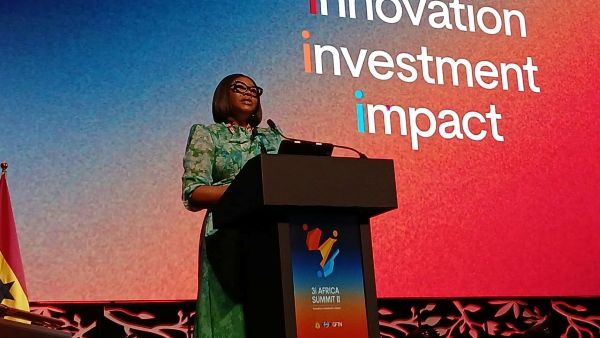
Africa’s financial inclusion progress has been driven not by high-end digital systems but by simple, accessible technologies such as USSD and mobile money platforms designed for everyday realities, Second Deputy Governor of the Bank of Ghana Matilda Asante-Asiedu has said.
Speaking at the 3i Africa Summit 2026 in Accra, Madam Asante-Asiedu said Ghana’s financial inclusion success proves that innovation must be grounded in existing infrastructure and user behaviour, not imported ideal systems.
She noted that anyone can now save and transact using a basic mobile phone without internet access, smartphones, apps or data through USSD technology, describing it as one of the most impactful tools for financial inclusion on the continent.
“For millions of people, that model has done more for financial inclusion than any sophisticated solution,” she said.

Citing the World Bank FinDex report, she highlighted that Ghana has achieved about 81% financial inclusion, attributing much of this progress to the widespread use of USSD-enabled financial services.
Madam Asante-Asiedu explained that Ghana’s approach to digital finance was shaped by practical realities rather than perfect conditions.
She said the country deliberately built systems on existing mobile networks and feature phones, ensuring that ordinary citizens could save, transfer money, insure themselves and make payments using tools already in their hands.
“That decision mattered because people could immediately participate in the financial system,” she said.
She also underscored the importance of agent banking networks, describing them as a core pillar of Ghana’s financial inclusion strategy.
According to her, small-scale agents such as kiosk operators and shop owners are not peripheral actors but essential infrastructure within the financial ecosystem.
“The woman at the roadside or in the kiosk handling cash-in and cash-out is central to inclusion,” she said, adding that regulation must therefore extend beyond innovation to include distribution and trust mechanisms.
A third pillar of Ghana’s progress, she said, is interoperability, the ability of different financial platforms to communicate and transact seamlessly.
She recalled that before interoperability, transferring money across networks was difficult and fragmented, limiting user experience and market efficiency.
With interoperability in place, she said, digital finance has shifted from isolated products to a connected ecosystem that supports broader financial activity.
Madam Asante-Asiedu stressed that Africa’s digital transformation must be built on a clear understanding of local realities rather than imported models.
She said policymakers must consistently ask three key questions: what barriers citizens face, what infrastructure already exists, and what systems can be scaled without excluding anyone.
“Designing for Africa means designing for inclusion from the start,” she said.
She concluded that Ghana’s experience demonstrates how simple, context-driven solutions when combined with strong policy and infrastructure can deliver large-scale financial inclusion and provide a blueprint for the rest of the continent.