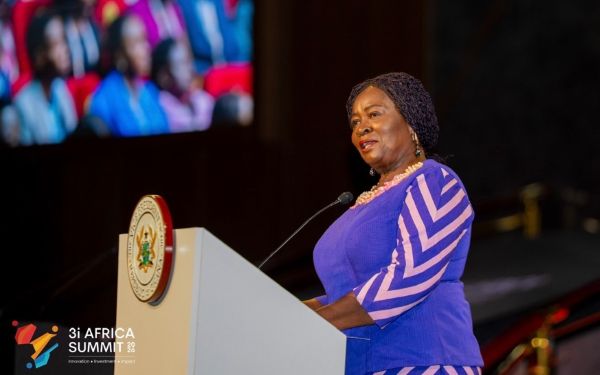
Vice President Jane Naana Opoku-Agyemang has announced that Ghana will collaborate with Rwanda, Zambia and other African countries to implement interoperable digital trade systems, marking a concrete step toward building a unified continental digital economy.
Speaking at the 2026 3i Africa Summit at Makers House, the Vice President said the partnership will focus on turning Africa’s digital integration agenda into practical, working systems across borders.
She explained that the initiative will centre on mobile money interoperability, mutual recognition of digital identity for cross-border verification, and harmonised electronic invoicing key building blocks for seamless trade within Africa.
“These dialogues will be implemented, tested and measured,” she said, stressing that the goal is to ensure integration is not just discussed at high-level forums but demonstrated in real economic activity across countries.

The collaboration aligns with frameworks developed under the African Union, particularly the Digital Trade Protocol, which aims to reduce friction in cross-border transactions through aligned regulations and interoperable systems.
The Vice President noted that Africa’s long-standing challenge has not been a lack of ideas, but the absence of coordinated execution at scale.
“For decades, Africa has been described as a frontier,” she said. “What matters now is how we organise ourselves to compete, integrate and build at scale.”
She emphasised that Ghana’s role as a gateway to Africa must be backed by systems that work efficiently—where transactions clear quickly, businesses connect seamlessly, and markets operate with certainty. Ghana’s hosting of the African Continental Free Trade Area Secretariat, she added, places it at the centre of this transformation.A major concern highlighted in her address was the continued reliance on external financial systems for intra-African trade, with many transactions routed outside the continent and denominated in foreign currencies.
She pointed to platforms like the Pan-African Payment and Settlement System as critical to enabling faster and more cost-effective payments within Africa.
“The objective is for a Ghanaian enterprise to invoice clients across Africa and receive payment directly, efficiently and at a reasonable cost,” she said.
The Vice President stressed that digital integration must be anchored on five pillars: payments, identity, regulation, infrastructure, and investment.
She warned that without interoperable identity systems, millions of Africans will remain excluded from formal economic participation, limiting the continent’s ability to scale trade and innovation.
She also highlighted the risks of fragmented regulatory environments and limited digital infrastructure, noting that Africa’s low share of global data centre capacity undermines both performance and control over its digital economy.
According to her, the systems being developed through Ghana’s collaboration with Rwanda, Zambia and other partners will determine whether Africa participates in the global digital economy on its own terms.
“If our data is stored and processed elsewhere, then even when we participate, we lack control,” she cautioned.
She added that Africa’s growing population and rapid adoption of technology present a unique opportunity to shape the next phase of global digital growth, particularly in sectors such as agriculture, health, education, and public service delivery.
The Vice President concluded by underscoring that integration will only succeed if systems work consistently across borders and at scale.
“The work before us is what we know we can do,” she said, urging governments, regulators, and private sector players to move from policy discussions to implementation.
Her announcement signals a shift from ambition to action, positioning Ghana and its partners at the forefront of efforts to build a truly integrated African digital economy.