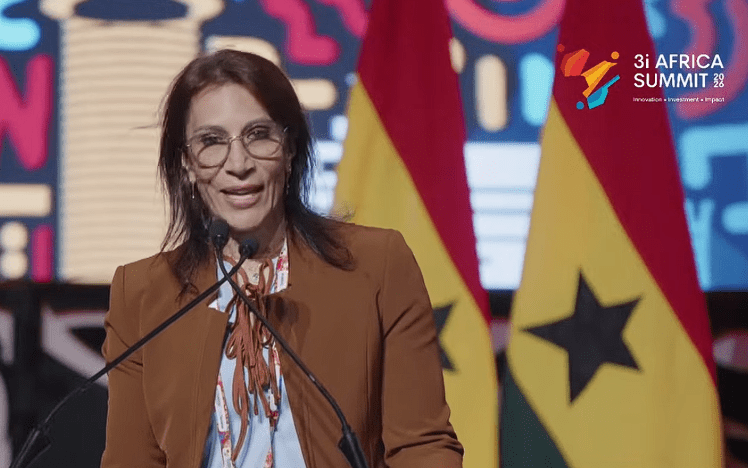
Africa risks missing out on a multi-billion-dollar artificial intelligence opportunity unless it urgently strengthens digital skills, regulatory readiness and innovation infrastructure, CEO of GFTN Solutions Maha El Dimachki has cautioned.
Speaking at the 3i Africa Summit 2026 in Accra, El Dimachki said Africa’s track record in financial innovation, particularly mobile money and agent banking, has already made the continent a global reference point for inclusive digital finance.
She noted that Africa now drives 66% of global mobile money transaction value, with Sub-Saharan Africa leading globally in mobile money adoption, proving that the continent is capable of scaling innovation at speed and impact.
However, she warned that the next wave of transformation driven by artificial intelligence will not automatically deliver similar success without deliberate investment in skills and systems.

El Dimachki highlighted projections from the African Development Bank indicating that AI could contribute up to $1 trillion to Africa’s economy by 2035, while also generating as many as 40 million jobs and significantly boosting GDP growth.
Even conservative estimates, she said, suggest at least $250 billion in added economic value, underscoring the scale of the opportunity.
She added that AI is already beginning to transform sectors such as healthcare, manufacturing, agriculture and financial services, with early deployments in Ghana including AI-powered identity systems and payment solutions tailored to local needs.
Despite these advances, she cautioned that AI development in Africa remains highly uneven.
Citing global indicators, she noted that Sub-Saharan Africa currently records the lowest average digital skills levels, while other regions continue to lag behind global benchmarks in readiness for advanced technologies.
According to her, challenges such as weak infrastructure, fragmented governance frameworks and persistent skills shortages continue to slow adoption at scale.
“This is not the full story, but it is a reality we must address,” she said.
To close the gap, El Dimachki outlined three key priorities:
1. Smarter regulation for innovation
She called on policymakers to ensure that regulatory frameworks enable rather than restrict innovation while maintaining a balance between risk management and market growth.
She referenced ongoing efforts to develop the Fintech Regulatory Features Index, which will help countries assess their readiness for digital financial innovation and benchmark themselves against global standards.
2. Stronger infrastructure and experimentation spaces
She emphasised that Africa must invest beyond physical infrastructure to include governance systems, regulatory sandboxes, and public-private partnerships that allow safe experimentation with emerging technologies.
Innovation hubs and incubators, she said, are critical to accelerating responsible digital transformation.
3. Urgent investment in skills and capacity
El Dimachki stressed that AI systems require human oversight and domain expertise to function effectively.
She warned against over-reliance on automation, noting that understanding model limitations, biases and risks is essential to responsible deployment.
“Technology only works when combined with human expertise,” she said.
She cautioned that Africa must move beyond excitement around AI and focus on execution, stressing that success will depend on whether governments and industry can translate potential into practical outcomes.
“Every model has limits. We must know when to trust the machine and when human judgement must lead,” she said.
Maha El Dimachki concluded that Africa is at a defining moment where innovation, investment and impact must converge.
She called for stronger collaboration between governments, regulators, private sector players and academia to turn technological potential into real economic transformation.
“This is Africa’s moment to innovate, invest and implement,” she said, adding that institutions like the Bank of Ghana and the Ghana Interbank Payment and Settlement Systems are already playing a critical role in advancing the continent’s digital finance agenda.