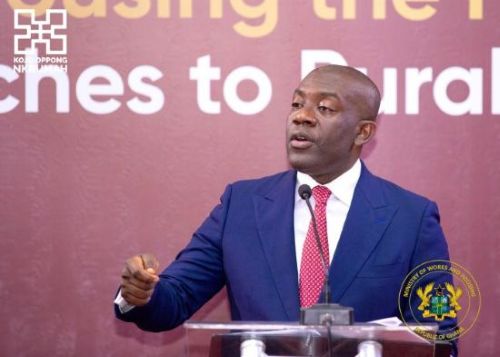
Former Information Minister and Member of Parliament for Ofoase Ayirebi, Kojo Oppong Nkrumah, has challenged the government’s assertion that it has significantly reduced the cost of running the state by appointing fewer ministers.
According to Mr Oppong Nkrumah, while the National Democratic Congress (NDC) administration has repeatedly highlighted its reduced ministerial appointments as evidence of fiscal prudence, a substantial number of senior party figures who were not appointed ministers have instead been assigned to newly created Deputy Ambassador and Deputy High Commissioner positions abroad.
He argued that rather than eliminating expenditure, the government may have merely shifted costs from one section of the national budget to another.
Mr Oppong Nkrumah disclosed that he filed a Right to Information (RTI) request in January 2026 seeking details of the remuneration and benefits attached to deputy heads of Ghana’s diplomatic missions. He stated that the Ministry of Foreign Affairs responded in June 2026 following what he described as a prolonged delay.

Citing information provided by the Ministry under Case No. RTIC/AFR/25/2026, the Ofoase Ayirebi MP said every Deputy Ambassador or Deputy High Commissioner receives a standard monthly basic salary of US$3,639.58 and a clothing allowance of US$150.
According to his calculations, these two allowances alone amount to approximately US$45,475 annually for each officer, equivalent to about GH¢537,000 per year.
The Ministry also reportedly confirmed additional benefits, including a child allowance of up to US$600 per month for up to three children under the age of 18, an education grant of US$1,750 per quarter, and a warm clothing allowance for officers serving in temperate countries.
Mr Oppong Nkrumah further noted that the Ministry acknowledged the existence of other benefits but did not provide their monetary value. These include foreign service allowances, fully furnished official residences, official vehicles with drivers, fuel and maintenance costs, comprehensive medical cover for officers and their families, as well as domestic staff support.
Based on the figures disclosed, he estimated that the 18 new Deputy Head of Mission positions created by the government could cost taxpayers approximately GH¢9.7 million annually at a minimum, considering only basic salaries and clothing allowances.
He projected that the annual cost could rise to about GH¢12.9 million when additional cash allowances are included, and as much as GH¢25.6 million when accounting for housing, transport, medical benefits, foreign service allowances and other associated costs.
Mr Oppong Nkrumah stressed that these costs are recurring and exclude relocation and establishment expenses incurred when officers assume their posts abroad.
He therefore questioned whether the government’s overall expenditure on political appointments had genuinely declined.
”If the people are largely the same, and the cost is higher than that of a minister, can we honestly say the cost of government has come down? Or has it simply been moved from the Cabinet table to our missions abroad?” he asked.
The government has consistently maintained that reducing the number of ministers and deputy ministers forms part of its broader strategy to streamline governance and reduce public expenditure.
The Ministry of Foreign Affairs has not yet publicly responded to Mr Oppong Nkrumah’s latest claims regarding the cost implications of the deputy diplomatic appointments.