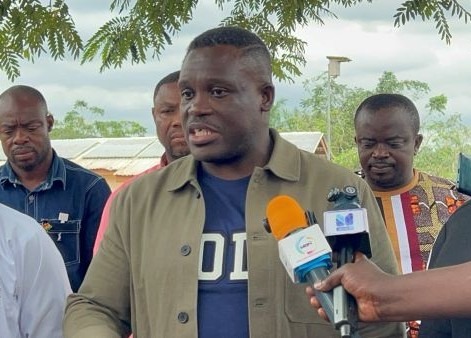
The Minister of Communication, Digital Technology and Innovations, Sam Nartey George, has inspected selected Rural Telephony Project (RTP) sites in the Eastern Region as part of efforts to address persistent network and internet connectivity challenges in underserved communities.
The inspection, undertaken in collaboration with the National Communications Authority (NCA) and the Ghana Investment Fund for Electronic Communications (GIFEC), followed several complaints from residents about poor mobile network and internet services.
The team visited communities including Dwupong-Akwapem, Nkumkrom, Nsatse and Obosono to assess the condition of existing telecommunications infrastructure, engage residents and examine possible interventions to improve connectivity.
Speaking to the media after the exercise, Mr George said the Ministry was reviewing the Rural Telephony Project with a new approach aimed at ensuring that rural communities benefit from modern and reliable telecommunications services.

He acknowledged the contributions of his predecessors, including the late Edwin Omane Boamah, Haruna Iddrisu and Ursula Owusu-Ekuful, to the development of the Rural Telephony Project.
However, he said the current administration had a different outlook for the project and was conducting an assessment of the existing infrastructure to determine the best way to improve connectivity.
According to him, the findings from the inspection would inform discussions with Cabinet and guide government decisions on investment in rural telecommunications.
Mr George said Ghana could no longer continue relying on outdated telecommunications technologies in rural communities at a time when the world was moving towards 5G.
He stressed that rural communities should, at the very least, have access to 4G connectivity.
He said existing mast and donor sites were largely capable of supporting 4G, with the main requirement being the replacement or upgrading of radio equipment at some Rural Telephony Project sites.
The minister said the country must make a deliberate decision to invest in telecommunications infrastructure and upgrade rural telephony sites to a minimum of 4G while making them ready for future 5G deployment.
He argued that reliable connectivity should be treated as an essential component of national development, just as the government invests in roads and other social infrastructure.
Mr George also disclosed that he had issued a policy directive to the NCA to address challenges that make telecommunications services more expensive for users in rural telephony areas.
He explained that under the existing arrangement, customers could lose access to their regular data bundles when they moved into some rural telephony coverage areas, forcing them to pay separately for services.
He said the NCA was therefore working with telecommunications operators to undertake the necessary technical integrations to allow customers to use their existing data bundles when connected to rural telephony sites.
The minister further disclosed that the government was working with telecommunications operators to significantly increase the number of new cell sites being constructed across the country.
He said Ghana had recorded relatively low levels of new telecommunications infrastructure development over the past decade, with some years between 2015 and 2025 recording as few as 40 new masts.
He said the country had averaged about 210 new sites annually over the period.
Mr George, however, said the situation was changing, with MTN expected to construct about 800 sites in 2026, while Telecel was expected to add approximately 350 sites.
He said nearly 180 new sites had already been completed at the time of the latest assessment.
The minister expressed optimism that about 400 of MTN’s targeted 800 sites would be completed by the end of 2026, with the remaining sites expected to be operational by the first or second quarter of 2027.
He was accompanied during the inspection by officials from the NCA, GIFEC and the telecommunications industry, including the Chief Technical Officer of MTN.
Mr George said the expansion and modernisation of telecommunications infrastructure would help improve network coverage, internet access and digital inclusion, particularly for communities that have historically struggled with reliable connectivity.
He reiterated the government’s commitment to ensuring that rural communities are not left behind in Ghana’s digital transformation and that access to reliable telecommunications services becomes available to more citizens across the country.