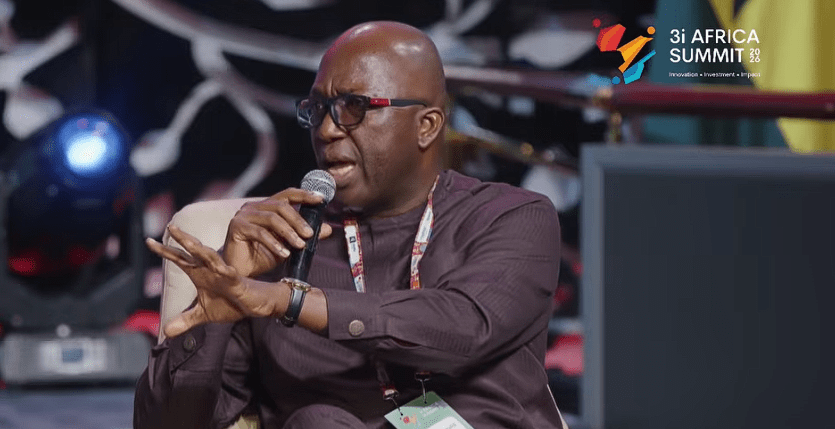
Ghana’s digital finance transformation must shift from fragmented innovation to building interconnected “big pipes” that drive exponential growth, Chief Executive Officer of Mobile Money Fintech Limited, Haruna Shaibu, has said, urging industry players to prioritise interoperability and customer-focused solutions over duplicative platforms.
Speaking at the 3i Africa Summit 2026 in Accra, the CEO outlined a strategic vision for fintech development centred on leapfrogging moving beyond incremental progress to achieve exponential impact.
He cautioned that the introduction of new technologies often leads to duplication rather than transformation, drawing parallels with the early days of the internet when businesses rushed to replicate the same models, such as internet cafés, ultimately cannibalising each other.
“The key question is whether we are growing incrementally or exponentially,” he said, stressing that true leapfrogging requires deliberate system design rather than reactive innovation.

Using infrastructure as a metaphor, Shaibu likened digital finance ecosystems to road networks and pipelines. He explained that sustainable growth depends on building strong “main arteries” or foundational systems, and then connecting smaller “feeders” to create a unified and scalable ecosystem.
In this context, he described interoperable payment systems and mobile money platforms as the “plumbing” of the digital economy—critical infrastructure that must be interconnected across markets rather than operating in silos.
“You don’t want one mobile money system that everyone depends on in isolation. You need big pipes connected to other big pipes, creating a universal ecosystem that allows seamless transactions across borders,” he said.
He noted that while the industry, in collaboration with regulators like the Bank of Ghana, has made significant progress in building foundational infrastructure, the next phase must focus on scaling and integration.
According to him, the biggest opportunity now lies not in building more standalone solutions but in connecting existing systems to deliver resilience, efficiency, and lower costs for customers.
Shaibu emphasised that innovation should increasingly shift to the customer level—where services are delivered—rather than duplicating core infrastructure.
“Sometimes it feels like everyone is crowding into the same space, forgetting that the bigger opportunity is in how we connect and serve the customer better,” he said.
Beyond infrastructure, he highlighted data as the “new currency” in fintech, playing a crucial role in credit scoring, customer experience, and fraud prevention. He explained that the ability to capture and responsibly use customer data—digital footprints will define the next phase of competition in the sector.
He pointed to a growing shift from rule-based fraud detection systems to behavioural analytics, enabling fintech firms to predict and prevent fraudulent activities before they occur.
“Trust is the biggest asset in fintech. Customers will only adopt systems that are reliable and secure,” he added.
On regulation, Shaibu welcomed reforms by the Bank of Ghana, particularly around open banking, describing openness as essential for building scalable platforms. While acknowledging potential commercial trade-offs, he argued that an open ecosystem ultimately benefits the broader industry.
“If you want to build big pipes, you must be open enough to accommodate others. It’s about thinking beyond individual gains to ecosystem impact,” he noted.
Touching on emerging technologies, he said artificial intelligence will play a transformative role in fintech, though its most impactful applications are still evolving. He highlighted both the opportunities such as improved customer insights and risks, including deepfake-related fraud, stressing the need for responsible adoption.
Shaibu concluded that Ghana’s digital finance sector stands at a critical juncture, where the focus must move from building isolated innovations to creating interconnected systems that deliver scale, trust, and real economic value.
“The future is not about more pipes it’s about turning those pipes into a fully connected system that works for everyone,” he said.