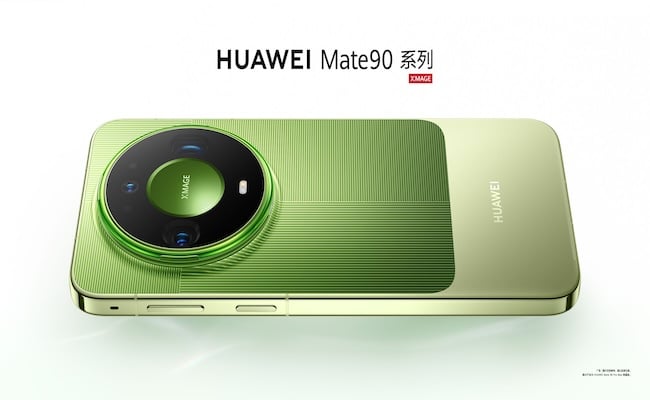
Huawei has unveiled its Mate 90 smartphone series, highlighting a new in-house chip architecture developed as the Chinese technology company continues to face restrictions on access to advanced semiconductor technologies.
The Mate 90 range comprises four models running on Huawei’s HarmonyOS 7, which the company said supports more than 450,000 apps and services.
Prices start at CNY5,999 ($895) for the standard Mate 90, while the Mate 90 RS Ultimate Design is priced at CNY12,999.
Huawei’s premium Mate 90 models feature the Kirin 9050 Pro chipset, which the company claims delivers a 31 per cent performance improvement over the previous generation.

The chipset also incorporates Huawei’s LogicFolding technology, which restructures chip wiring vertically to allow for denser processing, shorter critical paths and reduced latency.
Speaking at a briefing, Huawei Executive Director and Consumer Business Chief Richard Yu said the company developed LogicFolding in response to restrictions on access to advanced semiconductor manufacturing technologies.
“Our LogicFolding technology is just an approach we adopt to improve our capabilities when our access to certain technology is restricted,” Yu said.
He said China’s capacity to produce advanced semiconductors remained limited, while production capacity for semiconductors and smartphones was also under pressure.
Yu attributed the pressure partly to sharp increases in memory component prices over the past two years.
He disclosed that rising component costs had added more than $200 to the cost of each handset, putting pressure on Huawei’s margins.
“Moving forward, we will have to increase our prices, too,” he said.