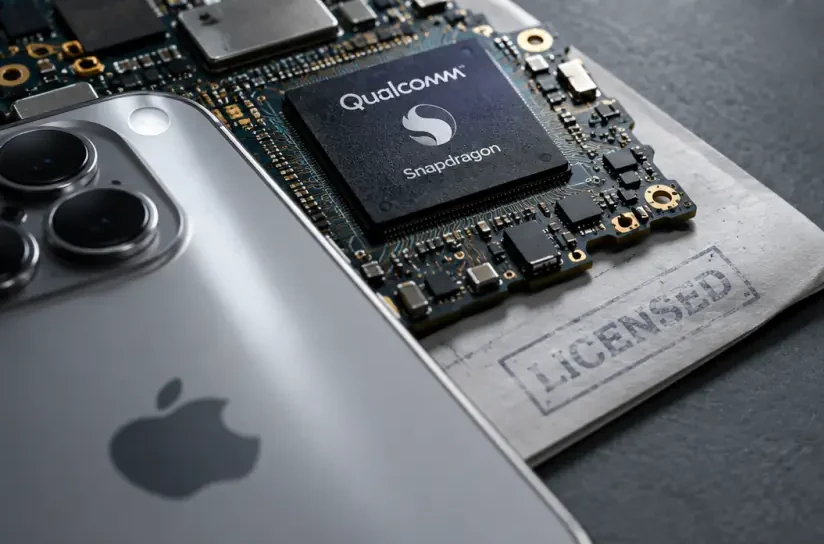
Qualcomm has renewed its global licensing agreement with Apple, securing continued licensing revenue from the iPhone maker from 1 April 2027.
The agreement, announced on 24 September, does not specify its duration, but Qualcomm said it was pleased to extend the arrangement.
“We are pleased to extend the Apple license agreement,” said John Han, Executive Vice President and General Manager of Qualcomm Technology Licensing.
Apple is Qualcomm’s biggest customer, accounting for more than a fifth of the chipmaker’s revenue, according to Bloomberg. The companies are also dealing with challenges linked to a global shortage of memory chips.

The renewed agreement comes as Apple continues efforts to reduce its reliance on Qualcomm hardware by developing its own silicon.
Apple’s iPhone Duo and iPhone 18 Pro smartphones feature the company’s custom C2 cellular modem, while the iPhone 18 Pro Max uses a Qualcomm Snapdragon 5G modem in the US.
Qualcomm’s handset chip business has faced pressure amid weaker smartphone demand and uncertainty over memory supplies. In its most recent results, the company reported that handset chip sales fell 20% to $5.1 billion.
Qualcomm Chief Executive Cristiano Amon attributed the decline to the China market reaching a bottom after original equipment manufacturers reduced orders amid uncertainty over memory supplies.
Paolo Pescatore, chief analyst at PP Foresight, told Mobile World Live that the renewed arrangement was significant for Qualcomm and highlighted the continuing value of its patent portfolio.
“Apple may be steadily reducing its reliance on Qualcomm hardware as it develops more of its own modem technology, but it still needs access to Qualcomm’s fundamental wireless intellectual property,” he said.
“For Apple, it removes a potentially significant area of uncertainty as it takes greater control of the underlying technology inside its devices.”
Mr Pescatore added that the agreement should not be interpreted as Apple abandoning its efforts to develop its own modem technology.
“Licensing Qualcomm’s patents and buying Qualcomm chips are two very different things,” he said.
Meanwhile, T-Mobile is deploying an AI and machine-learning system called AutoPilot to automate network optimisation and support the deployment of 5G-Advanced capabilities across its US network.
T-Mobile said AutoPilot is not itself a 5G-Advanced feature but adds AI and machine-learning automation to its self-organising network (SON).
The system allows engineers to set objectives, such as maintaining coverage or protecting network capacity, while AutoPilot determines which network parameters need to be changed.
Recent tests by T-Mobile showed that AutoPilot made real-time adjustments in about half the time required by its previous automated process.
During site outages caused by damage or power failures, the system can adjust antenna tilt and radio-frequency output at nearby sites to help maintain coverage while repair crews work on affected locations.
T-Mobile cited Winter Storm Fern as an example of the underlying SON technology, saying power-management changes helped conserve backup battery capacity and kept sites online for more than 250,000 additional minutes across more than 30 states.
The operator said AutoPilot is being rolled out across the US and is expected to be available nationwide by the end of 2026.