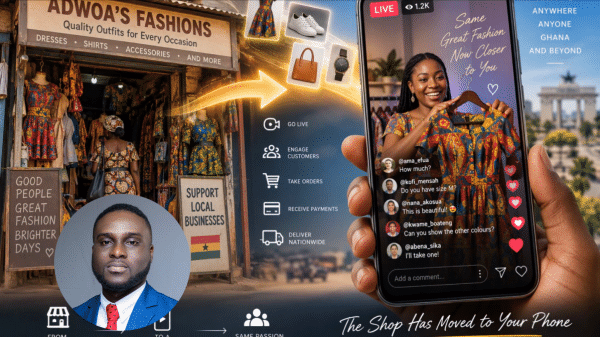
There was a time when starting a business meant finding a good location, renting a shop, putting up a signboard, printing flyers, and hoping customers would walk through the door. Advertising meant paying for billboards, radio jingles, television commercials, or newspaper space. Businesses spent significant amounts trying to get the attention of potential customers.
Today, something fundamentally different is happening.
A fashion retailer can wake up, switch on TikTok LIVE, showcase 30 outfits, answer questions, negotiate prices, demonstrate products and receive orders without owning a traditional showroom. A restaurant can broadcast its kitchen, showcase its meals and take orders in real time. A beauty entrepreneur can demonstrate a product, answer questions about its ingredients, address customer concerns and convert viewers into paying customers, all within a single live session.
And perhaps the most interesting part? The customer doesn’t necessarily have to leave the c omfort of their home to experience the business. The shop has moved to the phone. And the salesperson is now a content creator.

From traditional advertising to real-time commerce
Social media has fundamentally changed the relationship between businesses and their customers. Previously, advertising was largely a one-way communication process. Businesses created advertisements, pushed them to audiences and hoped that the message would generate interest.
Today, platforms such as TikTok, Instagram, Facebook and YouTube have transformed advertising into an interactive experience. Customers no longer have to wait for an advertisement to end before asking questions. They can comment, request demonstrations, compare products, negotiate, receive recommendations and make purchasing decisions while the business is still broadcasting. This is a significant shift from traditional marketing to what is increasingly known as social commerce.
According to DataReportal’s Digital 2025 Global Overview, the world had approximately 5.24 billion active social media user identities. Its Ghana report also estimated 7.95 million social media user identities in the country at the beginning of 2025. These numbers represent more than an audience. They represent a marketplace.

TikTok LIVE: The new digital storefront
One of the most fascinating developments is the growing use of live streaming as a sales and customer acquisition channel. Walk through TikTok today and you will find businesses selling almost everything imaginable.
Clothing vendors are modelling outfits live. Electronics dealers are demonstrating gadgets. Food businesses are showcasing meals. Car dealers are walking prospective buyers around vehicles. Even small businesses that previously depended entirely on word-of-mouth referrals are building audiences online. The traditional distinction between advertising, customer engagement and selling is becoming increasingly blurred.
A single live session can perform the functions of:
* A television advertisement.
* A product exhibition.
* A customer service desk.
* A sales representative.
* A product demonstration.
* A customer feedback platform.
TikTok’s UK LIVE Shopping Report, published in November 2026, offers an interesting illustration of this shift. According to the report, 61% of surveyed small and medium-sized businesses said one LIVE Shopping session generated more revenue than other channels typically generated in a week. Additionally, 92% said LIVE Shopping helped them reach customers they would not otherwise have reached. Although these findings relate to the UK market, they demonstrate the commercial potential of a model that businesses in other markets can learn from.
The real disruption is not advertising. It is the business model.
I believe the bigger story here is not simply that businesses are becoming more active on social media.
It is that social media is changing how businesses are established, operated, marketed and scaled.
Consider what this means for a small entrepreneur in Ghana.
A business owner can potentially start selling without immediately committing to expensive retail premises. They can build a customer base through consistent content, use live sessions to demonstrate products, receive orders through messaging platforms and facilitate payments through digital financial services.
This changes the economics of starting and growing a business.
It also creates new business models around content creation, influencer marketing, affiliate selling, digital storefronts and live commerce. However, visibility alone does not guarantee commercial success.
A business may attract thousands of viewers but still struggle to convert that attention into revenue. The real opportunity lies in connecting the entire customer journey: discovery, engagement, trust, ordering, payment, fulfilment and after-sales support.
Where financial services and digital transformation come in
This is where I find the development particularly interesting from a financial services and digital transformation perspective. As businesses migrate towards social commerce, the underlying financial infrastructure must evolve alongside them.
Think about the journey of a customer who discovers a product on TikTok. They ask a question, agree on a price, place an order and proceed to make payment. Behind that seemingly simple transaction are several important capabilities:
1. Digital payments and payment interoperability
Customers expect convenient, secure and seamless ways to pay. Mobile money, cards, bank transfers and digital wallets must support increasingly diverse payment journeys.
2. Trust, security and fraud management
How does a customer know that the vendor is legitimate? How does the business protect itself against fraudulent payments, impersonation and disputed transactions?
3. Customer experience and operational efficiency
Businesses must be able to manage orders, reconcile payments, track deliveries, handle complaints and maintain customer relationships without creating operational bottlenecks.
4. Data and analytics
Social platforms generate valuable insights into customer behaviour, product preferences, engagement patterns and purchasing trends. Businesses that can translate this information into better decisions will have a competitive advantage.
5. Scalable digital infrastructure
As transaction volumes increase, the systems supporting payments, customer management and business operations must be reliable, secure and scalable.
In other words, social commerce is not just a marketing conversation. It is also a conversation about payments infrastructure, digital banking, technology integration, operational resilience and financial inclusion.
The opportunity for Ghanaian businesses
Ghana is particularly interesting in this conversation. With millions of people accessing the internet and engaging with social platforms, there is an opportunity for local businesses to rethink how they reach customers. Our fashion retailers, food vendors, beauty entrepreneurs, electronics dealers and other SMEs do not necessarily need to compete with large businesses on advertising budgets. They can compete through creativity, authenticity, customer relationships and the intelligent use of technology. But there is still work to be done.
We need stronger connections between social commerce and formal digital payment channels. We need greater consumer protection, improved digital trust, better fulfilment capabilities and increased digital literacy among small business owners.
The financial services industry also has an opportunity to go beyond providing payment channels and develop solutions that support the broader needs of digitally enabled businesses.
What should businesses be thinking about?
I believe there are five important considerations for businesses navigating this shift:
1. Stop treating social media as an afterthought. It should be part of the wider business and customer acquisition strategy.
2. Sell experiences, not just products. Customers increasingly want to see, understand, question and trust what they are buying.
3. Invest in the transaction journey. Getting a customer’s attention is one thing; making it easy and safe for them to pay and receive their order is another.
4. Use data to make decisions. Views and likes are useful, but conversion rates, repeat purchases, customer retention and profitability are more meaningful business indicators.
5. Build trust as a competitive advantage. In a marketplace where almost anyone can open a digital storefront, credibility and consistent service will distinguish sustainable businesses from temporary online sensations.
My biggest takeaway
The future of business may not be determined solely by who has the biggest shop, the most expensive billboard or the largest advertising budget.
It may increasingly be determined by who understands their customers, captures their attention, earns their trust and provides the most seamless experience from discovery to payment and delivery.
We are witnessing the convergence of marketing, technology, commerce and financial services.
And while TikTok LIVE may look like people simply going online to sell clothes, food, gadgets and other products, there is a much bigger business transformation taking place beneath the surface.
The question for business leaders is no longer whether social media belongs in their business strategy. The question is whether their business model, technology and operational capabilities are evolving quickly enough to take advantage of it.
Because the next big retail revolution may not require another shopping mall. It may only require a smartphone, a reliable digital payment infrastructure and a business that understands how to turn attention into value.
#DigitalTransformation #SocialCommerce #Fintech #DigitalPayments #BusinessInnovation #BankingTransformation #Technology #TikTok #Ghana