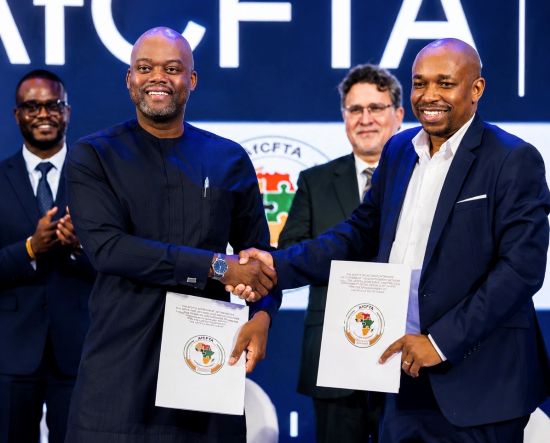
The Africa Continental Free Trade Area (AfCFTA) Secretariat and leading cutting-edge technologies solutions provider, Quest Ghana have signed a historic agreement to build Africa’s biggest and first-of-kind digital trade platform called the AfCTA Digital Trade Corridor (ADTC).
The platform, estimated to cost US$5.1 billion of private sector funds, will be located in Seychelles Island, but remain the on-stop-shop online trading platform where large scale, small and medium scales importers, exporters, wholesalers, retailers, service providers, and even individual sellers and buyers across Africa will have access to each other in a safe and secure ecosystem.
It will also be a place where cross-border payments will, for the first time, be made at scale directly from one African currency to the other, without first being converted into some foreign hard currency, usually the dollar, which often make the cost of such transfers very high.

Speaking at the signing in Accra, Secretary-General of AfCFTA, Wamkele Mene said that AfCFTA Secretariat’s main mandate is to facilitate and grow intra-Africa trade by finding ways to bridge the borders between African states through digitalization, adding that it was for that very reason that the secretariat is partnering with Quest Ghana to rollout the ADTC.

He noted that currently, intra-African trade is only 10% and is worth about US$220 billion. But the World Bank estimates Africa’s digital economy to be worth US$720 million, which means there is a US$500 billion opportunity waiting to be tapped, and that is what the ADTC aims to take advantage of.
“This is the first of its kind in the world and it presents an enormous opportunity for the private sector – from large corporates to MSMES (micro-small and medium-scale enterprise) and even whole countries to participate fully in and benefit immensely from the digital economy,” he said.
He is confident that once the ADTC is rolled out, it will help to grow the value of intra-Africa trade from the current US$220 billion to about US$500 billion by 2035, adding that “this will put Africa in a position where we are no more price takers but determinants of the prices of our own resources.”
No apologies for breaking the world economic order
“ADTC presents the biggest opportunity for Africa to change the world economic order imposed on us – and we do not have to apologize for taking that step because that has always been the mandate of AfCFTA and the heads of African countries who put me in this position are very clear in their minds about that,” the AfCFTA Secretary-General stated.
Wamkele Mene believes that with massive success of African digital innovations like mobile money, the continent has proven beyond every reasonable doubt that it has what it takes to takes to achieve the 2035 intra-Africa trade value target and even more.
He said partnership it critical for this transformational move, and that is why Seychelles Island deserves commendations for offering to host the infrastructure.
Philip Gammey is the Executive Chairman of Quest Ghana, who are the project implementers. In his statement, he said the project will start with a three-year pilot involving five to eight countries to establish proof of concept before other countries will be onboarded based on the readiness.
According to him, phase of the project one will be the rollout of the Africa Minerals and Commodities Exchange (AMCE), which will be the first time Africa’s precious minerals and agricultural produces will be traded on an exchange in various electronic derivatives.
“Under the AMCE, gold would for instance be tokenized so that those who cannot purchase them in kilos can now purchase the smaller tokens in grams or even milligrams with the aim of mobilizing the wealth of Africa through inclusivity to develop Africa,” he said.
He said the AMCE will also present the rest of the world with Africa’s commodities “but this time on our terms”, and not as price takers.
Affordable and Inclusive cross-border payments
According to him, ADTC will working with PAPSS (Pan-African Payment and Settlement Systems) to roll out payment rails that enable cross-border payments within Africa without the use of the dollar or any other foreign hard currency as the point of reference. He mentioned that gold and even stablecoins can be affordable options outside of the dollar.
“This will put control in the hands of Africa’s citizens to be able to make payments across the continent using either bank accounts or mobile wallets without the payment going outside of the continent,” he said.
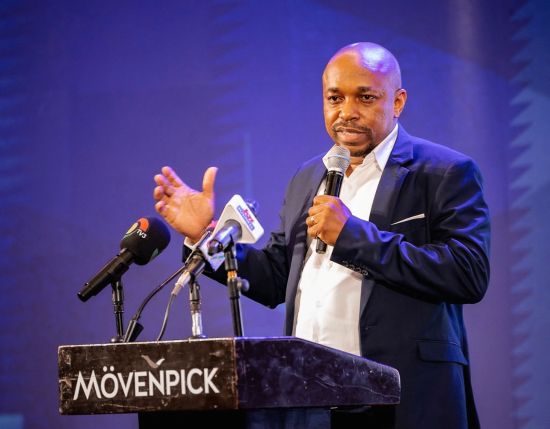
Philip Gamey said in between the 18th and 24th month of the three-year pilot, the Africa’s biggest digital marketplace will launched to allow micro and small businesses to participate and an IOT infrastructure will be deployed to enable a click-to-deliver feature will be tracked in real-time.
He said this is a good time to be an Africa because the use of the AfCFTA channels for trade comes with duty-free benefits, but that opportunity has not been fully explored, so, ADTC will open it up for businesses and citizens to take full advantage of it.
Regulatory Hurdles
Regulatory fragmentation remain one of the biggest hurdles in the way of effective cross-border trade in Africa and efforts are under way in various sectors to harmonize the regulations to allow seamless trade and payments across borders.
Philip Gamey noted that indeed, regulatory fragmentation was the biggest risk that came up in their preparations towards implementing the ADTC. So, they have decided that all member states to maintain their respective protocols, tax codes and others to ensure that the ADTC integrates with each country’s economic model in order not to deplete value of any country.
“Apart from the various treaties and rules that all the countries have signed on to, we are going to allow each country to maintain their economic models. My team have come up with fantastic solutions to inject best practices into the the ecosystem – we trust that this will work effectively to ensure the the overall benefits will not erode value for the individual economies,” he said.
Seychelle Island as the host country, is providing the lands, offices, cargo planes to do the deliveries for the long mile and the shipping lines to move the heavy cargo. So Seychelles with be the nerve centre of the ADTC providing the logistics.
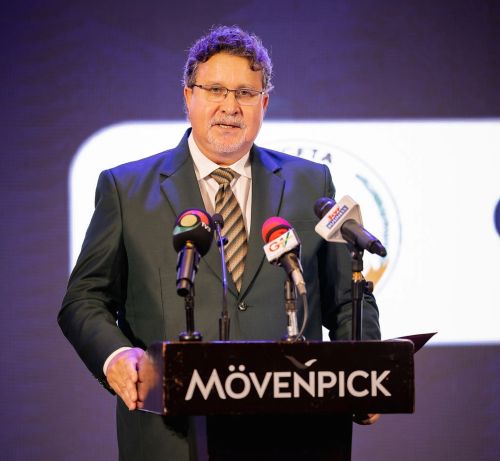
Minister of Finance, Economic Planning, Trade and Industry for Seychelles Island, Pierre Frank Laporte said his country is happy to play host to the ADTC because they believe that it promises shared prosperity across Africa through the power of digitalization.
He noted that the political boundaries imposed on Africa by the colonialists have held the continent back for centuries, but a solution like ADTC is poised to break those boundaries and drive borderless trade across the continent.