
Amanex Company Limited is Ghanaian-based manufacturer and exporter of household, cosmetics and plastic products. They export mainly within the west African sub-region. The CEO, Eric Amaquandor tells Techfocus24 that the company’s bank accounts have, on a number of occasions, been flagged for suspicious activity because their bankers and tax regulators noticed unexplained huge cash deposits into the accounts. The company is therefore compelled, on each of those occasions, to go and explain the sources of those funds before they are granted access to their accounts. Those huge funds are often hard cash payments they receive from clients in the sub-region via unapproved routes.
According to the CEO, when they export products out of Ghana, Customs (the tax collector) in Ghana sees the shipment going out of the country and are able to apply the necessary charges and fees. But the tax collector often doesn’t see records of payments coming into Ghana with regards to those exports. This is because, some clients of Amanex, particularly those in Mali, Burkina Faso and Niger refuse to pay for the goods via bank transfers. Their reason in chief, the CEO said, is the huge transfer fees and the exchange rates regime the banks apply, which often depletes value for them.

So, Amanex often receives payments from Mali, Burkina Faso, Niger via unapproved routes widely known as the “Black Market” or parallel markets. There are some “Alhajis” in Ghana, mainly in a community called Tudu, within Accra’s business district, who are willing to pay Amanex Ghana cedis on behalf of its clients in these countries at a smaller fee and better exchange rates than what the banks offer; then those clients will deposit the CFA equivalent in local bank accounts in their respective countries on the instructions of the Alhajis. According to the Amanex CEO, sometimes the cash is even delivered to them in Ghana in bags, before they deposit it in their bank accounts.
Amanex is not alone in this. John Defor, Director of Policy at the Association of Ghana Industries (AGI), of which Amanex is a member, stated that quite a number of its members who export and import products within Africa go through similar challenges because their clients often insist on paying them in cash, instead of using bank transfers. And the reasons are the same – high bank transfer fees and unfavourable exchange rate regimes and sometimes delays due to administrative and regulatory bureaucracies on the approved routes.

There is no single official figure for the total value of Africa’s foreign exchange black market because its transactions are informal, unrecorded, and illegal. However, it is estimated that, through cross-border transactions like the one described above, that market handles billions of dollars annually across the continent, particularly due to the massive currency mismatches, high cost of using the legal routes, and strict central bank controls on the continent. There have been several crack downs on forex black market in Ghana, but that market still thrives because it offers value for its clients.
Cost is key
Speaking of cost of money transfer on the continent, The World Bank estimates that every year, Africa records about US$100 billion in remittances, and for every US$200 sent, there is a seven to eight per cent (7.8%) transfer cost in most cases. Cumulatively, the continent is reportedly losing an estimated US$5 billion in transfer fees. In fact, in some cases the transfer fees go as high as 20% plus. That US$5 billion is money being lost to small businesses, families and individuals.
For instance, in March this year, Techfocus24 made a transfer of US$322 to Nigeria to pay for a service. The bank transfer fee for that was US$70, which is a whopping 21.74% of the amount transferred. This was largely due to the SWIFT fee. Again, a staff of AGI, Beauty Kafui Amoafo, who attended a conference in Morocco, said she had to pay $300 as hotel bills. According to her, she made a deposit of GHS4,800 in a Bank of Africa account in Ghana, for the US$300 to be transferred to another Bank of Africa account in Morocco for the hotel. The entire transaction cost her GHS1,600, which is equivalent to US$144, representing almost 50% of the amount transferred at the time.
The United Nations targets a maximum of 3% transfer fees for Africa, but some industry players think that is still too high. According to them, 1% across board should suffice, if traders on the continent are to see value in using the approved routes for transfers. As things stand now, using the unapproved routes cost far less, and that is a key reason why loads of traders choose that route.
PAPSS

The CEO of Amanex, Eric Amaquandor said they have actually introduced their clients on the continent to the Pan-African Payments and Settlement System (PAPSS) route, but the clients still prefer the black market because it is still much cheaper than PAPSS. In fact, according to him, “some of the client threaten to stop buying from us if we insist on payments via bank transfer or PAPSS.”
PAPSS was supposed to serve as the SWIFT (so to speak) for Africa, and eliminate the cost that comes with dollarization (multiple conversations) and correspondent bank services in the current scattered cross-border transfer channels on the continent. But till date, the PAPSS route still applies the dollarization feature largely, which makes the use of that channel still expensive. Currently, every cedi, naira, shilling etc transferred on the continent, has to go through a correspondent bank somewhere outside of Africa, and be converted into dollars before being reconverted and settled in the recipient African country. This is simply because there is no other point of reference to determine the exchange rates between the various currencies of African countries, except the dollar.
According to Romeo Bugyei, the CEO IT Consortium, from their experience as a fintech, PAPSS has still not been able to deliver on its original promise because it still uses the dollar as a point of reference for settlements between African countries, and that means the cost of transaction is still high. IT Consortium is one of the leading financial technology (fintech) firms in Ghana, with footprints in Liberia and Rwanda.
Improvements on PAPSS
Whereas the testimony about PAPSS is not quite a positive one from the user perspective (traders and even some fintech firms), there is an effort to improve and make PAPSS serve its originally intended purpose. PAPSS has partnered with some fintech firms on the continent to pilot cross-border payments without dollarization. A typical example is one that started in 2025 with a limited regulatory approval of the Bank of Ghana. It enables traders and individuals in Ghana to make bank and mobile money transfers in cedis to Nigeria for settlement in naira without the usually expensive dollarization (hard currency conversion).
Earlier this year, that service was expanded to include transfers from Nigeria to Ghana as well. This relatively more affordable and near instant pilot initiative is still on a smaller scale compared to the traditional transfer routes, but Techfocus24 has learnt that with the successful use cases in cross-border bank-to-bank, wallet-to-bank, bank-to-wallet and wallet-to-wallet payments among SMEs and individuals the service will soon be scaled across the continent.
Common Continental Currency
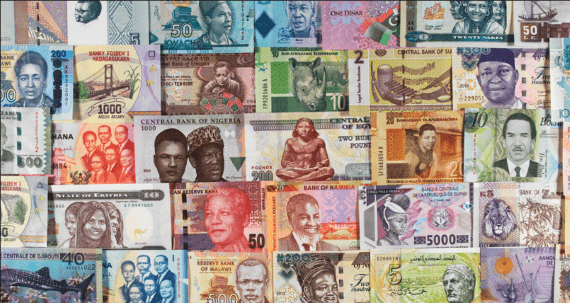
But Romeo Bugyei still thinks the ultimate requirement for an effective, affordable, seamless and inclusive instant cross-border payment system in Africa would be a common continental currency, which is currently lacking in Africa. According to him, even if such a currency is not rolled out to the populace for regular transactions, it should serve as a reference point at the level of central banks and regulated financial institutions, purely for the purposes of easy cross-borders payments and settlements.
Currently though, there are 14 countries in the Union Économique et Monétaire Ouest Africaine (UEMOA), who use a common currency – the CFA linked to the French Franc. That can be a starting point for the adoption of a common currency on the continent. The discussion on an ECOWAS-wide common currency (the ECO) has been on the table for decades, but it has still not seen the light of day, arguably because of what the Senior Vice President for Markets at MTN Group, Ebenezer Twum Asante described as “the tyranny of sovereignty“: Central banks in Africa are more prone to protecting their individual sovereignties than finding ways to integrate/harmonize regulations to enable their people’s to trade and make cross-border payments seamlessly, safely and affordably within the context of the Africa Continental Free Trade Area (AfCFTA).
Gold and Stablecoins

In the absence of a common currency, Romeo Bugyei thinks African countries can also adopt what the BRICS countries are doing now – using gold as the reference point for settlements among themselves. So, instead of using the dollar, African countries can agree that settlements between central banks will be done with gold as the reference point, and that will be the basis for simplifying the exchange rate between the various currencies, to ensure seamless cross-border payments. That also promises to be more affordable.
Meanwhile, at the moment, some fintech firms on the continent are gravitating towards digital assets, particularly stablecoins, for cross-borders payments on behalf of their clients. And that, according to Romeo Bugyei, is relatively more affordable than regular bank transfers. He explained further that, stablecoins have been sanctioned by the Bank of Ghana and by several other central banks across the continent. So, what the fintech firms often do is to purchase the coins in the sending country, and liquidate it in the receiving country, then use the cash for settlements. This, he said, is currently much cheaper than using direct banks channel or the PAPSS route.
He therefore believes that, faced with the high cost of using the approved routes, digital assets are gradually becoming a go to solution for cross-border payments. So, any meaningful inclusive instant payment system on the continent must find a way to integrate that as well.
Regulatory Hurdles
The other critical issue Romeo Bugyei pointed out, which is a matter on the front burner in this whole continental discourse on cross-border payments, is the need for regulatory harmonization to remove the grave regulatory hurdles fintech firms like his come up to in their attempt to expand and serve the entire continent. He explained, for instance, that till date, the company continues to face serious regulatory hurdles in Rwanda and Liberia, even though they have a very enviable proven record in Ghana, having built over 1,000 solutions for more than 500 corporate clients over the last 24 years.
For instance, according to him, for the three years plus that IT Consortium has been in Rwanda “I don’t think we have even made a thousand dollars yet – this is because of various regulatory restrictions regarding what we can and cannot do with our license.” That is a real life example of how regulatory fragmentation is hurting the fintech ecosystem on the continent; hence, the need for harmonization.
Ghana now has a license passporting agreement with Rwanda. This allows fintech firms from Ghana to set up shop in Rwanda and do business with the license acquired in Ghana, and vice-a-versa. IT Consortium got their license in Rwanda before the license passporting regime kicked in. But the CEO says the regulatory restrictions in Rwanda are so frustrating they are yet to realize any real value for the money they have invested over the last three years.
In Liberia, he said the company has since June last year, put in a request for a letter of “No Objection” from the Central Bank of Liberia. It’s been more than a year and they are still waiting. They don’t even know yet, what kind of restrictions will be placed on their operations once they get the letter of “No Objection”. This is not different from what another fintech, Nala had to go through in Ghana before finally getting a Payment Service Provider (PSP) license. According to the representative of the company in Ghana, it took them more than two years to get a license valid for just Ghana, but in Europe, they got a similar license valid for the entire European Union in less than three months.
Steps toward regulatory harmonization: AfricaNenda to the rescue

These real life stories confirm the assertion by the AfricaNenda Foundation that the challenge facing seamless, inclusive and instant cross-border payments in Africa is not whether the rails and the technology exist, but rather the fragmented rules around the rails. AfricaNenda is the leading inclusive instant payment systems experts and advocates, championing the establishment of a common cross-border payment system on the continent to facilitate trade within the context of the AfCFTA.
In what could be described as the summary on the way forward, Sabine Mensah, Deputy CEO of AfricaNenda, said “in all of our engagement with stakeholders, there was consensus that fragmented rules, rather than technology, are the real brake. Stakeholders want regulators to harmonize first, then innovate on top of existing domestic and regional rails with shared standards, trust frameworks, and coordinated settlement/liquidity.”
So what is being done now?
Currently, AfricaNenda is working with the African Association of Central Banks (AACB) under the auspices of the African Union to develop the framework for what a continent-wide seamless inclusive cross-border payment system for Africa should look like. They have already engaged with various industry stakeholders across the continent, including the private sector, and picked their thoughts and expectations on what regulatory harmonization for Africa should look like. They have also done a feasibility study to establish winning approaches to the implementation of the policy harmonization framework for cross-border payments. The policy harmonization framework from AfricaNenda’s work over a two-year period, was tabled at the African Union Congress Special Technical Committee (AUC STC) meetings in 2024 and 2025 for public sector and member state endorsement.
What is even more reassuring is that, on November 28, 2025, the AACB Assembly of Governors, instructed its own Task Force on Payment Systems Integration to lead the regulatory harmonization process, with AfricaNenda Foundation in a supporting role, explicitly ensuring the initiative is led from within the central banking community. This clearly shows that central banks on the continent have now agreed to take practical steps towards regulatory harmonization in the interest of building an inclusive instant cross-border payment system on the continent.
Harmonization beyond central banks
But in a presentation to journalists at an inclusive instant payments systems workshop in Cote d’Ivoire recently, Sabine Mensah noted that the need for regulatory harmonization does not entirely rest with central banks. There are other areas like trade laws, and particularly data privacy, cross-border data sharing and data protection regulations that also need to be harmonized.
In that regard, Ghana is about to award a contract for the building and deployment of a national data exchange, which will then be connected to the continental data exchange called the Smart Africa Data Exchange (SADX), built by Smart Africa Alliance, to enable a safe, secure and affordable data exchange between businesses across the continent.
Director of Technical Services at Ghana’s National Information Technology Agency (NITA), Solomon Richardson tells Techfocus24 that currently the continental data exchange is being piloted between Ghana, Benin and Rwanda, and when Ghana’s national exchange is ready, it will be connected to it via a national gateway.
He explained that, for instance, if a request comes from Rwanda seeking to verify the identity for a Ghanaian doing business in Rwanda, the request will go to SADX, then come through Ghana’s international gateway to the National Identification Authority (NIA), and they will respond with the information requested through the same channel.
“Similarly, if a company in South Africa wants to make payment to a merchant in Ghana, the transaction will go to SADX, come through Ghana’s international gateway and be directed to the respective financial institution for termination.
“This whole process will be in real-time, which is as instant as mobile money transfers happens,” he said.
But currently, there is a caveat. Solomon Richardson said every request would have to be within the data protection and cybersecurity laws of the country from which the data is being requested, or else the request will not be granted. So, to cure that regulatory hurdle, he said “the legal brains from the three piloting countries have just finished a meeting in Rwanda where they discussed ways to effectively harmonize the various data protection and cybersecurity laws/regulations and make them interoperable, to ensure seamless data sharing between the countries.”
He said Ghana has also deployed a national PKI (public key infrastructure) backbone and has made a request for interested private sector players to put in bids for licenses to provide a suit of trust services such as digital seals, digital certificates and digital signatures to institutions and individuals as an additional level of security within the data sharing space. This is to ensure that the verifiable credentials of persons and institutions are easily accessible. This will go a long way to prevent fraud within that ecosystem.
So, African regulators may be taking slow steps to get to a place where safe, affordable and seamless inclusive instant cross-order payments becomes a reality on the continent, but at least they are taking the steps and they are ably being shepherded by the expert hands of AfricaNenda Foundation.
Indeed, per AfricaNenda’s own timelines for achieving three key levels of results in the regulatory harmonization journey, it will take up to 10 years for all to come round.
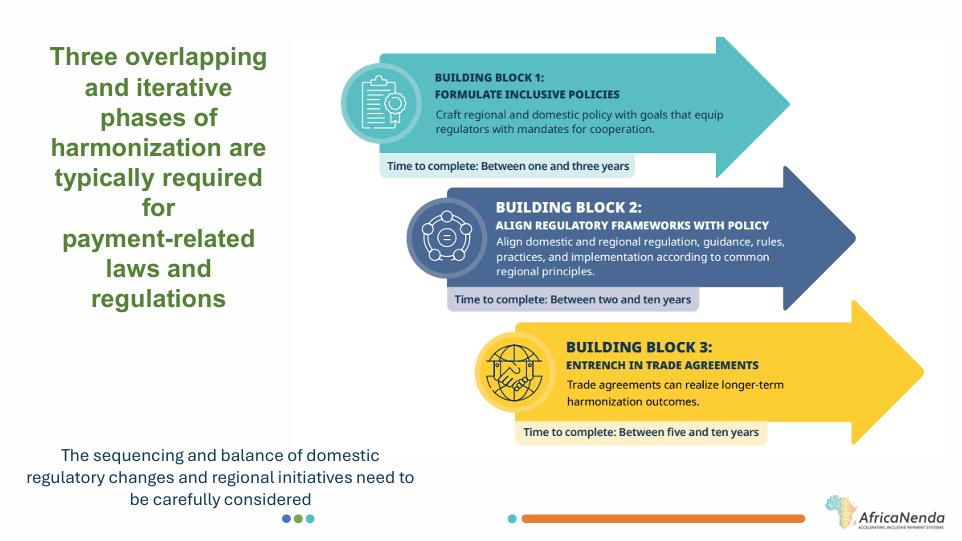
A journey of a thousand miles begins with one step. With the help of AfricaNenda Foundation, Africa has taken more than one step so far. Indeed, currently there is commitment in several countries to meeting AfricaNenda’s parameters for inclusivity for instant payments systems. That shows that there is light at the end of the tunnel for inclusive instant cross-border payments in Africa soon.
But in the meantime, companies like Amanex and it clients in the sub-region, and even individuals like Beauty Amoafo are waiting for the day when they can move money within the continent through safe and approved routes at the most affordable rates and with less hustle, while fintechs like IT Consortium are also waiting for the enabling regulatory environment that would allow them quicker access to markets across the continent.