On May 25, 2026, Ghana’s mobile money market leader, MobileMoney Fintech Limited (MMFL), popularly known as MTN MoMo, issued a circular informing customers that from June 1, 2026 they will start charging a 0.75% fee capped at GHS5 on all wallet to bank account transfers through its direct push and pull channel. This announcement was made with the blessing of the industry regulator, Bank of Ghana.
I personally got the message on my phone at exactly 6.51pm that day. The announcement generated so much public outcry on social media that in less than 24 hours, the Bank of Ghana asked MMFL to suspend the planned application of the fee for further public consultation. The central bank then issued a statement announcing the suspension. In that statement, the Bank of Ghana claimed its decision to order the suspension is a reflection of its “commitment to ensuring that any changes in charges in the mobile financial services ecosystem, are introduced fairly, protect consumers, and support their (consumers) financial wellbeing.”
Take note of the highlighted statement, we will come back to it shortly.


Given that MMFL’s announcement of the fee on May 25, 2026 was with the blessing of the central bank, it is clear that there must have been a very good reason for the decision to apply the fee. And the suspension, in less than 24 hours, of the planned application of the fee must have as well been rooted in equally very good reasons.
So, the simple questions this piece seeks to answer are:
- What was the rationale for the decision to implement the fee in the first place, and
- What were the reasons for the decision to suspend the earlier decision less than 24 hours after the announcement?
- Was the central bank really thinking of fairness to and protection for the consumer as it claimed, when it first approved of the fees?
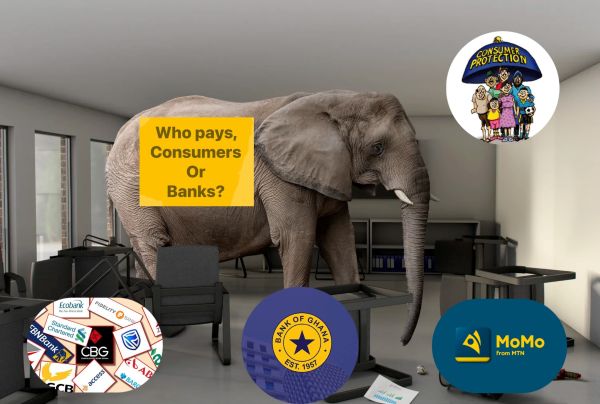
That leaves the elephant in the room – it is obvious there is a fee to be paid. But the question now is – who should pay that fee?
Justification for the fee
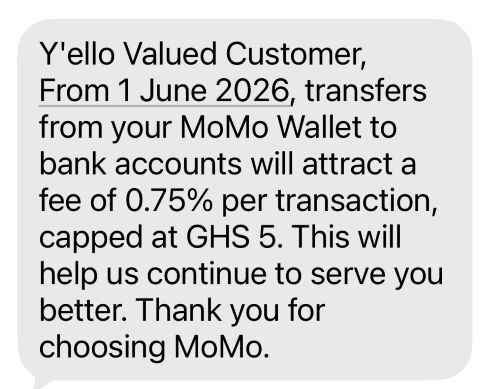
In the MMFL May 25, 2026 circular, they were very vague on the reasons for the fee. They only said “This will help us to serve you better.” Now that cannot pass for proper communication meant to get customers’ buy in. Clearly the channel used – SMS – did not allow MMFL enough room to state all the details. But that was not because there were no real valid reasons that occasioned the fee. At least two reasons emerged as we went behind the scenes to look for why MMFL has suddenly decided to charge for transfers from wallet to bank account via its push and pull channel.
It is important to noted that this fee is specifically in connection to wallet to bank transfers via the MMFL’s push and pull gateway. There is another channel via which such transfers can be made – the mobile money interoperability (MMI) channel, which sits at the Ghana Interbank Payments and Settlements Systems (GhIPSS). There is already a 0.75% fee capped at GHS7.5 (higher than what MMFL is proposing) when you use that channel. So, it is not as if a fee for wallet to bank is a completely new phenomenon.
So, why has MMFL zero rated the use of its push and pull channel all this while, but has suddenly decided to slap a fee on it?
GhIPSS Fees
- Whenever customers receive funds into their wallet via the GhIPSS MMI channel – usually international remittance, it means two things happened:
- The money went through a local bank and that bank charged a fee from the sender agency abroad.
- From the local bank, the money then went through the GhIPSS MMI platform and GhIPSS charged the operator of the receiving wallet 0.2% of the money before lodging the money into the customer’s wallet.
This simply means that when MMFL customers receive international remittance directly into their wallets, MMFL pays GhIPSS 0.2% of the amount received, in the hope that the customer will use the money for various transactions on the MMFL platform so that they can also make some money in the form of services fees.
But lately, what has been happening often is that, when people receive international remittance, or any funds via the GhIPSS platforms, and MMFL pays the 0.2% fee to GhIPSS, the customers then transfer the money via the MMFL push and pull channel into their bank account totally free of charge. So, MMFL loses money to GhIPSS without any remedy on that scenario.
Agent Fees
2. Again, when mobile money customers go to an agent and deposit physical cash in exchange for electronic cash, MMFL pays the agent up to 0.5% of the money the customer deposited but the customer’s wallet is credited with the full amount without any fee being charged on it. Again, this cash-in transaction is zero-rated for the customer in the hope that he or she will transact with the funds in the wallet and MMFL will make some money in the form of service fees. But when the customer moves that money into his bank account, that becomes a fund mobilization service MMFL is providing for the bank at zero cost. But that service needs to be paid for.
Those were the two main reasons that occasioned the wallet to bank account transfer fee announced by MMFL with the blessing of the central bank.
So, then why did the regulator order a suspension of the planned implementation of the fee? A number of reasons:
Financial Inclusion
- The industry has been preaching affordability as a tool for driving financial inclusion for several years. In fact, it was for that reason that the commercial banks introduced the bank-based wallet called GhanaPay, which has made all transfers totally free of charge – be it bank to wallet or wallet to bank. So, one would have expected that the industry should be moving towards zero rating basic transfers and not be introducing new transfer fees. Alternatively, industry players are expected to think of other innovative ways around payments to shore up their revenues instead of simply introducing more fees for basic services. The regulator has a duty to ensure that at every material moment, financial inclusion remains a guiding principle for everything industry players do. A new fee on a basic transfer is counterproductive to financial inclusion, ab initio.
Fraud
2. Consumers have also raised a critical issue regarding why they are compelled to transfer funds from their MMFL wallets into their bank accounts. That behaviour is mainly for safety. Apparently, MMFL customers who often receive substantial amounts as international remittance are often targeted by fraudsters who seem to know every detail about the funds the customer received. So, in their bid to avoid losing the money to fraudsters, a lot of these customers said they opt to transfer the money out of the wallet into their bank accounts for safety. So their cry is that if MMFL can assure customers of safety on the platform, they will be happy to keep huge sums in their wallets. Indeed, such customers eventually return the money in bits into their wallet for transactions. But they now prefer to keep it out of the wallet for safety. So, the customers say they rather expect MMFL to find ways to sanitize the platform and prevent the wallet to bank transfers instead of seeking to cash in on it. The regulator heard the consumers and hence the suspension.
The real elephant in the room
But the real elephant in the room is that MMFL, like all other wallet operators, pays GhIPSS 0.2% of every cedi that comes through the MMI channel into a wallet. They are also paying agents up to 0.5% of every physical cash a customers deposits into his or her wallet. That is a funds mobilization service MMFL is performing for the banks, which has to be paid for. Yes, it is a service MMFL is performing for the banks because the actual cash behind every cedi floating on all mobile money and digital finance platforms in the country are sitting with the banks, and they get to invest these moneys and make huge profits.
For instance, in February this year, the Bank of Ghana reported that the total cash float mobilized by mobile money wallets was almost GHS34 billion (GHS33.9 billion). That is cash that the banks are sitting on and investing and making decent profits on. The wallet operators like MMFL, who mobilize all these funds for the banks, don’t get the benefit of holding and investing that money to earn profits on it. In other jurisdictions, wallet operators even get to decide which banks to deposit the money with based on negotiated returns. But not in Ghana. Our model empowers the banks to decide what part of the profits they pay to wallet operators. And what is even worse is that the wallet operators pay out about 90% of the meagre sum the banks pay to them to their customers.
So, the big question is, whereas we all recognize that there are fees to be paid to GhIPSS and to MoMo agents, which MMFL is already paying, who should pay MMFL when moneys are transferred from wallets to bank account and MMFL is denied earnings on that money for which it had already paid fees to GhIPSS and MoMo agents – should it be the customers or the banks that are receiving the money to then go and invest and make more money?
Our simple answer is that, THE BANKS MUST PAY THAT FEE TO MMFL, and here is why:
MMFL, like all other digital wallet operators, is performing a funds mobilization function, not for the customer but for the banks. So, if any fee is occasioned relative to that function, it should be borne by the beneficiary of the services. Wallet to bank account transfers constitute less than 1% of the over 23 million monthly transactions on the MMFL platform. So, the fees being proposed is not going to make a big dent in the earnings of the banks. As it were, customers are already paying for person to person transfers and for various payment services. Why should they also pay for the banks when funds are mobilized for them?
In fact, when it even comes to bank to wallet and bank to bank transfers via the Apps of the various banks, the fees are even sometimes higher and there are no caps to protect consumers. BoG is fully aware of this.
BoG’s questionable consumer protection claim
This is where the claim by the Bank of Ghana that it is committed to “ensuring that any changes in charges in the mobile financial services ecosystem, are introduced fairly, protect consumers, and support their (consumers) financial wellbeing” is highly questionable. BoG of all institutions, is fully aware that wallet to bank account transfers is a funds mobilization function of MMFL, which benefits the banks more than anyone else. So, if its orientation, as it claims, is to protect consumers and support their financial wellbeing, why did it approve a fee on consumers in the first place, when it should have insisted that the banks should rather be paying MMFL? BoG can’t have its cake and eat it too. The claim to be committed to consumer protection does not wash.
A transfer from one’s own wallet into one’s own account or vice-versa is just like moving money from your left pocket to your right pocket. How can that activity come at a cost? If we say digital funds is like cash, we need to start cancelling some of these senseless service charges. All of those transactions must be zero rated for consumers, in spite of whichever channel – whether via direct push and pull or via mobile money interoperability platform.
The Bogus E-Levy Claim
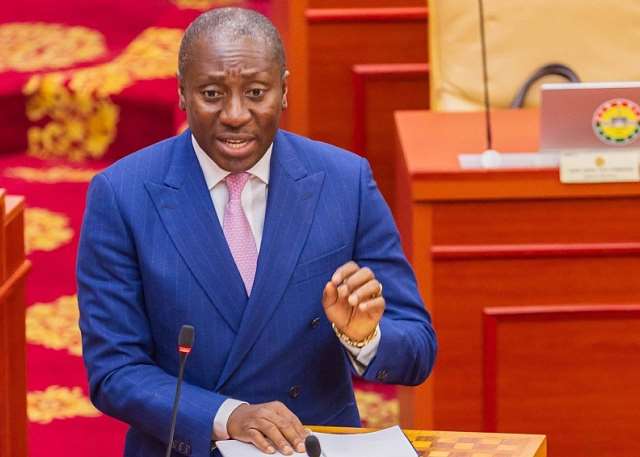
Initially, I thought not to speak to the bogus and disingenuous claim that the fee MMFL announced was actually e-levy being sneaked in on us by the sitting government. From the start it sounded like one of those unlearned social media hot air. But I was on a radio news program to speak on this matter and the very last soundbite played before I was asked to speak was that of no less a person than the Minority Leader in our Parliament, Alexander Afenyo-Markin spewing out this baseless e-levy claim with tangible conviction. I thought MPs, and particularly the leaders of the house, have researchers they work with?!
Three simple questions:
- How could it be e-levy and yet only MMFL announced it – why didn’t Telecel Cash, AT Money, Zeepay, G-Money and GhanaPay announce the so-called “e-levy” as well?
- If it was e-levy, how come it was applied on only wallet to bank transfers via just a single channel (MMFL push and pull), which is less than one percent of the volume of transactions on MMFL?
- If it was e-levy, how come GRA did not announce it, and it took just a directive by Bank of Ghana to suspend it. How could Bank of Ghana issue a directive to suspend a tax that GRA is in charge of?
He is where we let the elephant rest.