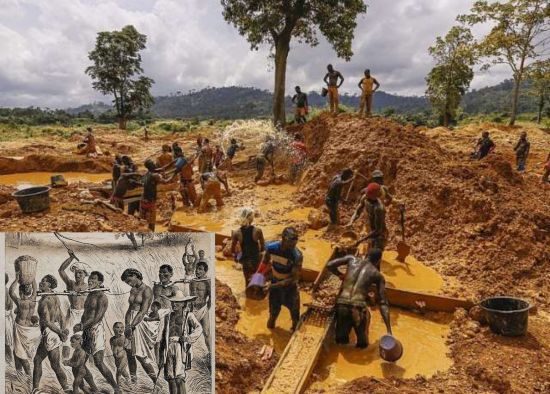
History remembers the Transatlantic Slave Trade as one of humanity’s darkest chapters. Between the 16th and 19th centuries, Africa was violently drained of millions of its people, shipped across oceans in chains, and reduced to a source of forced labour for foreign prosperity. The consequences were catastrophic: depopulation, broken societies, arrested development, and intergenerational trauma.
Yet today, in Ghana – is living through another form of devastation. It does not come in chains or ships, but in excavators, mercury, and poisoned rivers. It is called galamsey. And uncomfortable as it may sound, the long-term damage from galamsey may rival – or even surpass – the destruction of the Transatlantic Slave Trade.
- External Exploitation vs. Self-Inflicted Destruction
The Transatlantic Slave Trade was driven primarily by external demand. European powers created the market, financed the ships, and controlled the global system. Africans were betrayed by some of their own elites, yes – but the machinery of the trade was foreign.
Galamsey, however, is different.

This time, *there is no foreign gunship forcing compliance*. The destruction is largely *self-enabled* – tolerated, protected, and in some cases actively facilitated by political leaders, traditional authorities, security agencies, and citizens who know better but choose silence.
Slavery was imposed.
Galamsey is allowed.
That distinction matters.
- 2. Loss of People vs. Loss of Life Systems
The slave trade stole *people* – men and women in their most productive years. This loss weakened Africa’s labour force, innovation capacity, and demographic growth.
Galamsey steals something even more fundamental:
the systems that sustain life itself.
- Rivers poisoned with mercury and heavy metals
- Farmlands rendered toxic and infertile
- Aquifers contaminated beyond natural recovery
- Fish, wildlife, and entire ecosystems collapsing
People can give birth again
Dead rivers cannot.
A poisoned Volta, Pra, Ankobra, Birim, Afram, White or Black Volta does not just affect this generation. It condemns *every generation after it*.
- Temporary Atrocity vs. Permanent Damage
The Transatlantic slave trade, horrific as it was, eventually *ended*. Its scars remain, but the physical mechanisms stopped. Societies, slowly and painfully, began to rebuild.
Galamsey leaves irreversible damage.
Mercury does not disappear.
Heavy metals bioaccumulate.
Topsoil once destroyed can take centuries to regenerate – if at all.
This means galamsey is not just an economic crime or an environmental crime.
It is a crime against the future.
- Ignorance Then, Knowledge Now
Another damning contrast: During the slave trade, many people did not fully grasp its long-term implications.
With galamsey, we know.
We have scientists, doctors, hydrologists, economists, and farmers all warning of the same outcomes:
- Rising cancers
b. Food insecurity
c. Water scarcity
d. Public health collapse
e. Economic stagnation
Continuing galamsey in the face of this knowledge is not ignorance.
It is deliberate negligence.
- Reparation Demands and the Irony of Present-Day Leadership
African presidents, including President John Mahama, have rightly called for *reparations* for the immense harm caused by the Transatlantic Slave Trade. He recently announced plans for Ghana to file a motion at the United Nations to formally designate the Transatlantic
Slave Trade as a crime against humanity – a key step in advancing the reparations agenda on the global stage. These demands are morally justified. Slavery devastated African societies, stripped the continent of human capital, and altered its development trajectory for centuries. But there is a painful irony we must confront. While we demand accountability for historical crimes, we are simultaneously overseeing a modern catastrophe of our own making. Under our current leadership, galamsey continues – unchecked, protected, normalized. Rivers are being poisoned, farmlands destroyed, and future livelihoods erased in real time. It raises an uncomfortable question history will not ignore:
“How do we demand reparations for yesterday’s destruction while actively permitting an even more devastation today?”
The slave trade damaged Africa’s past. Galamsey is sabotaging Africa’s *future*. Reparations cannot restore poisoned rivers. No compensation will cleanse mercury from entire river basins. No apology can revive extinct ecosystems.
If leadership fails to stop galamsey decisively, then our moral argument for reparations risks becoming hollow – not because slavery was justified (it never was), but because we refused to protect what remained.
History will not only ask what the world did to Ghana (and much of Africa). It will ask what *Ghana did when it finally had the power to choose differently*.
- How History Will Judge Us
Future generations may ask:
“You knew this would poison our water, destroy our land and farms, and shorten our lives. Why didn’t you stop it?”
That question will be harder to answer than any question about slavery.
Because this time, there is no coloniser to blame.
No slave ship to point at.
No foreign empire to accuse. Only us.
Conclusion
Slavery Took Our Past. Galamsey Is Taking Our Future. The Transatlantic slave trade robbed Africa of its people and delayed its progress. Galamsey threatens to make progress *impossible*. Slavery was a crime against humanity. Galamsey is a crime against *humanity yet unborn*. If history teaches us anything, it is this: nations rarely collapse from external enemies alone. They fall when they *fail to protect the foundations of their own survival*. And water, land, and life itself are those foundations.
The tragedy of our time is not that galamsey exists, it is that we *allow it to continue*, fully aware of what it will cost.