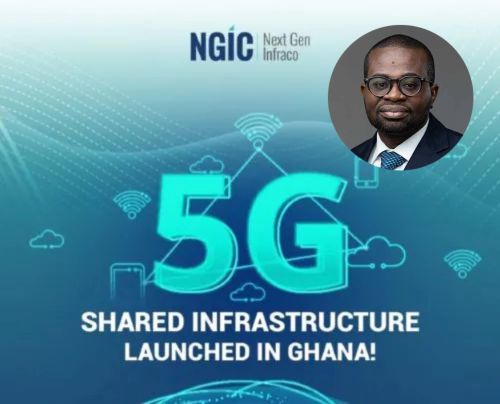
The Director-General of the National Communications Authority (NCA), Rev. Ing. Edmund Yirenkyi Fianko has disclosed that Ghana’s only licensed 5G wholesaler, Nex-Gen Infraco (NGIC) has officially filed its objection to moves by the NCA to amend its license and remove the 10-year exclusivity rights.
He was speaking to journalists on the side lines of a ceremony to mark this year’s World Telecommunications and Information Society Day (WTIDS), which coincides with the NCA’s own 30th anniversary celebration.
NGIC was awarded a license in 2024, by the previous government, to rollout a shared 5G network with a 10-year exclusivity rights ending 2034. This means between 2024 and 2034, any company that wants to roll out commercial 5G services directly to its consumers, must go through NGIC.
The intent, as was explained by the previous government, was to save operators, particularly the smaller ones from having to come up with hard cash to purchase their own spectrum for 5G. The wholesale route makes it much cheaper for all operators.

It was also to help correct the market imbalance created by the way 4G was rolled out with one player going ahead of the pack to gain market advantage because the others could not afford the highest cost of spectrum at the time (US$67.5 million).
But on March 2, 2026, barely two years after NGIC got its wholesale license, the sitting government, through the NCA, issued a notice to NGIC informing them of a decision to amend their license and remove the exclusivity right to make way for other players to enter the space. This was to drive competition and protect consumers’ right to choice.
The NCA indicated in that notice, that its move was rooted in law – Section 14 of the Electronic Communications Act 2008 (Act 775), and it is also driven by public interest.
On March 3, 2026, just a day after NGIC received that notice from NCA, it announced that it had readied at least 43 sites in parts of the country for 5G, except that no operator was ready to start providing commercial 5G services to consumers through the NGIC network.
In the NCA’s notice, it stated that by law, NGIC had 90 days to raise its objection for consideration, following which spectrum will be auctioned for other entities to come into the space.
Rev. Fianko told journalists that NGIC has since filed its objections so currently the NCA board is looking at them to determine the way forward.
“Amending a license impacts the license holder so the law says we must give them a fair hearing to understand how it affects them – then we analyse all that before we make a final decision.
“NGIC has made their statements of objection as to why NCA should not go that route – we are now analysing that before we reach a conclusion – until we are done with that the status quo remains. We are obliged to follow the law strictly,” he said.
The NCA boss stated that until all the opportunities available to NGIC have been exhausted and the NCA board had subsequently taken a decision, it is not a given that in 90 days, from the date the notice was issued, March 2, there will be a spectrum auction to others to come into the space.
Even though he did not say what the exact objections from NGIC were, based on several previous experiences, companies affected by policy decisions that impact their investments, often resort to the law courts for judgment debt as a final resort. So, that option could be on the table for NGIC.
Meanwhile, as NCA is going through this legal process, the sector minister, Sam George has been seeking expert advice on how to effectively rollout the 5G spectrum to ensure that he achieves his vision of 70% coverage by next year, when Ghana turns 70.
He has also been expressing confidence that soon MTN Ghana will acquire spectrum for 5G and drive the speedy rollout of commercial 5G network across the country.
The Ghana Chamber of Telecommunications (GCT) has also been pushing the NCA to expedite action on steps towards the rollout of 5G to help address the grave quality of service issues, which has become topical in recent times due to heightened nature of it. Indeed, Ghana is over six years behind the rollout of 5G and that is an anomaly, as the country has always been a leader or among the leaders in the rollout of technology on the continent.