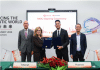
Nokia has opened its first research and development centre in Saudi Arabia, with the Riyadh facility focused on developing artificial intelligence-driven network automation and orchestration software for customers in the Kingdom and global markets.
The centre will advance Nokia’s service management and orchestration (SMO), self-organising networks (SON), Autopilot and rApps technologies, which are designed to enable communications networks to self-configure, self-heal and optimise performance while reducing energy consumption.
Engineers at the facility will develop automation and efficiency capabilities for telecoms operators and enterprises in Saudi Arabia, while also exploring AI-native technologies for 6G networks.
Nokia said the centre’s work would produce “Made in Saudi” software innovations that could subsequently be deployed across its global customer base.

The facility follows an agreement signed earlier this year between Saudi Arabia’s Minister of Communications and Information Technology, Abdullah Amer Alswaha, and Nokia president and chief executive Justin Hotard.
The investment forms part of Nokia’s broader alignment with Saudi Arabia’s Vision 2030 economic diversification plan, particularly its focus on local innovation, talent development and advanced research.
Mikko Lavanti, Nokia’s president for the Middle East and Africa, said AI was reshaping industries and that communications networks were critical infrastructure supporting that transformation.
He said the Riyadh centre would combine Nokia’s global expertise with Saudi talent to develop automation software capable of making networks more autonomous, efficient and responsive.
Beyond software development, the centre is expected to create high-value engineering and research positions and support the development of a domestic technology talent pipeline.
Nokia will also provide training schemes, boot camps and certifications in AI and automation as part of efforts to strengthen local expertise.
Abdulrahman AlMufadda, Deputy Minister for Telecom and Infrastructure at Saudi Arabia’s Ministry of Communications and Information Technology, described the centre as a strategic step towards positioning the Kingdom as a global hub for intelligent network technology.
He said the facility would help localise advanced research and development capabilities while expanding national expertise in AI and software.