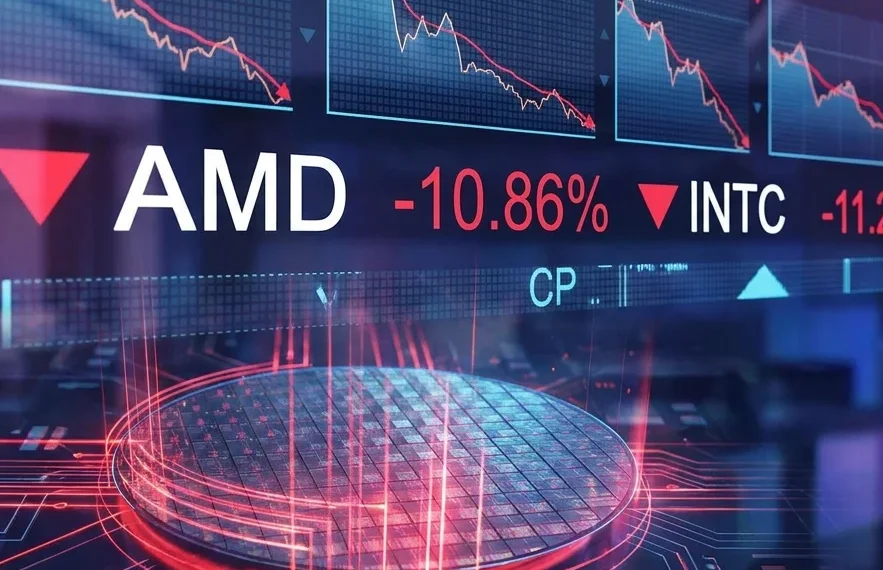
US semiconductor stocks extended their decline as concerns over the sustainability of artificial intelligence (AI) investment and growing competition from China intensified pressure on the sector.
By 09:36 ET (13:36 GMT), memory chipmakers recorded some of the steepest losses, with Micron and SanDisk falling more than 8 per cent, while Western Digital dropped over 11 per cent. Other major chip companies also declined, including Intel, which shed about 6 per cent, Marvell Technology, down 7.5 per cent, and Applied Materials, which fell approximately 6.5 per cent.
Advanced Micro Devices (AMD) dropped 8.1 per cent, newly listed US shares of South Korea’s SK Hynix declined 6.8 per cent, and Super Micro Computer lost 7.1 per cent.
The sell-off pushed the Philadelphia Semiconductor Index, which tracks the wider chipmaking industry, to its lowest level in more than two months.

The decline followed Monday’s sharp fall in Nvidia shares, which dropped 5 per cent in New York and lost its position as the world’s most valuable listed company. The fall came after reports that the company was in discussions to provide about $250 billion towards a major data-centre project linked to OpenAI.
Apple surpassed Nvidia after its shares gained roughly 25 per cent since the beginning of the year.
The weakness spread across Asian markets on Tuesday, with investors reducing exposure to companies that had benefited significantly from the rapid expansion of AI infrastructure spending.
South Korea’s benchmark Kospi index plunged about 11 per cent, triggering its eighth circuit breaker of the year. Trading was temporarily halted after the index fell 8 per cent before it resumed and closed 10.8 per cent lower.
Technology giants Samsung Electronics and SK Hynix were among the biggest casualties, ending the session down 13 per cent and 15 per cent respectively. In Japan, the Nikkei 225 declined 4 per cent, while memory-chip producer Kioxia fell 18 per cent after being one of the strongest performers during the first half of the year.
SK Hynix, a major supplier of high-bandwidth memory chips used by Nvidia’s AI processors, has benefited significantly from the surge in AI-related demand, making its shares particularly vulnerable to changes in investor confidence.
Analysts said the market correction was driven by concerns over the financing of AI infrastructure projects, China’s rapid progress in semiconductor technology and increasing competition from Chinese chip manufacturers.
Investor attention has also turned towards China’s semiconductor sector following the strong market debut of memory chipmaker CXMT on the Shanghai Stock Exchange on 27 July. The company’s initial public offering raised $8.6 billion, making it Asia’s largest IPO of 2026, while its market value climbed to 3.3 trillion yuan, or about $487.73 billion, according to Reuters.
The pressure on chip stocks has been compounded by growing concerns in credit markets over the scale of spending by technology companies building AI infrastructure.
Credit-default swaps (CDS) linked to major AI beneficiaries, including Oracle, SpaceX, Alphabet, Amazon, Meta, Broadcom and Nvidia, have reached record levels in recent days, according to LSEG data. Investors use CDS contracts to protect against potential corporate debt defaults.
The rise in credit risk reflects broader concerns about the hundreds of billions of dollars being committed by technology companies towards data centres, advanced chips and AI model development.
“Credit markets don’t deal well with uncertainty, and the sheer unpredictability of the pace and cost of AI financing is triggering a serious crisis of confidence right now,” said John Aylward, chief investment officer at Sona Asset Management.
Oracle has faced particular pressure after its five-year CDS rose to 215 basis points on Monday, compared with 144 basis points at the start of the year. The increase means investors now pay $215,000 annually to insure $10 million of Oracle’s debt against default.
The company announced plans last month to spend $70 billion over the next year on expanding its data-centre capacity. The investment prompted S&P Global Ratings to downgrade Oracle’s credit rating to triple-B-minus, the lowest investment-grade rating, citing uncertainty over profitability as the company increases spending on AI infrastructure.
The latest market decline highlights growing investor concerns that the AI boom, which has driven significant gains for semiconductor companies, may face challenges as companies balance ambitious expansion plans with rising costs, debt exposure and stronger global competition.