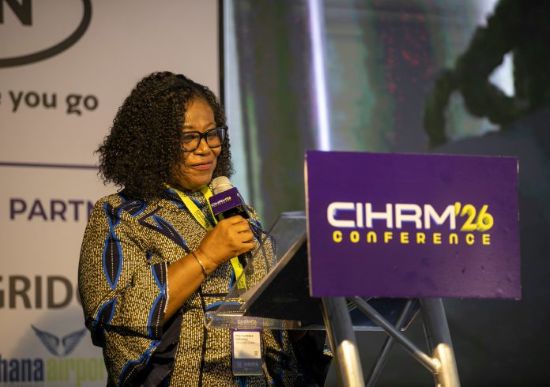
The President of the Chartered Institute of Human Resource Management (CIHRM), Ms Florence Hutchful has called on human resource professionals to assume a more strategic leadership role in shaping the future of work while upholding the highest standards of ethics and professionalism.
Addressing participants at the opening of the Chartered Institute of Human Resource Management 2026 Conference in Accra, Ms Hutchful said the rapidly evolving world of work demands that HR professionals move beyond traditional support functions to become drivers of organisational growth, sustainability and transformation.
She noted that the conference had brought together seasoned professionals and business leaders to discuss emerging trends and challenges in human resource management, with the aim of equipping practitioners with the knowledge and skills needed to navigate a changing workplace environment.
“HR can no longer take a backseat,” she stated. “As the DNA of every organisation, the HR function must move beyond merely supporting the development and execution of organisational strategy to leading organisations to build robust and adaptive mechanisms for growth and sustainability.”

According to her, the time had come for HR practitioners to lead from the front by shaping the future of work and influencing key organisational decisions. She added that the rollout and adoption of HR standards developed by the Institute should provide the impetus needed to advance the profession in Ghana.
Ms Hutchful underscored the importance of ethical leadership within the HR profession, drawing parallels between biblical principles on work ethics and the values that guide human resource management.
Reflecting on a presentation she delivered earlier this year on the topic, The Bible as a Guide: Work Ethics and National Development – The HR Perspective, she said principles such as fairness, integrity, accountability and diligence remain central to both effective governance and HR practice.
She described HR professionals as the “conscience and moral compass” of organisations, explaining that through policies and practices, HR ensures transparency, fairness and consistency in employee management while supporting organisational performance and productivity.
The CIHRM President acknowledged that HR professionals often operate in challenging environments where they must balance organisational priorities with employee concerns and aspirations.
“Effective HR professionals should remain objective and principled. They should uphold organisational goals while protecting employee well-being, ensuring that decisions are made with both strategic intent and human sensitivity,” she said.
Ms Hutchful, however, expressed concern over reports of unethical conduct involving some HR practitioners. She said there had been instances where individuals allegedly abused their authority, leading to decisions perceived to be motivated by personal interests rather than organisational objectives.
She cited a recent case in which an HR manager was accused of influencing the dismissal of employees who were viewed as obstacles to a personal agenda.
“Whether such accounts are ultimately substantiated or not, they serve as a reminder of the importance of accountability, ethical leadership and the responsible exercise of authority within the HR function,” she noted.
She stressed that HR professionals must always consider not only the outcomes of their decisions but also the processes through which those outcomes are achieved.
“Results matter, but how we achieve results is extremely critical to our profession,” she emphasised.
On the regulatory front, Ms Hutchful announced that the Institute had entered the full implementation phase of the Chartered Institute of Human Resource Management Act, 2020 (Act 1020), which mandates CIHRM to regulate HR practice and promote professional training in Ghana.
She warned that it was now a breach of the law for individuals who are not registered members of the Institute to perform HR functions, provide tuition for professional examinations, train HR practitioners, outsource personnel or offer HR-related services.
“The HR profession in Ghana is now regulated and can no longer be left in the hands of unqualified individuals,” she said. “HR work in Ghana shall be performed by trained HR professionals certified by the Chartered Institute of Human Resource Management Ghana.”
She therefore urged all HR practitioners and HR firms to register with the Institute and maintain good standing.
In a significant development for the profession, Ms Hutchful disclosed that CIHRM, in partnership with the University of Ghana Business School, was making progress towards establishing Ghana’s first Human Resources Professorial Chair.
The initiative, she explained, would support research, curriculum development, thought leadership, policy formulation and professional practice in human resource management.
She revealed that substantial progress had already been made, including the identification of a sponsor, with final institutional processes currently underway.
An official announcement regarding the commencement and outdooring of the Professorial Chair, she said, would be made in due course.
Ms Hutchful commended members of the fundraising committee, including Ellen Hagan, Professor Opibare Kodamwa and Dr Francis Seduku, for their leadership and commitment in advancing the initiative.
She described the Human Resources Professorial Chair project as a major milestone in strengthening research, professional excellence and thought leadership in Ghana’s HR sector.
Ms Hutchful concluded by encouraging participants to take full advantage of the two-day conference through networking, learning and collaboration.
She expressed gratitude to attendees for their support and participation and wished them a fruitful and successful conference.