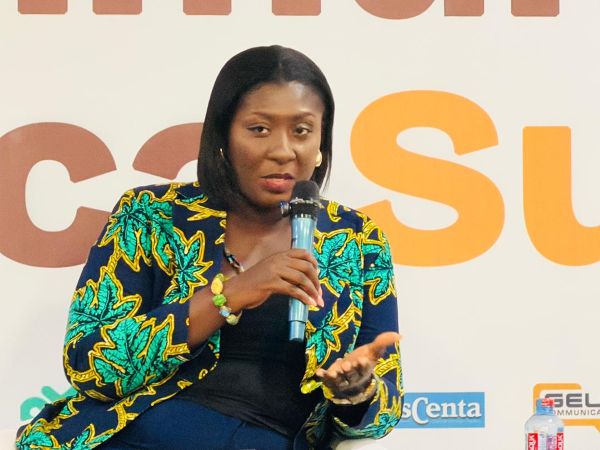
The Chief Executive Officer of the Ghana Chamber of Telecommunications, Sylvia Owusu-Ankomah, has urged Africans to take deliberate steps to shape how artificial intelligence (AI) influences communication across the continent, warning that failure to do so could leave Africa vulnerable to external control and manipulation.
Speaking at the inauguration of “Africans Communicating Africa”, she emphasised that while technology is opening vast opportunities for the continent, it also presents significant risks that must be carefully managed.
According to her, telecom operators across Africa are already leveraging advanced technologies, including AI-driven algorithms, to improve network optimisation and personalise service delivery.
She explained that these innovations enable companies to better understand user behaviour and tailor services to individual needs, enhancing customer experience across the board.

However, she cautioned that the same technologies could be misused if not governed properly.
“We see the risks—especially in how narratives can be shaped and how misinformation can spread,” she noted, highlighting concerns for journalists, policymakers and the broader public in distinguishing truth from falsehood in an AI-driven information ecosystem.
She further warned that AI could subtly influence political discourse and public opinion if appropriate safeguards are not established, stressing that governance must remain central to Africa’s digital transformation.
For her, the key challenge is ensuring that Africans take ownership of the systems shaping their digital future.
“The opportunity for Africans is to ensure that the ethics and governance frameworks guiding AI truly serve our interests,” she said.
She also raised concerns about data sovereignty, pointing out that much of the world’s data processing power and infrastructure remain outside the continent. This, she argued, limits Africa’s ability to fully control and benefit from emerging technologies.
To address this, she called for increased investment within Africa to build local technological capacity, including data infrastructure and computing systems that can support homegrown innovation.
She stressed that without such efforts, AI could widen existing inequalities rather than close them.
“We may think this technology is bridging gaps, but without the right measures, it could end up deepening them,” she warned.
Madam Owusu-Ankomah urged industry players, governments and stakeholders to work together to develop strong governance frameworks that balance innovation with risk management.
She concluded that Africa’s digital future must be intentionally designed to reflect the continent’s realities, values and aspirations.
“This is about ensuring that Africa does not just adopt AI but adapts it on its own terms,” she added.