CBI Ghana Ltd. made history on 5th March 2026, with the official commissioning of the world’s largest calcined clay plant valued at US$110 million.
The landmark facility, located in the Tema Free Zones Enclave, is set to revolutionizes Ghana’s construction landscape through sustainable innovation.
By pioneering Limestone Calcined Clay Cement (LC3) technology, CBI Ghana is reducing Ghana’s dependence on imported clinker, of which Ghana is Africa’s leading importer.
This shift to locally sourced clay will help strengthen the Ghana Cedi and position Ghana as the global Centre of Excellence for green construction.

Speaking at the launch, President John Dramani Mahama observed that what CBI Ghana has built is a statement about Ghanaian potential, saying that “For decades, our industrial growth has faced a punishing import bill that grew on a culture of exporting raw materials and importing finished goods. Today, we are proving that responsible African industrialisation is possible.”
He urged the engineers, technicians and laboratory staff of CBI to keep in mind that “Ghana’s industrial future will be built by your hands.”
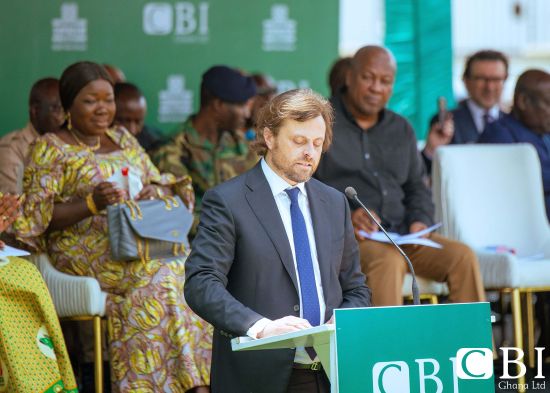
Managing Director of CBI Ghana Ltd, Frédéric Albrecht noted that every year, Ghana spends close to half a billion US dollars importing clinker, saying that, that is hard currency that can stabilize the Ghanaian currency.
He assured that public of CBI’s readiness to reverse the import trend, saying that “The eyes of the cement world are on Ghana as we set a new global standard for sustainable construction and bring stability to our economy.
“From this plant, the largest of its kind in the world, we are replacing imported clinker with locally produced calcined clay, which enables us to cut carbon emissions by up to 40%, similar to taking 80,000 cars off the road every year. We did not build this plant for CBI alone; we built it to inspire the cement world and ensure Ghanaian scientists lead the way in sustainable construction.”
The CBI plant is officially the world’s largest Limestone Calcined Clay Cement (LC3) plant, with a production capacity of400,000 tons of calcined clay per year and boasts of an advanced packing technology of up to 10 bags at a time, loading a 40-ton truck in just 25 minutes.
Economic impact
It is set to make significant impact on the Ghanaian economy by reducing clinker imports of about 400,000 tons, which is equivalent to 10 vessels per year. This supports domestic value chains, high-skilled job creation in labs and on the factory floor and retains important foreign exchange.
Sustainability and carbon footprint
The facility is intentionally designed to drive Ghana’s climate and sustainability goals in the construction sector.
Ita design automatically cut CO₂ emissions by at least 40% through the use of its LC3 technology, which delivers a massive decrease in greenhouse gas emissions compared to traditional cement.
Again, Calcined clay requires significantly lower thermal energy during production than traditional clinker, and that ensures energy efficiency.
Durability and More
Beyond ensuring sustainability, and making a significant impact on the local economy, CBI Ghana’s LC3 cement is also engineered for superior performance in Ghana’s tropical and coastal environments.
Its enhanced resistance makes it ideal for marine and high-density projects. It has excellent consistency for both mass concrete and precision block production, and also meets and exceeds all structural performance requirements set by the Ghana Standards Authority.