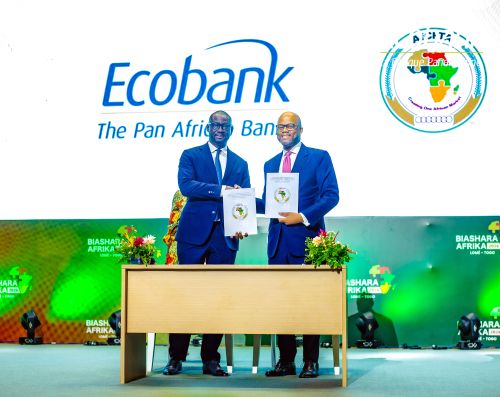
The Ecobank Group and the African Continental Free Trade Area (AfCFTA) Secretariat have signed a Memorandum of Understanding (MoU) aimed at deepening economic integration across the continent and closing the trade finance gap.
A statement from Ecobank said the agreement seeks to expand access to trade and finance opportunities for African businesses, with particular focus on Small and Medium-sized Enterprises (SMEs), women-led businesses, and youth entrepreneurs.
The MoU, it said, establishes a strategic framework to support the implementation of the AfCFTA, and advance the objectives of the African Union’s Agenda 2063 , “The Africa We Want”, through the development of an integrated single market of over 1.3 billion people and a combined GDP of approximately $3.4 trillion.
Building on a US$3 billion Trade Finance Commitment

The MoU follows Ecobank Group’s landmark announcement at the recent Africa-Forward Summit in Nairobi, where the bank unveiled a US$3 billion trade finance commitment to be deployed over the next three years in partnership with Development Finance Institutions (DFIs) to support trade with and across Africa.
The partnership with the AfCFTA Secretariat will serve as an important platform for advancing the impact of this this US$3 billion commitment across the continent, ensuring that African businesses — from large corporates to SMEs — are better positioned to take advantage of opportunities created under the AfCFTA Single Market.
“Access to trade and affordable finance remains critical to unlocking the full potential of the AfCFTA. Through this partnership with Ecobank, we are strengthening the support available to African businesses, particularly SMEs, women-led enterprises, and young entrepreneurs, to enable greater participation in intra-African trade and value chains across the continent,” said H.E. Wamkele Mene, Secretary-General of the AfCFTA Secretariat.
“For 40 years, Ecobank has been built on a singular vision: to advance the economic development and financial integration of Africa,” said Mr. Michael Larbie, Group Executive, Corporate and Investment Banking at Ecobank. “With our unmatched presence across 34 African markets and our digital capabilities, we are uniquely positioned to serve as a catalyst for the AfCFTA. This MoU formalises our commitment to connecting African businesses to the markets, finance, and knowledge they need to thrive.”
Key Areas of Cooperation
The partnership will focus on several priority areas, including:
- SME Capacity Building – Equipping African businesses with the knowledge, tools, and networks to seize opportunities created by the AfCFTA.
- Closing the Trade Finance Gap – Joint promotion of Ecobank’s Ellevate Program, a specialised initiative designed to support women entrepreneurs and women-led, women-owned, and women-focused businesses across both the formal and informal sectors, with tailored financial and non-financial solutions, including capacity building
Single Market Trade Hub – Positioning Ecobank’s trade platform as a key tool to reduce information asymmetry between traders across the continent and foster strategic partnerships with similar platforms globally.
- Business Referrals and Information Sharing – Leveraging the AfCFTA Trading Companies database and Ecobank’s continental network to connect buyers, sellers, and trade associations.
- Policy Advocacy – Joint engagement with regulators and stakeholders to eliminate non-tariff barriers and frictions in cross-border payments.
- Thought Leadership and Events – Co-curation of high-level panels, seminars, and business forums to advance dialogue on the AfCFTA Protocols.
A Defining Moment for African Integration
The MoU comes at an important stage in the implementation of the AfCFTA, as efforts continue to remove barriers to intra-African trade, strengthen regional value chains, and create an enabling environment for sustainable, inclusive growth. By combining the AfCFTA Secretariat’s mandate with Ecobank’s continental banking footprint and its US$3 billion trade finance commitment, the partnership is expected to support greater participation of African businesses in intra-African trade and accelerate the objectives Africa’s economic integration goals.