The news is out that American Tower Corporation (ATC) Ghana has secured a victory in international arbitration at the International Chamber of Commerce (ICC), against Airtel Ghana with respect to over GHS1 billion in tower and utility bills arrears, which piled up over several years.
The ICC ruling was issued exactly on March 17, 2026. The reliefs granted ATC Ghana in that ruling are mainly three fold:
- That Airtel Ghana owes ATC Ghana GHS1.1 billion as of August 2025
- That Airtel Ghana also owes an additional one month tower fee for September 2025, the month ATC finally cut them off
- That they must also settle the arbitration cost and legal fees of ATC Ghana.
In the ruling, ICC gave Airtel Ghana ten (10) days from the day of ruling to pay all the moneys to ATC Ghana. If they fail to do so in ten days, an interest of about 4% will be added to the total for every month they delay. This means that on March 27, the first interest was added, and as April 27 approaches, another 4% interest in coming up.
The news of this ruling has generated considerable debate in the industry as to what implications it has for the various stakeholders, particular in the face of the ownership structure around AT Ghana.

The ownership structure of AT Ghana is as follows:
- The government of Ghana owns 100% shares in Airtel Ghana;
- Airtel Ghana owns all the shares in People’s Network (PPL Net) Ghana; and
- PPL Net is the company that owns all the assets of, and operates the telecom brand AT Ghana.
Often when you see a public facing brand like AT Ghana trace its ownership to several layers of entities, it is a deliberate attempt by those owners to either hide something. We saw the manifestations of that in WikiLeaks and Panama Papers. But in this case, we are informed that this unusually long chain of ownership entities around AT Ghana was created with noble intentions, and other entities with interest in AT Ghana, particularly ATC Ghana and Stanbic Bank were given notice of that action and the intent thereof.
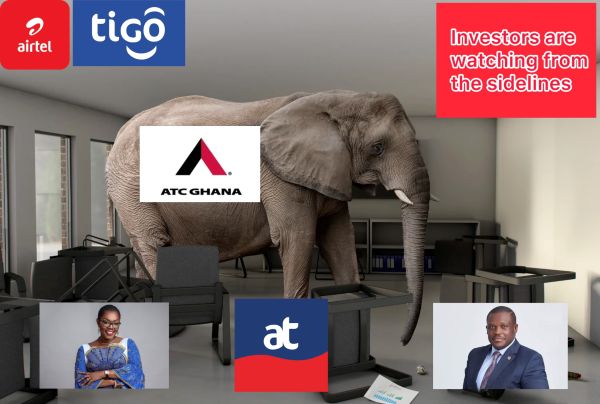
Basically, the ICC ruling confirmed the obvious – that Airtel Ghana owes ATC Ghana and they must pay according to the contract they signed. The elephant in the room, however, is that, if ATC Ghana decides to enforce the ruling in Ghana, exactly who would they tackle for their money, and what assets can they hold on to if the money is not paid? The other implication worth discussing is what signal this whole saga sends to potential investors about Ghana as an investment destination.
In our conversations with industry experts and some legal brains, two main schools of thought emerged regarding the enforcement of the ruling:
- One school of thought holds that since the ruling was secured against Airtel Ghana, and Airtel Ghana has no cash and or physical assets for ATC Ghana to take hold of, the ruling is of no effect. In fact, all Airtel Ghana has now are shares in PPL Net, and even those shares are now under the control of Stanbic Ghana due to some unpaid loan. Which means ATC Ghana cannot even take hold of those shares either.
- The other school of thought says that if ATC Ghana can prove in court that Airtel Ghana intentionally created PPL Net and transferred all its physical assets to PPL Net with the sole purpose of making it difficult for creditors and vendors to take their pound of flesh in times of dispute, they can get a court in Ghana to give a ruling that allows them to garnishee the assets of PPL Net, which is owned by Airtel Ghana.
In fact, the second school of thought also holds that ATC Ghana could even secure a court order to garnishee some state assets since Airtel Ghana, and by extension, PPL Net and AT Ghana are ultimately owned by the government of Ghana.
So let’s break down the basis for these two schools of thought by tracing our steps back to where all this came from and how we got here.
Sale of AirtelTigo
Back in 2021, the government of Ghana, during the era of Ursula Owusu-Ekuful as Communications and Digitalization Minister, acquired the entire assets and liabilities of AirtelTigo for a nominal US$1. AirtelTigo, as we know, is the entity that resulted from a merger between Airtel, then owned by Bharti Airtel of India, and Tigo, owned by Millicom International PLC of Sweden.
Government then made Airtel Ghana the holding company of AirtelTigo. In 2023, government found a potential investor called Hannam and Partners from the UK. Hannam and its local partner (a real estate developer), created a local subsidiary called Hannam Investment and they reached a deal with government under Ursula’s leadership on November 1, 2023. But that deal never took off because the 2024 elections was close. The sitting government lost the elections and that was the end of the Hannam deal.
Ahead of the Hannam deal, Airteltigo had in June 2023, rebranded to AT Ghana, just to let go of the names Airtel and Tigo. Then on November 1, 2024, exactly one year after announcing the failed Hannam Investment deal, Airtel Ghana wrote to it key creditors – Stanbic Bank, ATC Ghana and Helios Towers about plans to transfer its assets and staff to a newly created entity called PPL Net for two reasons:
- To ensure that AT Ghana is run by a clean entity, free of all the debts of Airtel Ghana. This was to ensure that AT Ghana becomes attractive to investors. Some potential investors had raised concerns about the debt overhang all the way from the days of Airtel and Tigo as separate entities, and then AirtelTigo and AT.
- The second reason for transferring the assets and workers to PPL Net was to secure all the jobs at AT Ghana. The heavy debt was threatening to bankrupt the company, and that would have meant all the over 300 workers were going home. But once the assets and staff were dropped down to PPL Net, which is a completely debt-free entity, it means PPL Net can operate AT Ghana on a clean slate, make some money and pay dividends to Airtel Ghana, so they can also pay off its debts to Stanbic, ATC Ghana and others.
The ATC Ghana’s late Court Injunction
On paper, this arrangement looks very noble and great because it creates a win-win situation for all. And both Stanbic and ATC Ghana, as well as other key creditors of Airtel Ghana were duly informed about this move either before or during the process of execution. But after the transfer had been fully executed in November 2024, with all the noble intentions stated above, ATC Ghana secured a Ghana High Court injunction against it in January 2025. This was two clear months after the deal was done, rendering the injunction totally futile. Clearly, you can’t injunct what is already done.
What is even more striking about this whole futile injunction was that, the survival of AT Ghana serves ATC Ghana better than it does Stanbic Ghana. But it is surprising that Stanbic was rather supportive of the transfer intended to make AT Ghana survive, but ATC Ghana rather sought to stop it, pending the outcome of ICC arbitration, which ATC filed back in 2023.
As fate would have it, a new government took over the administration of the country in January 2025, so ATC Ghana presented a bill to the new sector Minister, Samuel Nartey George, who told journalists that he had been presented with a bill of GHS1.5 billion, which he openly blamed on the negligence of his predecessors and her cohorts, describing them as “haters of Ghana”. He then gave indication that because government is the sole shareholder of Airtel Ghana, that debt was sitting on government’s books. This declaration by the minister did not sit well with cabinet, and rightly so, because Airtel Ghana is a limited liability company, which means its shareholder, the government, has no responsibility for its liabilities.
Even though by law government is NOT liable to settle any of the debts of Airtel Ghana, whether to Stanbic, ATC Ghana or whoever, government, from the time of Ursula Owusu-Ekuful, made it its business to lead negotiations with the creditors of Airtel Ghana, and that was what gave ATC Ghana in particular the confidence that so long as government was in the picture, their moneys will eventually be paid by the state.
But how did that huge GHS1.5 billion come about?
In the second part of this two-part piece, we will look at how the Airtel Ghana debt ballooned to GHS1.5 billion, how it was slashed down to US$20 million, and the issues about ATC Ghana’s alleged legalistic and monopolistic posture versus the morality of same. We will also look at ATC’s insistence on binding its clients to long-term contracts in pursuit of predictability of its return on investment (ROI). And how about the whole tower-location model that makes towercos insensitive to the profitability or otherwise of its clients, and the need for the regulator to do something about it?!