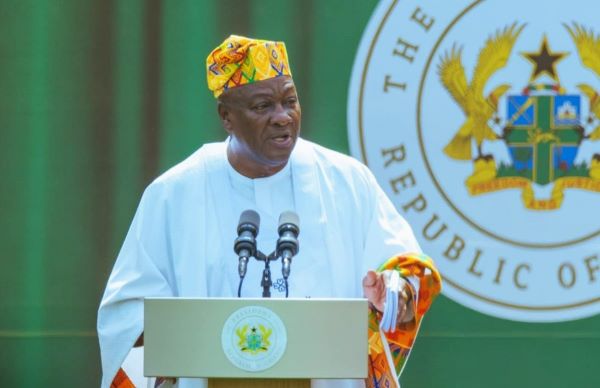
President John Dramani Mahama assented to the Electronic Transfer Levy Repeal Act, 2025 on April 2, 2025, exactly 85 days in office, indicating that he fulfilled that campaign promise in less than 100 days.
On August 4, 2024, candidate John Mahama promised Ghanaians that if elected as president, he was going to abolish E-levy, Covid Recovery Levy and other taxes within his first 100 days in office.
On April 2, 2025, he fulfilled that promise, following which all institutions authorized to collect the 1% E-levy on behalf of the Ghana Revenue Authority (GRA) have successfully implemented the abolition of the tax.
These institutions include the six mobile money operators, all banks and deposit-taking institutions as well as fintechs operating in the country.

In fact, not only have they stopped collecting e-levy, but they have also refunded all e-levy charged on April 2, 2025, the day President John Dramani Mahama assented to the e-levy repeal act passed by the Parliament of Ghana a few weeks back.
E-levy was first implemented in May 2022 by the previous government, much to the chagrin of Ghanaians, including even the then Vice President, Dr. Mahamudu Bawumia, who publicly stated the mobile money is a pro-poor service meant to drive financial inclusion, and he thought e-levy was going to work against that drive.
Fintech sector leaders made several representations to the government, explaining to them that mobile money/digital finance is a technology service heavily dependent on human behaviour, but the finance and communications ministers and their lieutenants at the time were too arrogant to listen to the voice of reason.
They were caught up in the fanciful thinking that because the mobile money platforms was recording over GHS90 billion value of transaction every week, there was so much money to be made in the form of transfer taxes from that platform. But value of transaction is not the same of balance of float (actual cash).
Actors of the government even went as far as telling blatant lies that a country like the United Kingdom charges 10% e-levy so Ghana’s 1% was small. Meanwhile, the digital tax they referred to in the UK, applied to firms making a minimum US$500 million globally and US$25 million in the UK alone. It was never applied to ordinary consumers.
True to the advice of industry leaders and massive opposition by Ghanaians, the first two months of the e-levy implementation in Ghana, it collected only GHS93 million, which was a far cry (7%) of the targeted GHS1.46 billion for that period. In the first year, it collected just about GHS1 billion, instead of the targeted GHS6.9 billion.
This was a clear sign that e-levy had failed to live up to its billing and the politicians and their advisors who sat in their boardrooms and decided on the impact of a service heavily dependent on human behaviour, got it all wrong. It was time for the politicians to be magnanimous and shut it down but they were too arrogant to do so.
In effect, the Presidential Candidate of the then sitting government, Dr. Bawumia, who had earlier registered his protest to the e-levy, made a campaign promise to abolish it when elected president. But at the time, John Mahama had already made that promise, and so Ghanaians had to choose between the two, considering other factors, which included the many failed promises by the incumbent and the fact that they pursued a domestic debt exchange policy (DDEP) that depleted the life savings of many Ghanaians among other things.
Now e-levy has been abolished and it only goes to show that in the long run, power belongs to the people. The previous government failed to listen to the people, but the people adopted coping strategies which made e-levy fail to meet its target. Then at the 2024 elections, the people voted to reflect their disapproval for e-levy.