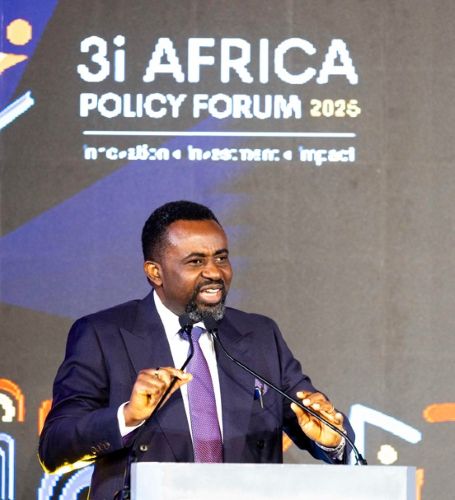
Governor of the Bank of Ghana (BoG), Dr Johnson Pandit Asiama, has called for intensified efforts towards regulatory harmonisation to create the innovation-driven financial ecosystem that supports seamless cross-border payments and trade across the African continent.
Speaking at the 2nd edition of the 3i Africa Policy Forum in Accra, under the theme “One Africa, One Market: Driving Innovation, Investment and Impact for a Connected Future”, Dr Asiama emphasised the need for greater coordination among African economies to transform the continent into a digitally unified economic bloc.
“The theme for the forum calls on policymakers to envision Africa not as a patchwork of disconnected economies, but as a single dynamic economic bloc powered by innovation, enabled by investment, and committed to inclusive and sustainable development,” he stated.
Citing ongoing advancements in fintech, digital assets, and cross-border payment solutions, Dr Asiama pointed to their growing role in deepening financial inclusion and boosting intra-African trade.

“Fintech is bridging access gaps, particularly for underserved and remote communities. Cross-border digital payments are gaining traction, promising to ease trade friction and accelerate regional commerce,” he noted.
He also highlighted national initiatives such as regulatory sandboxes, digital public infrastructure frameworks, and innovation hubs as critical in fostering safe and responsible innovation. However, he stressed that these isolated efforts are not enough, advocating instead for continent-wide regulatory harmonisation and interoperability.
“To fully realise the vision of one Africa, one market, we must scale our efforts through continental coordination. This means harmonising regulatory frameworks, fostering interoperability across financial infrastructures, and building trust and transparency across jurisdictions,” Dr Asiama said.
The BoG Governor further outlined key priorities for the Forum, including attracting sustainable investment in digital finance, unlocking cross-border payments through regulatory alignment, empowering SMEs, and operationalising digital trade protocols.
Dr Asiama also mentioned Ghana’s participation in the Next-Gen Digital Payment Infrastructure Project (DPI), a collaboration between the BoG, the National Bank of Rwanda, and Singapore’s Global Financial Technology Network. The initiative seeks to modernise cross-border payments using a central bank-led model co-developed with fintechs and financial institutions.
“Our work with the Pan-African Payment and Settlement System (PAPSS), our fintech passporting arrangement with Rwanda’s central bank, and now the DPI initiative all reflect our conviction that regional integration is achievable through trust-based partnerships,” he added.
GSMA
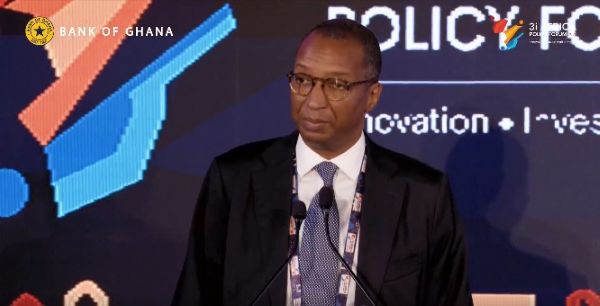
On the issue of the need for regulatory harmonization to drive seamless cross-border payments and trade, GSMA Senior Regulatory Specialist for Mobile Money, Karim Dia noted that in Africa today, there is grave regulatory fragmentation within the digital financial ecosystem, with over 40 licensing categories, all of which have different KYCs (know your customer) requirements and foreign exchange rules.
He said added to that challenge are three other bottlenecks standing in the way of seamless cross-border payments and trade through the use of mobile money, which has proven be the backbone and the key driver in that space.
The three other bottlenecks are:
- Limited switch to switch connectivity: National ACHs and mobile platforms often use incompatible APIs
- High total user cost: This is due to extra compliance checkpoints and bilateral settlements, which add the mark up.
- Infrastructure gaps: From universal ID to rural connectivity to onshore foreign exchange liquidity
Mobile Money the Backbone of Cross-Border Payment in Africa
Karim Dia noted that per the GSMA’s State of the Industry Report on Mobile Money 2025, globally there 2.1 billion registered mobile money wallets, 108 billion volume of transactions worth US$1.68 trillion in 2024. Out of that, sub-Saharan Africa alone had 1.1 billion mobile money wallets (56% of global total) and US$1.1 trillion in transactions value – which is two-thirds of global total.
“This means sub-Saharan African handles a minimum of $3 million worth of mobile money transactions every minute, clearly showing that mobile money is already a backbone for cross-border payments and for intra-Africa trade,” he said.
He said a key reason for that is the average cost of mobile money transfer being 2.5 per centage points cheaper than all other money transfer channels studied by the GSMA in more than 100 corridors.
According to Karim Dia, the target of the SDGs is to bring money transfer cost to below 3%, and mobile money is already within striking distance with average transfer cost of about 3.5%. What is however missing is the seamless cross-border connectivity for mobile money due to the four reasons mentioned above.
He said currently, 32 African countries have domestic wallet to wallet and wallet to bank interoperability, out of which 12 support live cross-border mobile money corridors. Cross-border transfer fees is now averaging at 7%. If that can be pushed down to 3%, Africa stands to rake in an estimated US$40 billion remittance dividend every year into households and SMEs.
Ghana Shines
He lauded Ghana for being a shining example of what happens when policy tackles the bottlenecks head on.
Ghana is ranked number one in the current GSMA Mobile Money Report, and the driving factors, according to Karim Dia are the fact that the Bank of Ghana introduced risk-based KYC tiers, mandated open access into the GhIPSS instance payment switch, and enforced a robust consumer protection code.
Again, he noted that between 2018 and 2024, the average domestic transfer fee in Ghana fell 82% and the country also launched Africa’s first multi-currency wallet pilot.
He believes it is time for Africa to go on the back of Ghana’s milestones to launch an interoperability sandbox, to serve as a pilot in the march towards a harmonized ecosystem that drives seamless cross-border payments and trade.