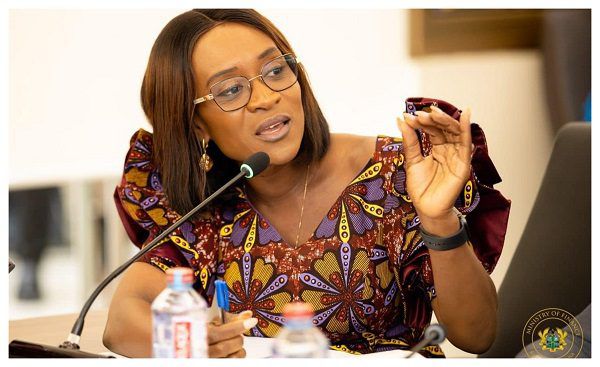
Member of Parliament for Atiwa East, Abena Osei-Asare, has called for stronger domestic institutions and greater accountability to safeguard Ghana’s economic recovery and prevent a return to past fiscal difficulties.
Speaking during a panel discussion at the Business Roundtable Extended under the theme, “After the Corrections: Building Resilient Economic Pillars for the Next Decade”, she said institutions must be allowed to independently perform their mandates rather than relying primarily on external interventions.
Mrs Osei-Asare said Ministries, Departments and Agencies (MDAs) account for about 90% of domestic revenue generated, making weaknesses in their financial management a significant concern.
She cautioned that the Fiscal Council could only report based on the information presented to it, stressing the need to strengthen institutions responsible for procurement, financial management and oversight.

“We should let our institutions work on their own,” she said, arguing that institutions must be allowed to carry out their mandates as expected.
The MP also raised concerns over the preparation of financial statements by state-owned enterprises, saying a report indicating that only 61% had prepared their financial statements suggested weaknesses in institutional accountability.
She said the International Monetary Fund could serve as a buffer, but should not become Ghana’s first response to fiscal challenges.
“The IMF can be a buffer, but that should not be our first response,” she said, adding that effective domestic institutions, coupled with stronger parliamentary oversight, would improve accountability.
Rethinking value for money
Mrs Osei-Asare said Ghana must also change its approach to value for money, arguing that securing the lowest price for a contract should not be the sole measure of whether public funds have been properly used.
She said the focus should extend to whether the results delivered are commensurate with the money spent.
Using road construction as an example, she said if one million was allocated to fix two kilometres of road and 800,000 had been spent midway through the project, authorities should assess whether the work completed justified the expenditure.
“Value for money” should therefore consider both the price paid and the results achieved, she said.
The same principle, she added, should apply to skills training, where government should assess whether investments in training translate into employment and, ultimately, taxable incomes.
Accountability must extend beyond Parliament
The MP said accountability should not be regarded as the sole responsibility of Parliament’s Public Accounts Committee, arguing that every institution and individual has a role to play.
She urged public institutions to use the powers provided by their respective laws, including taking appropriate action and imposing sanctions where necessary to prevent circumstances that could result in financial losses.
She also called for stronger monitoring between quarterly reporting periods, noting that significant developments could occur before an institution submits its report to Parliament.
“If the institutions are doing what they are supposed to do within that quarter, if anything untoward is happening, they will be able to check before the end of the quarter,” she said.
Mrs Osei-Asare extended the responsibility for accountability beyond government, saying individuals in academia and other sectors must also account for public resources entrusted to them.
She cited research and book allowances as an example, saying recipients should question themselves where public funds had been provided but expected research had not been produced.
Caution over fiscal rule changes
Osei-Asare also cautioned the government against weakening fiscal safeguards as it considers amendments to the Public Financial Management Act.
She said the government was seeking to reduce the primary balance requirement from 1.5% to 0.5% to create more space for spending, warning that such safeguards should not be removed without caution.
She noted that a 1.5% primary balance surplus had been established through an amendment brought to Parliament in 2025 and said the proposed reduction should be approached carefully.
“These things act as a check or a buffer for you,” she said, urging government to tread cautiously if it sought to remove such safeguards.
For Mrs Osei-Asare, the objective after Ghana’s fiscal correction should not simply be to restore stability but to build resilience capable of preventing a recurrence of the difficulties the country had previously experienced.
“We need to be resilient such that we ourselves do not end up causing problems that will make us go back to the situation we found ourselves in some time ago,” she said.The article follows the hourglass structure: it leads with the central news point, develops the major arguments and supporting examples, then closes on her broader caution about preserving fiscal resilience.